
AI in healthcare news 2026: use cases, vendors, and what actually ships
9 min read
Last updated: Oct 02, 2026
Summary
Ambient scribes write notes while a doctor talks to a patient. Radiology AI flags a stroke before a radiologist opens the scan. A chatbot tells a patient to go to urgent care instead of the ER. Most of the AI in healthcare news in 2026 sorts into one of five buckets, and only some of it survives contact with a real hospital budget, a real compliance team, and a real EHR integration. This guide sorts what's shipping in production from what's still a slide deck, names the vendors doing the shipping, and shows what a first pilot actually costs. To see what it takes to bring these pilots to life – from business logic to final integration – read more about healthcare software development services.
Key takeaways
AI in healthcare news 2026 breaks into roughly five vendor categories, each tied to one narrow use case: documentation, imaging, decision support, revenue cycle, and patient chat.
Ambient documentation delivers measurable ROI by saving clinicians time and reducing documentation burden.
Radiology AI works best as a second reader, helping prioritize critical cases and speed up treatment.
Revenue cycle AI shows some of the fastest payback, particularly by reducing denials and administrative work.
Full clinical autonomy is still off the table. High‑stakes decisions require human oversight, and general‑purpose AI should not handle sensitive patient data without appropriate safeguards.
Budget realistically: a focused pilot built on an existing model with a retrieval layer runs $45,000 to $130,000; fine‑tuning a model on your own data pushes that past $150,000.

Olga Tsygan
Head of Strategic Partnerships at Modsen
The 2026 AI‑in‑healthcare landscape in one page
Imaging AI, ambient scribes, decision support, revenue cycle tools, and patient chatbots are the five AI healthcare solutions doing almost all the real work in 2026, and each maps to a different buyer inside the hospital.
Doctors use ambient scribes right in the exam room. Radiologists get imaging AI embedded directly into their picture archiving and communication system (PACS) workflows. Decision support hooks into the electronic health record (EHR) order sets, while revenue cycle software runs quietly in the back office. As for patient chatbots, they sit right at the front door – on the hospital website or inside the call center.
Follow medical AI news in any given month and you’ll see announcements across all five categories, but the money moves unevenly. Ambient documentation and radiology AI are already locked into large‑scale production contracts. Chatbots and decision support are still mostly stuck in pilot mode. Revenue cycle tools sit somewhere in the middle: live in specific departments, but rarely deployed across an entire enterprise.
That split is the real story behind digital transformation in healthcare 2026. If a use case delivers measurable ROI twice in a row, the CFO signs off. Everything else spends another year in pilot purgatory.
So where does the money actually work hardest for doctors, not just for accountants?
Clinical AI: what actually helps doctors, what's still theatre
Three technologies do almost all of the clinical work that reaches production this year: documentation copilots, imaging second‑readers, and decision support tucked into the order set. Each earns its place differently, and most headlines about clinical tools fall into one of these three. Where none of them fit the workflow as‑is, scoping a narrow, purpose‑ built model with a dedicated AI services team is usually faster than waiting for a vendor roadmap.
Ambient scribes
Where it works
Exam room
Primary user / buyer
Physicians
Adoption in 2026–2027
Scaled
Imaging AI
Where it works
PACS / radiology workflow
Primary user / buyer
Radiologists
Adoption in 2026–2027
Scaled
Decision support
Where it works
EHR & order sets
Primary user / buyer
Clinical teams
Adoption in 2026–2027
Pilot
Revenue cycle AI
Where it works
Back office
Primary user / buyer
Finance / RCM teams
Adoption in 2026–2027
Partial rollout
Patient chatbots
Where it works
Website & call center
Primary user / buyer
Patient access teams
Adoption in 2026–2027
Pilot
Ambient scribes and documentation copilots
A microphone in the exam room feeds a live transcript to the model, which drafts the note in the EHR's format before the doctor leaves the room. The doctor edits and signs it instead of typing it from scratch.
How much time do clinical AI solutions actually save here? Less than the marketing decks suggest, and the real numbers are still worth having. A STAT News report on a study of 1,800 clinicians across five academic medical centers, running from 2023 to 2025, found an average saving of 16 minutes of documentation time and 13 fewer minutes inside the record per eight‑hour shift. A separate trial at the University of Wisconsin School of Medicine and Public Health measured a larger effect: 30 minutes a day per provider, plus a clinically meaningful drop in burnout scores, in a program that has since scaled to roughly 800 physicians and advanced practice providers. A randomized trial at UCLA Health, published in NEJM AI, compared two scribe tools directly: physicians using Nabla cut note‑writing time by 41 seconds per note against an 18‑second drop in the control arm, a modest but statistically significant gap, while the DAX arm did not reach significance over the same period.
That spread is the real lesson. Measure your own numbers during the pilot instead of importing a vendor's benchmark from a different hospital and a different specialty. For the EHR side of this workflow, see our guide to EHR vs EMR software in 2026.
Imaging: AI as the second reader
Much of the AI in healthcare news around radiology now centers on triage tools already running in live hospital workflows.
Aidoc is the most widely deployed vendor in this category, running across close to 2,000 hospitals and processing roughly 60 million cases a year, according to figures the company reported and Diagnostic Imaging and STAT News covered. In January 2026, the FDA cleared Aidoc's CARE foundation model to triage 14 conditions from a single abdominal CT scan, including appendicitis, bowel obstruction, and spleen injury, at a mean sensitivity of 97% and mean specificity of 98% in the pivotal study. Viz.ai took a narrower path, built around large‑vessel‑occlusion stroke detection from CT angiography. It holds more than 50 FDA clearances, runs in over 1,700 hospitals, and, per independent studies cited by AI Health Guide, cuts door‑to‑puncture time in stroke care by 30 to 60 minutes.
Neither tool makes a diagnosis. Both send an alert that moves a case up the queue. For a hospital, the win shows up as minutes saved on the cases where minutes decide the outcome.
Clinical decision support
A risk score or a flagged drug interaction appears inside the order set. That's as far as most tools in this category go. The word that matters here is surface: the system suggests, the clinician decides.
For all their visibility in AI in healthcare news, general‑purpose large language models don't belong in this category yet. Most carry no FDA clearance for diagnostic or treatment recommendations, and they can produce a confident, wrong answer with no warning label attached. A narrow, FDA‑cleared model trained on one task (sepsis risk, readmission risk, a specific drug‑interaction check) is a different, much safer proposition than a chatbot improvising clinical advice.
If an off‑the‑shelf decision support tool doesn't cover a hospital's specific order set or specialty, a purpose‑built module folded into the broader medical software development work already underway keeps the model narrow, auditable, and inside the same compliance boundary as the rest of the record.
Clinical AI earns trust one narrow task at a time. Where does AI earn its budget just as fast, but with far less scrutiny attached?
Don't build expensive features nobody will use
Get a free 30‑minute consultation to map out a clear, cost‑effective tech plan.
Operational AI: where the ROI is easier to prove
Back‑office AI doesn't touch a patient, which is exactly why it moves faster through procurement.
Revenue cycle management is the clearest case. Black Book Research's 2025 evaluation of AI‑driven RCM tools found that 83% of health systems using them cut claim denials by at least 10% within six months, and mature deployments reached 30% to 40% denial rate reductions. The HFMA Revenue Cycle of the Future survey, published in February 2026, found 27% of health systems already running AI at scale across the revenue cycle and another 53% piloting it.
Three other use cases round out this healthcare AI software category. Scheduling tools predict no‑shows and rebook the slot automatically. Inventory tools forecast consumable use so a unit doesn't run short on daily supplies. Call‑center voice AI takes the first line of patient calls, handling appointment booking, prescription refill requests, and basic benefits questions before routing anything complex to a person. Voice AI, scheduling, and inventory forecasting typically run as part of the wider healthcare IT support stack a hospital already maintains, not as a standalone project.
None of this is glamorous. All of it counts toward the same budget line the CFO already tracks, which is exactly why these AI healthcare solutions tend to get funded before anything in the exam room does.
Operational AI proves its ROI with a spreadsheet. Picking the right vendor for any of this takes a different kind of homework. Here's how to do that homework without booking twenty demo calls.
Top AI healthcare software companies: how to read the market
The market for top AI healthcare software companies splits into two groups, and knowing which one you're evaluating changes what questions to ask.
Big vendors (Epic, Oracle Health, Microsoft, Google Cloud) sell healthcare AI platforms that plug into an EHR or cloud stack a hospital likely already runs. The integration work is smaller. The roadmap moves at the vendor's pace, not the hospital's, and a single customer's feature request rarely jumps the queue.
Focused players iterate faster and go deeper on one workflow: Nuance/Microsoft DAX, Abridge, Suki, and Nabla for documentation; Aidoc and Viz.ai for imaging; Infermedica and Clearstep for triage and patient routing. The trade‑off runs the other way. Expect more integration work up front, and more vendors to manage if a hospital adopts several of these healthcare AI services at once.
Neither group is the right answer by default. A large academic medical center running twelve specialties needs a different mix than a five‑clinic regional group with one EHR and one IT administrator.
How to compare them without buying every demo
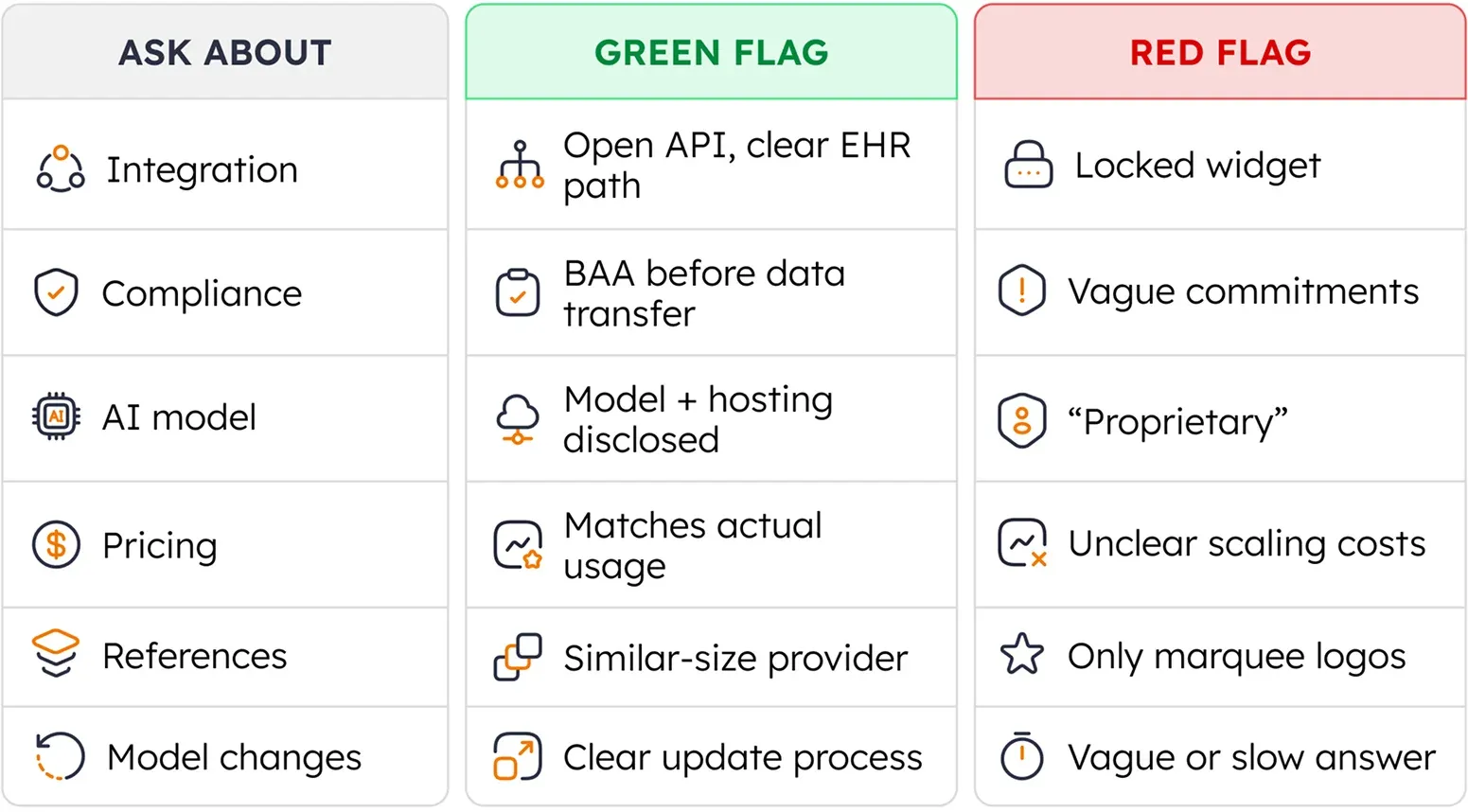
How to spot the right healthcare AI vendor
Comparing medical AI software starts with five questions that cut most vendor conversations down to a manageable size.
1. Does the API allow real integration, or only a locked-in widget?
2. Will the vendor sign a Business Associate Agreement before any data moves?
3. Can they name which model runs underneath and where it's hosted, or is that treated as proprietary?
4. Does pricing scale per user or per outcome, and which one matches how the hospital will actually use the tool?
5. And can they produce a reference from a provider close to your size, not just their biggest logo?
One question tends to separate the vendors worth a second call from the rest: what happens when the underlying model changes. Watch how fast, and how specifically, they answer it.
If nothing on the market fits the workflow, integrates cleanly with the hospital’s existing systems, or provides the level of control the use case requires, a scoped custom build around healthcare software development services becomes the only viable path forward. Instead of adapting clinical processes to the limits of a general‑purpose platform, the hospital can build around the specific workflow, integration points, data requirements, and deployment environment it already has.
The next question is how to get a pilot live in a hospital before a two‑year procurement cycle eats the budget first.
No off‑the‑shelf AI fits? Build one around your healthcare workflow.
Launching your first healthcare AI pilot: a 90‑day plan
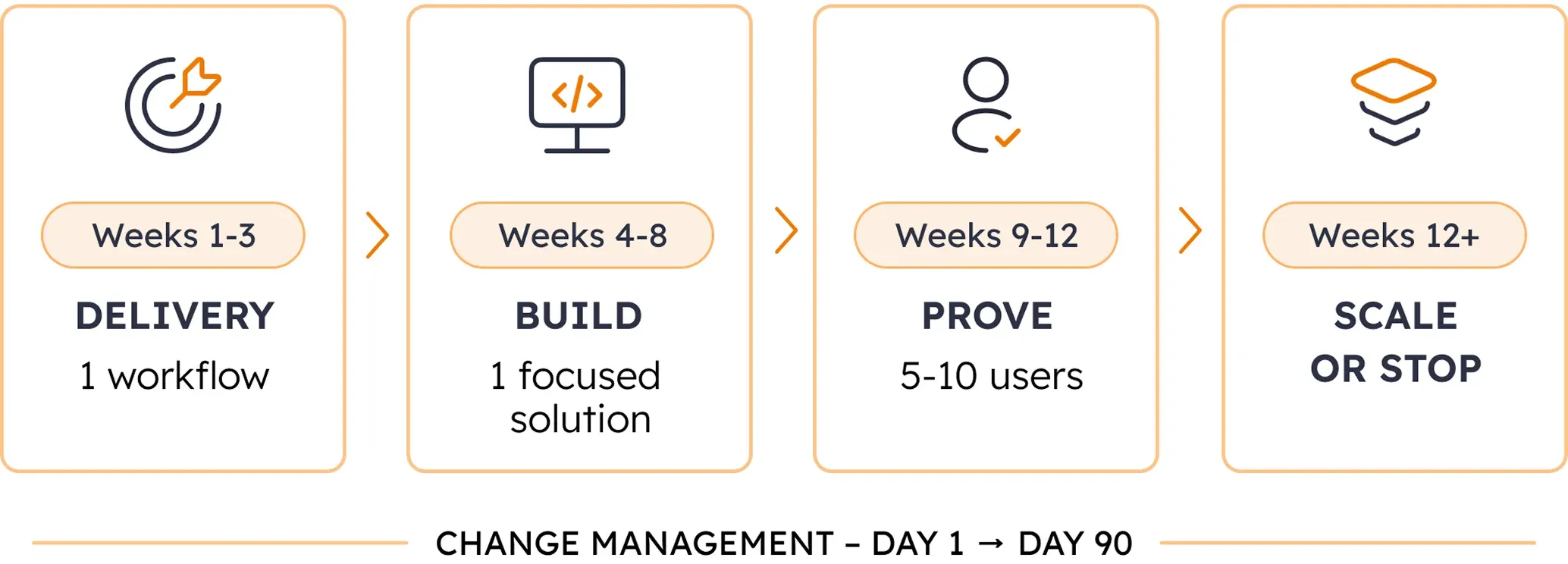
Ninety days is enough time to prove or kill a pilot, if the scope stays narrow. A lot of AI in healthcare news coverage skips this part: the unglamorous, procedural weeks that decide whether a pilot survives contact with legal.
Weeks 1 through 3 go to picking one workflow, not five. Write a data contract that spells out exactly what data the AI touches and where it lives. Get IRB approval if the pilot involves patient‑facing research rather than a purely operational tool. Resist the urge to promise the whole hospital an AI strategy in week one; nobody signs off on that, and nobody should.
Weeks 4 through 8 go to building. Most pilots run on an existing model with a retrieval layer over the hospital's own documents, which Taction's 2026 healthcare AI pricing guide prices between $45,000 and $130,000 for a single‑workflow proof of concept or MVP, depending on whether it's a documentation tool or a decision‑support copilot. Fine‑tuning a model on the hospital's own data instead of using retrieval usually lands past $150,000, and it's rarely the right first move for a team that hasn't proven the use case yet. This is where AI healthcare app development spend concentrates for a first project.
Weeks 9 through 12 go to the pilot itself: 5 to 10 users, one workflow, and metrics chosen before launch, not after. Time saved per encounter. Error rate against a clinician‑reviewed baseline. Whether users still open the tool in week eight the same way they did in week one.
A team running one of these for the first time usually underestimates one thing: how much of the ninety days goes to change management rather than code. Budget for it anyway.
Our team handles the team extension side of this when a hospital's own engineers need extra hands, and the AI advisory side when the real question is which workflow to pick first.
A pilot proves the workflow works. Before it goes anywhere near real patients or real claims, one more list needs checking.
Safety, compliance, and the questions you must ask before go‑live
Six questions decide whether a pilot is ready for real patients and real claims, not just a demo environment.
1. Where does the model run, and does that location meet data residency requirements for the patients it touches?
2. Is a signed Business Associate Agreement in place before any protected health information moves through the tool?
3. Are prompts and outputs logged in a way that supports an audit months later, if a regulator or an attorney asks?
4. Who owns the prompts themselves, and can that person explain why the system was configured the way it was?
5. Is the tool formally listed among the hospital's HIPAA‑covered systems, or is it running in a gray zone nobody documented?
6. And has staff been trained to recognize when the AI is wrong, not just when it's convenient to trust it?
The regulatory ground is also moving under this AI in healthcare news cycle. In the European Union, the AI Act classifies diagnosis, clinical decision support, treatment recommendations, and patient triage as high-risk uses. Tandem Health's regulatory summary notes that the core obligations, including conformity assessments and human oversight requirements, apply in full from August 2026. Penalties for a high‑risk system that misses those requirements run up to €15 million or 3% of global turnover, whichever is higher, according to Regumatrix's analysis of the Act's Annex III provisions. A US‑based pilot planning a later move into European markets should build to that standard now rather than retrofit it later.
None of this replaces legal review. It's the list that makes legal review faster, because the answers are already documented instead of reconstructed under deadline. If your team wants a second set of eyes on this checklist before go‑live, our IT consulting team reviews AI pilots against exactly these six questions.
FAQ
What's the biggest AI-in-healthcare story of 2026 so far?
Which AI use cases in healthcare give the fastest ROI?
Is medical AI safe to use on real patients?
How do you compare healthcare AI platforms without buying every demo?
What's a realistic budget for a first healthcare AI pilot?
Conclusion
Four things carry the most weight from this AI in healthcare news roundup. Ambient documentation has the strongest independent evidence behind it, and the honest numbers, 16 to 30 minutes saved per shift, are still worth having. Imaging AI earns its keep as a second reader on time‑critical cases, but it's definitely not a replacement for the radiologist. Revenue cycle AI pays back fastest because the metric is a denial rate, not a patient outcome. And the safety line holds where it held last year: assistive roles yes, autonomous clinical decisions no, under both FDA guidance and the EU AI Act.
These points connect. The use cases with real ROI data are the ones a CFO can defend to a board, which is why they scale first, and why the AI that touches a patient directly still moves at a more careful pace.
The practical starting point is a narrow use case with a measurable outcome. If you have one in mind, send us the details – we can help define the technical scope around it.
References
1.
STAT News. Large AI scribe study finds modest time savings, inconsistent use. April 1, 2026.
2.
3.
4.
Diagnostic Imaging. FDA clears CT-based AI triage platform from Aidoc. 2026.
5.
6.
AI Health Guide. Viz.ai review 2026: first FDA-cleared AI stroke triage platform. April 2026.
7.
8.
9.
Tandem Health. EU AI Act explained: what healthcare organisations need to know. 2026.
10.
Regumatrix. EU AI Act for medical & healthcare AI: high-risk rules explained. 2026.

Get a weekly dose of first-hand tech insights delivered directly to your inbox