
Custom travel solutions in 2026: When off‑the‑shelf stops being enough
10 min read
Last updated: Sep 22, 2026
Summary
Most companies start a travel program on an off‑the‑shelf platform, and almost all of them eventually run into the same wall: the platform covers booking, but not the systems around it. Custom travel solutions are the integration and application layer that connects a company's travel booking to everything else it depends on: a unified data model, real‑time sync with the ERP system, and an audit trail behind it all. This guide covers what custom travel solutions actually fix, five scenarios where the investment pays off in 2026, and what a custom build costs compared with staying on a rented platform, drawing on our work in travel & hospitality software development services.
Key takeaways
Custom development pays off once integrations with corporate tools keep breaking, or the travel workflow does not match what any off‑the‑shelf platform offers.
Five scenarios cover most of the demand: corporate travel enhancement, cost optimization, AI‑enhanced itineraries, sustainability tracking, and crew travel.
Identity solutions, including single sign‑on (SSO) and passkeys, are no longer optional in a 2026 travel stack.
Cost ranges from $60,000 to $400,000, depending on scope.
The rule of thumb is simple: a process that differentiates a company from its competitors deserves custom software, while a process every company runs the same way is better served by SaaS.

Olga Tsygan
Head of Strategic Partnerships at Modsen
When off‑the‑shelf stops working: signals to look for
An off‑the‑shelf platform usually breaks down the same way at most companies, and the pattern is easier to catch once someone knows what to look for.
Integrations keep breaking. Custom travel solutions integration with corporate tools starts failing on a schedule. Every vendor upgrade breaks two or three connections that were built in‑house to the ERP or HRIS system, and IT spends its time on repairs instead of improvements.
Reporting doesn't add up. Split travel spend by cost center, project, and grade, and one of two things happens. The report takes three weeks to put together by hand in a spreadsheet, or it comes together faster and the numbers miss the ERP system 5‑8%.
The workflow is non‑standard. A company that needs two parallel approvers and a compliance check already asks more of the system than a generic workflow supports. Add a policy check that changes by country, and that logic simply doesn't exist in a platform built for thousands of companies with one approval flow for everyone.
Sustainability reporting is stuck. The Corporate Sustainability Reporting Directive (CSRD) asks companies to report carbon output per travel request. Most booking tools were never built for that level of detail. They produce a summary once the trip is already over, not a number the company can act on beforehand.
Identity isn't covered. Single sign‑on (SSO) may already run through a provider such as Okta, but the travel tool keeps its own separate logins and has no support for passkeys.
Vendors keep piling up. Four tools means four invoices and four service‑level agreements to track. Add the cost of switching between them, and that usually ends up costing more over three years than one custom platform with a single interface.
These six signs rarely show up alone. Most of the time, it comes down to sync and integration issues. The same gap shows up on the hotel side of travel technology too. Our reservation system guide breaks down exactly how it happens and why it gets fixed the same way.
The corporate integration problem in 2026
Most travel programs run on four systems that were never designed to talk to each other natively: HR platform, expense management tool, booking engine, and policy engine.
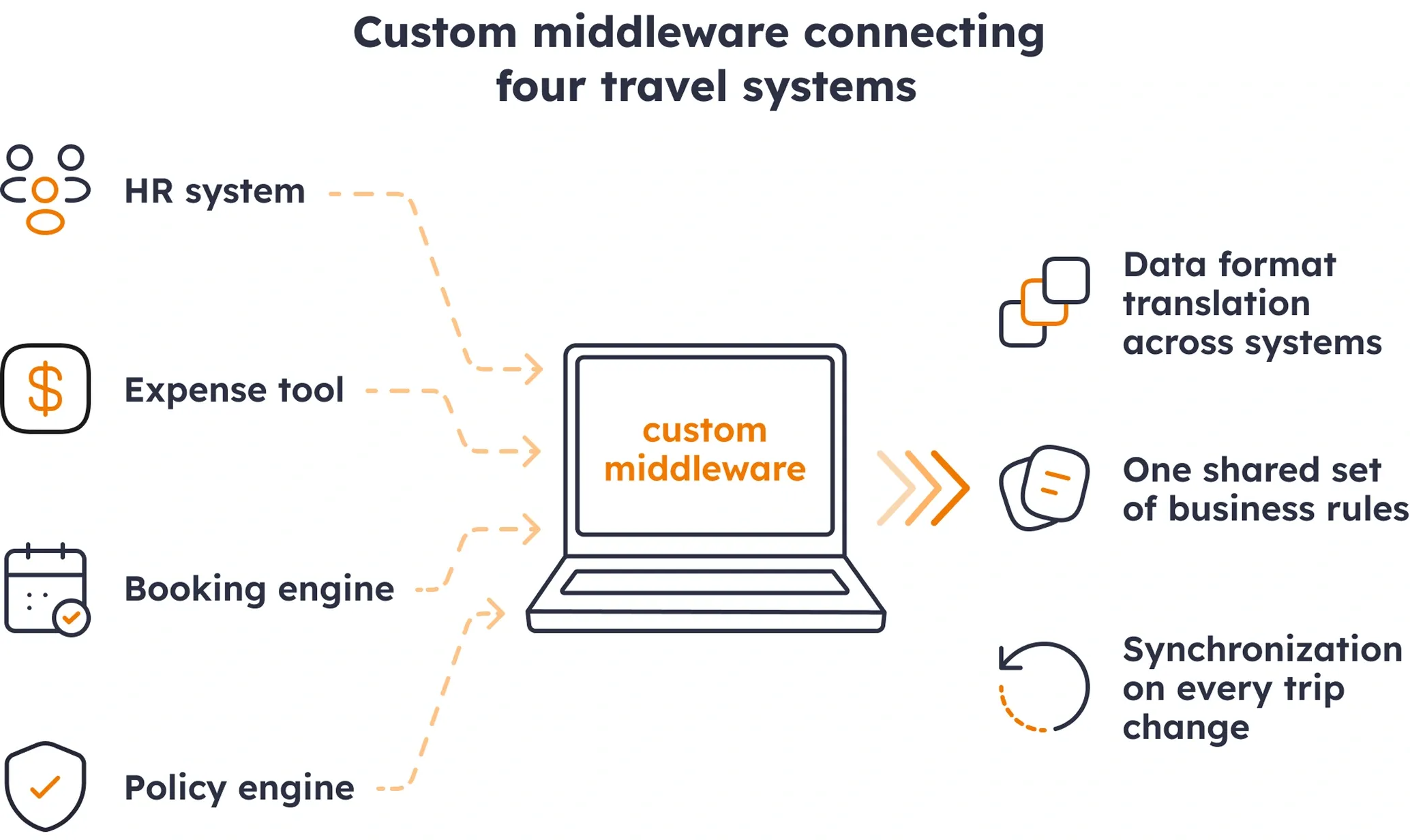
A custom middleware layer sits between these systems. Without it, each system stores its own version of a trip, and those versions drift apart the moment something changes: a rebooked flight, a new cost center, an updated policy. The middleware catches that drift before it becomes a discrepancy: it rewrites data into a format every connected system can read, applies the same rule regardless of which system triggered the change, and pushes the update everywhere at once instead of leaving one system a step behind the rest. That is usually where custom software development for corporate travel starts paying for itself, since it removes the manual reconciliation that otherwise falls on finance and IT.
Integration problems solved, but a working connection between systems is not the same as a travel experience employees actually want to use. What should companies build once the plumbing is in place?
Corporate travel experience enhancement: what to actually build
Custom travel solutions corporate travel experience enhancement usually starts with four capabilities that a generic booking tool does not offer out of the box.
Policy‑aware booking
What it is
Shows only in‑policy options.
Hides the rest until requested.Business result
Cuts approval time 40‑60%.
Cuts policy‑violation reports up to 80%.
Itinerary automation
What it is
One live, self‑updating itinerary.
Syncs with Google Calendar, Outlook, Slack, WhatsApp.Business result
No more digging through five emails.
Expense pre‑fill
What it is
Booking data auto‑fills the report.
Via OCR and the expense tool's API.Business result
70‑80% of the report is pre-filled before opening.
Duty‑of‑care alerts
What it is
Combines live location with risk feeds.
Alerts HR, manager, and traveler instantly.Business result
Meets duty‑of‑care requirements (Navan)
These capabilities are examples of travel customer experience solutions, shaped around how a business actually runs its trips. Together, they're the case for a custom business travel software solution over a standard subscription.
But building it is another matter. In‑house teams often haven't worked with policy engines or expense matching based on optical character recognition (OCR). That's usually when companies augment their team with travel‑tech engineers, bringing in people who already know this space so the improvements ship faster.
Experience improvements are visible to travelers right away. Savings take longer to show up, and that's usually the next question on the table.
Cost optimization in travel: where custom pays back
Custom travel solutions cost optimization in travel comes from five specific changes that work together.
Automated pre‑trip approval. A booking that already matches company policy gets approved without anyone reviewing it by hand.
Fare auditing. The system checks each price against the rate the company negotiated with that airline or hotel.
Class‑of‑service enforcement. The class of service a traveler is allowed to book gets applied automatically at the moment of booking.
Rate aggregation. Corporate discounts apply across the entire travel program, at every property and every route.
Spend reporting. The report shows exactly where the travel budget went.
Total cost of ownership (TCO) is what decides whether these five changes are worth building. A real TCO comparison has to include integration, training, and future upgrades, not just the price on the invoice. The savings this approach produces typically fall between 8‑18% of total travel spend, and they show up once the booking, approval, and reporting layers work together.
Not sure if you need a custom build or just a better SaaS setup?
Tell us how your travel program runs today, and we'll help you see which direction makes sense. A short consultation gives you a clear answer, straight from people who've built both.
AI‑enhanced itinerary planning and other emerging examples
Generative AI (GenAI) is starting to move from a chat interface into the itinerary layer itself, and it's not the only shift happening in custom travel solutions right now. At Phocuswright Europe 2026, industry leaders debated the same build‑versus‑buy question for AI, a sign of how much momentum this direction is gaining.
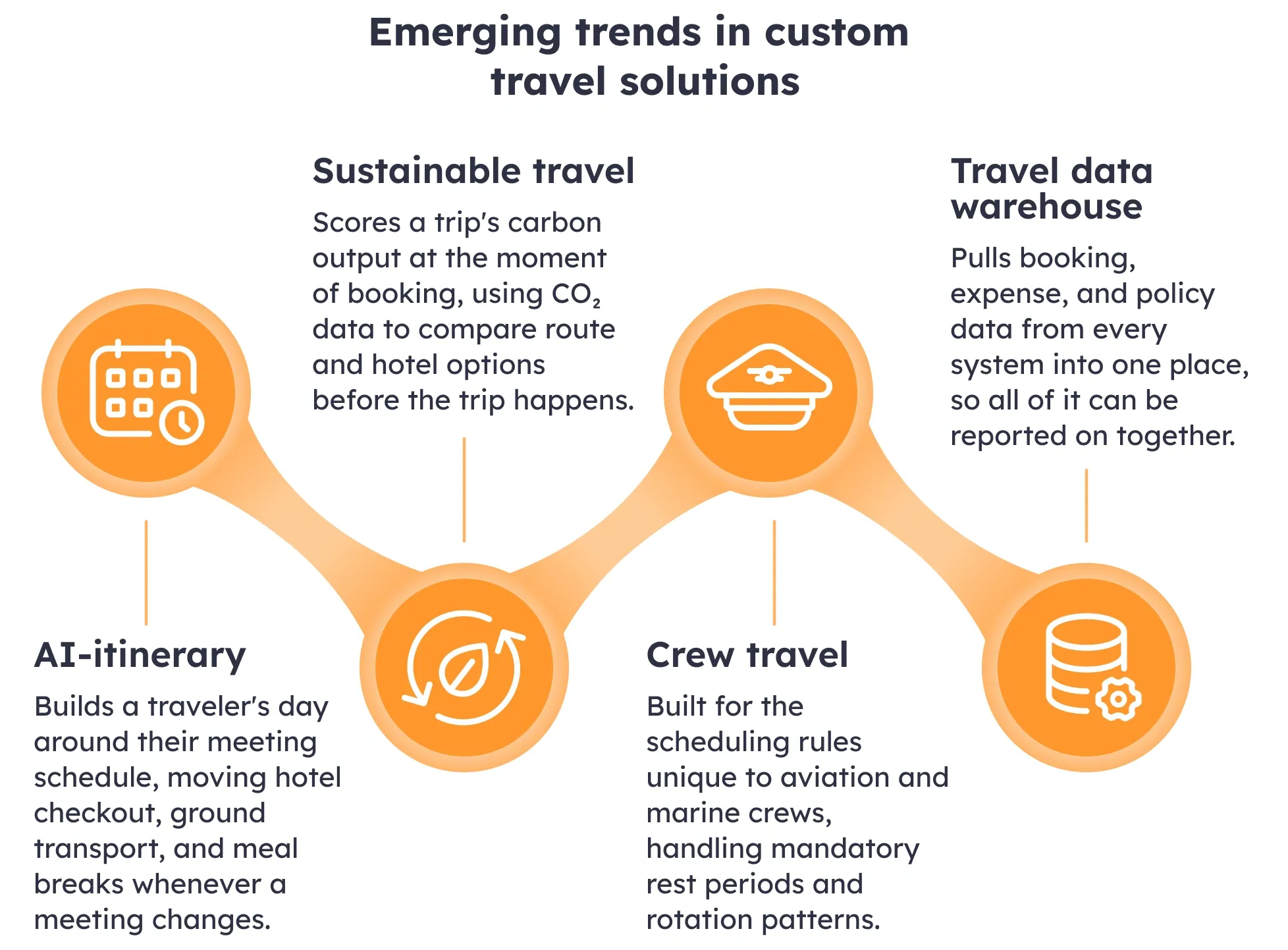
Examples of custom travel solutions with AI‑enhanced itinerary planning already work by watching a traveler's calendar in real time. When a meeting gets rescheduled, added, or cancelled, the system recalculates the rest of the day around it: hotel checkout shifts, ground transport gets rebooked, and meal breaks move to fill the new gaps. None of this requires the traveler to open an app and adjust anything themselves.
For a closer look at how AI shows up on the guest‑facing side of travel, our guide to AI chatbots for hotels covers that in detail. The engineering side, how systems like this actually get built, is something we cover through our AI development services.
Trends like sustainability tracking, crew travel systems, and a shared data warehouse are among the emerging trends in custom travel solutions right alongside AI‑itinerary. Each one grew out of a specific gap that a generic booking platform never accounted for, whether that's carbon reporting, crew scheduling rules, or data scattered across separate tools.
Sustainable and crew travel: niche but growing
Custom sustainable travel solutions usually serve one team inside a company, the one that owns emissions reporting. That team already tracks specific categories and time periods for its existing report, and the carbon score only creates real value once it plugs directly into that same report instead of living somewhere separate.
Custom crew travel solutions solve a different kind of problem. Airlines and shipping companies can't book a crew member the way a corporate travel program books an employee. A crew member's next assignment depends on where the previous one ended, rest periods are required by regulation, and missing one carries real safety and legal consequences. Standard business travel tools were built around a different kind of trip, so this scheduling logic was never part of them.
Crew schedules, emissions data, and corporate travel spend all end up needing the same thing: one place where all three can be reported on together. Custom travel data solutions typically provide that place, pulling records from each source system into a shared warehouse so the numbers from booking, expense, and policy tools finally line up.
Identity, data, and the security layer for custom travel solutions
Best customer identity solutions for travel and hospitality now cover more than a login screen. Single sign‑on lets an employee log into every company system with one set of credentials. Multi‑factor authentication adds a second check on top of a password. Passkeys replace the password entirely with a key stored on the employee's own device. All three need to work across every system a travel program touches. Personally identifiable information moves between the booking tool, the expense tool, and the HR system, and it needs to stay compliant with regulations such as GDPR and CCPA. For a closer look at what that compliance work actually involves, see our IT consulting for hospitality guide.
The most common mistake is building identity last. A team spends four months building the booking interface first, then tries to add identity on top of it. By that point, the identity model usually misses cases like these: a traveler who needs delegate access while on leave, a contractor who needs credentials that expire after 90 days, or a manager who books on behalf of their whole team. Retrofitting the model to cover them almost always costs more than building it in from the start.
The order that avoids this: build the identity model first. Then classify the data it protects. Then design the API contracts with an audit log built in. Only after that, build the interface on top. This approach lets the system absorb new roles and edge cases as the business grows, instead of forcing a rebuild every time one shows up.
If a company is planning a custom travel stack, this is the layer to prioritize early. A short consult on the right size is usually the sensible first step for a team that isn't sure whether it needs a full rebuild or a smaller fix.
FAQ
What counts as custom travel solutions in 2026?
When should a company go custom instead of SaaS for travel software?
How much do custom travel solutions cost?
Can custom travel solutions integrate with existing corporate tools?
What are the current emerging trends in custom travel solutions?
Conclusion
The decision between an off‑the‑shelf platform and a custom build comes down to one question: does this travel process look the same at every company that uses the vendor's platform, or does it look like this specific business? Five scenarios usually answer that question in favor of custom travel solutions: corporate travel enhancement, cost optimization, AI‑enhanced itineraries, sustainability tracking, and crew travel.
The signals above tend to get louder the longer they're left alone. There's no need to have every answer first, so contact us and we'll walk through your travel program and tell you exactly where a custom solution would fit and what it would cost.

Get a weekly dose of first-hand tech insights delivered directly to your inbox