
Digital transformation in healthcare 2026: What actually moves the needle
13 min read
Last updated: Sep 29, 2026
Summary
Digital transformation in healthcare in 2026 is a coordinated shift across several layers at once: the EHR core, patient‑facing apps, an AI layer that saves clinicians hours, RCM, cloud infrastructure and HIPAA‑grade security. The point of connecting them is a set of numbers a board understands – time to appointment, clinician documentation hours, denied‑claim rate, patient retention. This guide walks through what changed, the stack underneath a modern provider, where AI pays for itself, how providers buy software, where compliance quietly breaks, and how to plan a year of change.
Key takeaways
Digital transformation in healthcare in 2026 is about connecting systems – the value comes from the record, AI, billing and security working off the same data.
Interoperability is the new foundation: with FHIR and the national TEFCA network, a system that cannot share data holds the whole stack back.
AI now pays off in real workflows – documentation and administrative automation – but only when it is built into the systems around it.
Security fails on the boring basics (access logs, shared logins, unencrypted backups, missing vendor agreements).
The winning approach is hybrid and sequenced: buy the commodity, build what sets you apart, and change things in order so the team can absorb it.

Olga Tsygan
Head of Strategic Partnerships at Modsen
Why 2026 is different from another "digital healthcare" wave
Healthcare software has moved past the stage of putting old systems in the cloud and running AI pilots that never reach daily use. Five shifts have changed what providers expect from their technology, and they underpin the digital healthcare trends in 2026.
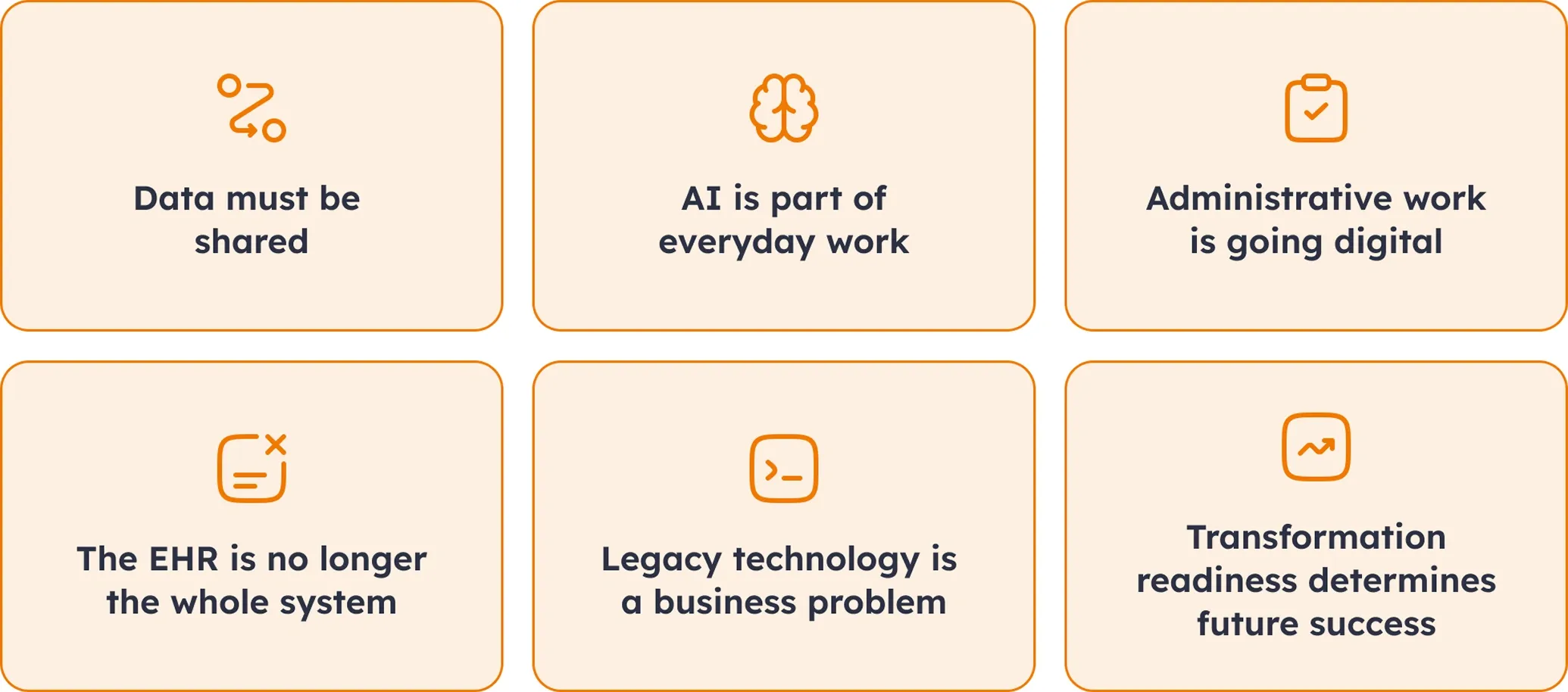
First, healthcare systems have to share data. EHRs (electronic health records) are no longer expected to work as closed systems. FHIR‑based APIs and national health information networks make it easier to exchange patient data between providers, labs, pharmacies, and other systems. If a new product cannot connect to the systems already in use, it quickly becomes another isolated tool.
Second, AI moved from a demo to everyday work. AI is being built into clinical documentation, administrative work, patient communication, and other routine processes.
Third, administrative processes are becoming software driven. Prior authorization is a good example. Processes that once depended heavily on phone calls, faxes, and manual work are moving toward standardized electronic workflows and APIs. This puts pressure on healthcare software to automate processes that were previously handled manually.
Fourth, the EHR is no longer the whole system. Healthcare organizations increasingly rely on a connected ecosystem of EHRs, platforms, labs, pharmacies, apps, and specialized tools. A system’s value now depends both on what it can do itself and on how easily it can work with everything around it.
Fifth, legacy technology is becoming a business problem. Older systems can still run the day‑to‑day operation, but they make every new integration, AI feature, automation, or regulatory change harder to implement. Technical debt can directly affect how quickly a healthcare organization can introduce new services and respond to market changes.
Understanding digital transformation in healthcare in 2026 is one thing; making existing systems ready for those changes is another. That’s where thoughtful healthcare software development becomes critical.
The stack that actually powers a modern hospital in 2026
Behind the marketing, a modern stack has four parts that must agree:
1. The record system – where patient data lives (EHR/EMR)
2. Patient‑facing tools – what patients touch: portal, app, video visits
3. The back office – the healthcare management software that runs the business: billing, scheduling, HR, supplies
4. Connectivity – how all of it exchanges data with the outside world (FHIR, TEFCA)
They matter in that order. Get the record system right and everything above it works from clean, current data. Get it wrong – the portal shows outdated info, the bill uses the wrong code, the report counts one visit twice.
Many providers still run old systems installed inside the building, bought one at a time over the years and never built to talk to each other. One clinic we worked with could not add online booking because its aging scheduling system had no way to connect to anything new. Replacing them is usually the first real project of digital transformation in healthcare, and it is where custom software development earns its place.
EHR/EMR core: the systems of record
EHRs and EMRs are the foundation of a healthcare organization's digital stack: they store the patient and clinical information that every other piece of digital health technology reads from. An EMR (electronic medical record) typically covers a patient's records within one practice or organization, while an EHR is designed to make that information available across providers and care settings.
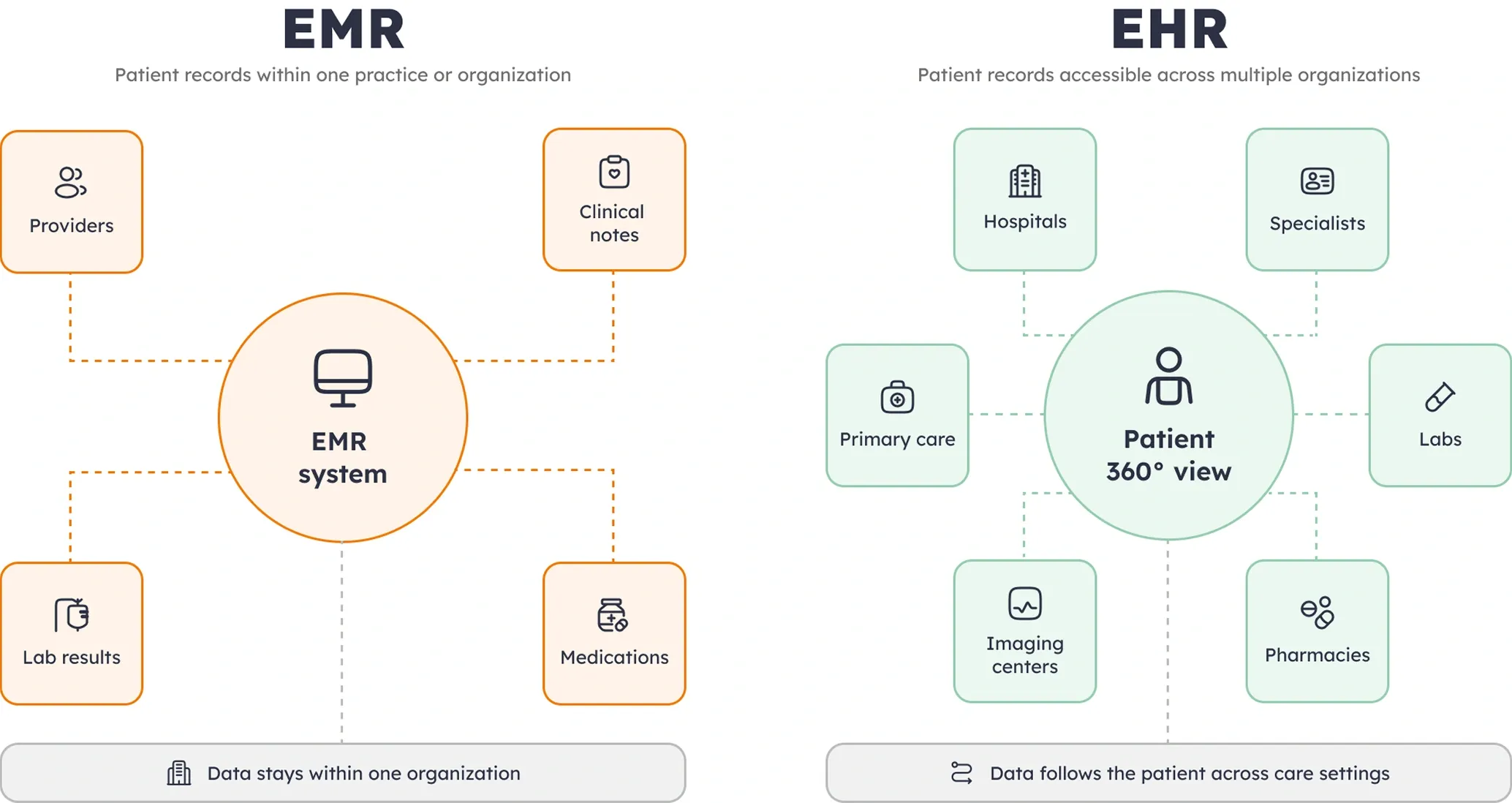
The EHR/EMR sits at the center of the workflow, linking clinical data to the processes that keep a provider running. When it is reliable and open, staff work from the same data, other systems connect without manual work, and new services are added without rebuilding the foundation. If you are choosing between the two, see the difference between EHR and EMR in a short guide.
Connecting outward: FHIR and TEFCA
In 2026, your record system can plug into a nationwide network, so when a new patient arrives, their history from other doctors and hospitals is already on screen.
FHIR (Fast Healthcare Interoperability Resources) is the common format records use to exchange data, so a tool that speaks it plugs in with far less custom work.
TEFCA (the Trusted Exchange Framework and Common Agreement) is the network itself. You connect once, through a gateway called a QHIN (Qualified Health Information Network), and reach every provider on it instead of wiring up partners one by one.
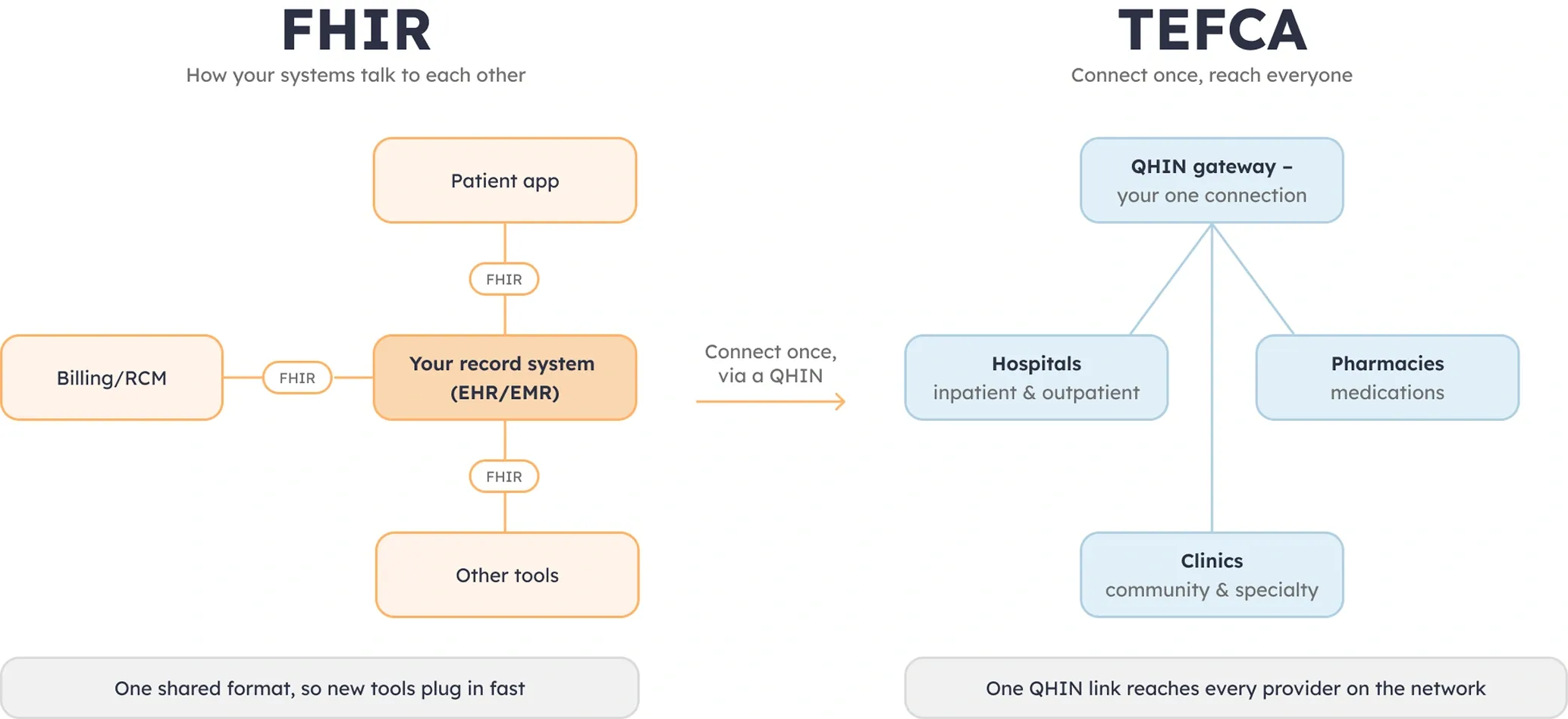
It caught on fast. HHS reported close to 500 million records exchanged through the network by early 2026, up from around 10 million in 2025. For a provider, the payoff is a lower cost to share data and a faster route to it, which is why interoperability now sits at the core of digital transformation in healthcare.
Patient‑facing tools: portal, app, video visits
This is the layer patients actually see, and the most visible technology in healthcare from their side: the portal where they book and view results, the mobile app, and video visits. A portal that cannot read the record shows stale data, and a booking page that does not talk to scheduling creates double‑bookings. The metric that matters here is adoption: a portal only pays off when patients use it instead of calling the front desk.
Back office: RCM, scheduling, HR, inventory
The systems behind patient care can have just as much impact on a provider’s business as clinical software. This includes revenue cycle management (RCM), scheduling, HR, and inventory – the healthcare technology solutions that keep the business running.
The problem is that back‑office systems are often upgraded last. Providers invest in modern EHRs and clinical tools first, while billing and administrative systems keep running on older technology. A modern EHR may end up feeding an outdated billing system, creating data errors, claim denials, and payment delays.
Before the next technology budget, look at two numbers: how many claims are denied, and how long does it take to get paid? If either number is high, modernizing the back office can have a faster business impact than adding another feature to the clinical system.
Start with a discovery call
Planning changes to your healthcare software in 2026? We map the requirements and give you a realistic scope.
AI in healthcare: Where it earns its keep and where it still fails
Healthcare AI solutions are moving from experimentation to operational value. The winners are not the organizations with the most AI pilots, but those that put AI into workflows where it can reduce costs, increase capacity, and improve how care is delivered.
First, clinical documentation is becoming a capacity play, and often the first visible win of a digital transformation in healthcare program. Ambient AI scribes turn clinician‑patient conversations into structured notes, cutting the time clinicians spend on documentation by as much as one to two hours a day.
Second, patient intake and navigation are taking pressure off the front desk. AI can collect patient information, answer routine questions, and route patients to the right service before a staff member gets involved. This means fewer repetitive calls, less manual intake, and better use of front‑desk and call‑center capacity.
Third, AI is strengthening medical imaging workflows. Imaging models can act as a second reader, helping radiologists detect, prioritize, and quantify findings across scans. The clinician remains responsible for the final decision, while AI helps teams process growing volumes without simply adding more workload or headcount.
Fourth, administrative automation is targeting one of healthcare’s biggest cost centers. AI can support prior authorization, coding, claims processing, and other repetitive back‑office workflows. This is also where regulation is pushing the market toward more automation: CMS’s Interoperability and Prior Authorization Final Rule requires impacted payers to meet operational requirements beginning January 1, 2026, while the prior authorization API requirements generally begin January 1, 2027. Providers that build these capabilities now will be better positioned for the transition.


One thing ties all four together: AI is only as useful as the systems around it.
For a provider planning an AI initiative, the win comes from building AI into the systems and processes that already run the business, turning it into a broader digital transformation strategy with measurable operational gains. For a running view of what actually ships in healthcare AI solutions, we track it separately; teams planning an AI initiative can also explore our AI development services.
Where AI still needs guardrails
The common denominator is integration. An AI tool that cannot write back to the EHR, access current data, or move an approval to the payer does not create much business value. The technology may work; the workflow does not.
Some jobs stay off‑limits until the return can be measured safely. Keep a person in the loop for:
high‑stakes clinical decisions
patient‑facing medical advice
autonomous financial or administrative decisions
The rule underneath all of them: the software suggests, the clinician decides.
Under the HTI‑1 rule, a predictive tool in a certified system has to show how it was built and tested, so "the model said so" will not pass an audit. To see the payoff first, start with a pilot on your own data – Modsen engineers can scope one in a call.
Compliance, security and where teams cut corners
We will not rewrite HIPAA here. More useful: five places in everyday hospital technology where teams quietly economize and pay for it later.
1. You don’t track who accesses patient records. If someone opens or downloads patient data without permission, you may not notice it for months.
2. Several employees use the same admin account. If something goes wrong, you can’t tell which person made the change.
3. Your backups aren’t encrypted. If someone steals a backup, they can potentially read the patient data stored in it.
4. A vendor has access to patient data, but you don’t have a BAA with them. A Business Associate Agreement (BAA) is the contract that requires the vendor to protect patient data and follow HIPAA rules.
5. MFA is required only for admins. Everyone else can access the system with just a password, so one stolen password could be enough to get into patient data.
In 2026, compliance across technology in healthcare is a live posture: zero‑trust access, a BAA with every contractor, and documented AI governance under HTI‑1 and, in Europe, the EU AI Act. Healthtech fails audits on the boring items above far more often than on anything exotic. The teams that hold these controls day to day are usually the ones running dedicated IT support, and getting an outside read is what our IT consulting services exist for.
Not sure where your security stands?
Get an outside read of your access controls, vendor agreements, and audit logs before your next budget cycle.
SaaS, custom, or hybrid: How modern providers actually buy software
Providers buy software three ways, and each has an honest cost.
Off‑the‑shelf (SaaS, software as a service – a subscription you use in a browser) is quick to start. The trade‑off shows up later: limited flexibility, questions about where your data lives, and a roadmap you do not control. When the tool cannot do what your operation needs, you wait on a vendor who is building for everyone at once.
Custom software asks for more up front and in return you own it, shape it around how you actually work, and keep the data and the roadmap in your hands.
Hybrid is where most providers land, and where most of a digital transformation in healthcare actually happens: off‑the‑shelf for the commodity work, custom for the parts that carry the business.
Off‑the‑shelf
Best fit for
Commodity work every provider does the same way
The trade‑off
You inherit its limits and its roadmap, and the data lives on the vendor's terms
Custom
Best fit for
The workflows that set you apart and the integrations you depend on
The trade‑off
Four to eight months and real budget up front
Hybrid
Best fit for
Most mid‑size providers
The trade‑off
A clear line between what you buy and what you build
Healthcare software companies play different roles – some sell a platform, some build the custom layer that makes it yours. If you are deciding what to buy and what to build, our guide to custom development works through it.
Team model: in‑house, vendor, or team augmentation
Three ways to staff the work:
In‑house
Best for
Long‑term ownership and full control
The trade‑off
Slow and expensive to hire and keep
Single vendor
Best for
A fast start when you hand off the whole build
The trade‑off
Lock‑in to one vendor's pace and stack
Team augmentation
Best for
A defined push where the knowledge should stay with you
The trade‑off
You still lead the work day to day
The practical rule: when you need two or three engineers for six months and a full‑time employee (FTE) is not justified, augmentation is usually the right call. Digital transformation healthcare programs rarely need a permanent department; they need the right people for the length of the push.
How to plan a 12‑month transformation without burning the team
A year of change fails when everything ships at once. The goal of healthcare digital transformation over twelve months is momentum the staff trusts.
Two decisions carry most of the risk: the order you ship in, and who does the work. Both are covered below, and both benefit from an honest look at capacity before the calendar is set. When a short‑term push needs hands you do not have on payroll, team augmentation fills the gap without a permanent hire, and the build side lives in custom software development.
Quarter‑by‑quarter: what to ship and when
Q1: Audit and prioritize
Find out what the EHR can expose via API, what is out of compliance, and which metric hurts most. Nothing else is scoped well without this.
Q2: EHR integrations and one AI pilot
Get data flowing cleanly out of the core, and run a single high‑value pilot, usually documentation.
Q3: Patient portal and telehealth
With clean data available, the patient‑facing layer becomes a straightforward build rather than a fight.
Q4: RCM and security hardening
Close the revenue loop and tighten the controls from the compliance section before the next budget cycle.
The 2026 checklist: what to audit before the next budget cycle
A short pass before you commit next year's spend. Each item is either a source of measurable savings or a place digital transformation in healthcare tends to break.
API access to the EHR – confirmed and documented.
MFA coverage across all users.
Audit logs rotated and actually reviewed.
A signed BAA with every contractor touching PHI.
A telehealth stack that bills correctly under current flexibilities.
Patient‑portal analytics that show real usage.
An AI pilot scoped to run without any PHI leak.
Uptime for critical systems, with a number attached.
A tested Disaster Recovery (DR) plan.
A defined onboarding process for new software.
Staff training, because these healthcare technology solutions only pay off when people use them.
FAQ
What does digital transformation in healthcare actually mean in 2026?
Where should a mid‑size clinic start?
How much does a full transformation cost?
SaaS or custom software for healthcare – which wins?
Is AI in healthcare safe to deploy right now?
What does compliance require beyond HIPAA in 2026?
Conclusion
Digital transformation in healthcare in 2026 comes down to how well your systems work together. A record system that shares data, an AI layer built into real workflows, and security that holds under audit deliver far more together than any single tool on its own. The providers who move ahead treat these as one connected system and plan them in order.
The practical path is straightforward: audit what you have, connect the core, pilot AI where the return is clear, then harden security. If you are planning your 2026 stack, the healthcare software solutions development team at Modsen can run a discovery session, map what you already own, and size the build before you commit a budget.
References

Get a weekly dose of first-hand tech insights delivered directly to your inbox