
Medical software development services in 2026: build vs buy decision guide
10 min read
Last updated: Sep 30, 2026
Summary
Buying a healthcare SaaS product in 2026 solves part of the problem and leaves the part that matters. The medical software vendor market now splits three ways: SaaS platforms, software as a medical device (SaMD), and custom development partners, and each answers a different need. Choosing a medical software development company means knowing which of the three you actually need. For most mature healthcare organizations the answer is not pure build or pure buy but a hybrid stack. This guide covers when off-the-shelf runs out, how the decision works, what custom work costs, and how to vet a partner. Our healthcare software development services page gives the build-level view.
Key takeaways
Medical software development covers three different kinds of vendor, and the wrong one solves the wrong problem.
For most healthcare organizations, hybrid beats pure build or buy. SaaS works well for standardized workflows, while custom development makes sense where the product needs to differentiate.
A realistic custom MVP takes 4–8 months, so treat any promise of a compliant product in weeks as a warning sign.
Compliance and security are architecture decisions made on day one, and the hardest things to change after launch.
The best signal of a capable vendor is a first call about PHI, integrations, and references.

Olga Tsygan
Head of Strategic Partnerships at Modsen
When off-the-shelf medical software stops being enough
A SaaS product is the right call for some clinics some of the time. It stops being enough when a clinic needs something the product was never built to do. Vendors design for the typical customer, so non-standard requirements fall outside what the software can handle. Four signals show up in the software development for healthcare briefs I get.
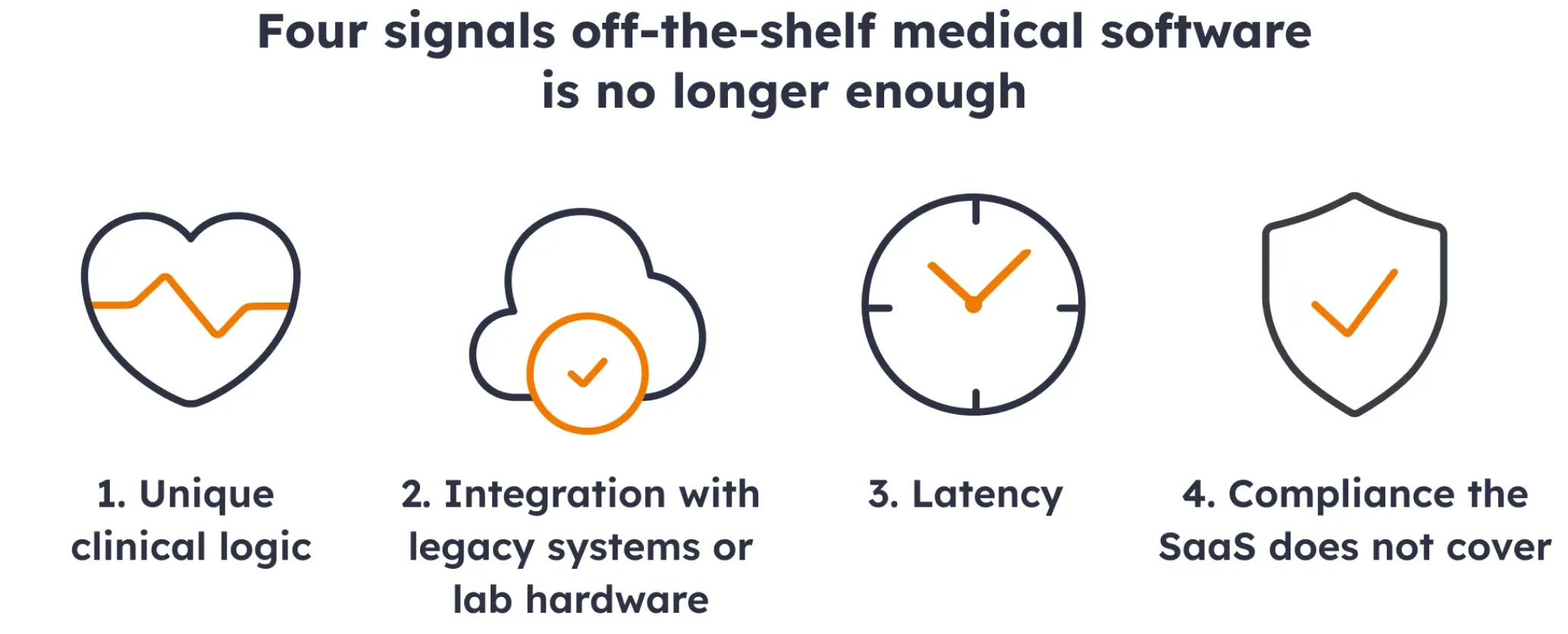
The first is unique clinical logic. An oncology group scoring chemotherapy eligibility against its own protocol cannot bend a generic rules engine to match. The logic is the product, and a SaaS form field will not hold it.
The second is integration with legacy systems or laboratory hardware. If a custom module cannot exchange data with the electronic health record (EHR) in the format the clinic already uses, the problem is not the module. The problem is the integration, and off-the-shelf tools rarely speak to a fifteen-year-old lab analyzer over its native protocol.
The third is latency. A bedside monitor feeding a dashboard has a hard ceiling on how late data can arrive before it is clinically useless, and SaaS built for scheduling was never designed for it.
The fourth is compliance the SaaS does not cover. A vendor certified for one jurisdiction can leave you exposed in another. When any of these four signals appears, buying stops being cheaper, and a medical software development company starts to pay off. See our digital transformation in healthcare 2026 for the wider context.
Build vs buy: a decision framework
Most mature healthcare organizations do not choose pure build or pure buy. They build a hybrid stack. Buy the commodity but build the clinical workflow that gives you an edge.
That is where custom software development earns its place: not across the whole platform, but on the two or three workflows that separate you from every other provider. Scheduling, billing, standard patient records are a solved problem you should not be paying to reinvent. Custom work of this kind works best as a high-value layer on top of bought infrastructure, which is where a medical software development company adds more than a platform vendor can. For the record-system side of that decision, our EHR vs EMR software in 2026 breakdown is the companion read.
The 5 questions that decide it
Does this feature create competitive advantage or is it a utility?
If every provider handles it the same way, buy it. Build only what differentiates you.
Is there a mature SaaS product that already solves it?
A proven product with a real customer base beats a custom build you have to maintain forever.
Does it fit our data-residency requirements?
A SaaS that stores Protected Health Information (PHI) in the wrong region is a compliance problem no feature list offsets.
What will lock-in cost over three years?
Cheap today can mean trapped tomorrow. Price the exit, not the entry.
Can our team actually support the custom solution?
A custom module nobody can maintain becomes a liability the day its author leaves.
When hybrid wins
Picture a mid-size hospital with a SaaS EHR that works fine for records, scheduling, and billing. What it cannot handle is the hospital's oncology workflow: multi-cycle treatment plans, protocol-driven eligibility checks, and toxicity tracking its own oncologists designed.
Rewriting the EHR for that would be expensive and risky. A custom oncology layer that reads from and writes back to the EHR through its application programming interface (API) is cheaper and cleaner. The SaaS keeps doing its job; the custom layer carries the part that sets the hospital's cancer program apart. That is custom medical software development at the right scale.
Not sure whether custom is worth it for your case?
Book a free call and we will help you figure out if custom development fits or if you're better off with what you already have.
What healthcare custom software development actually looks like
Healthcare custom software development is not a normal web project with a login screen bolted on. The difference shows up in every phase, and medical software development services that skip these steps produce software that fails an audit or, worse, a patient.
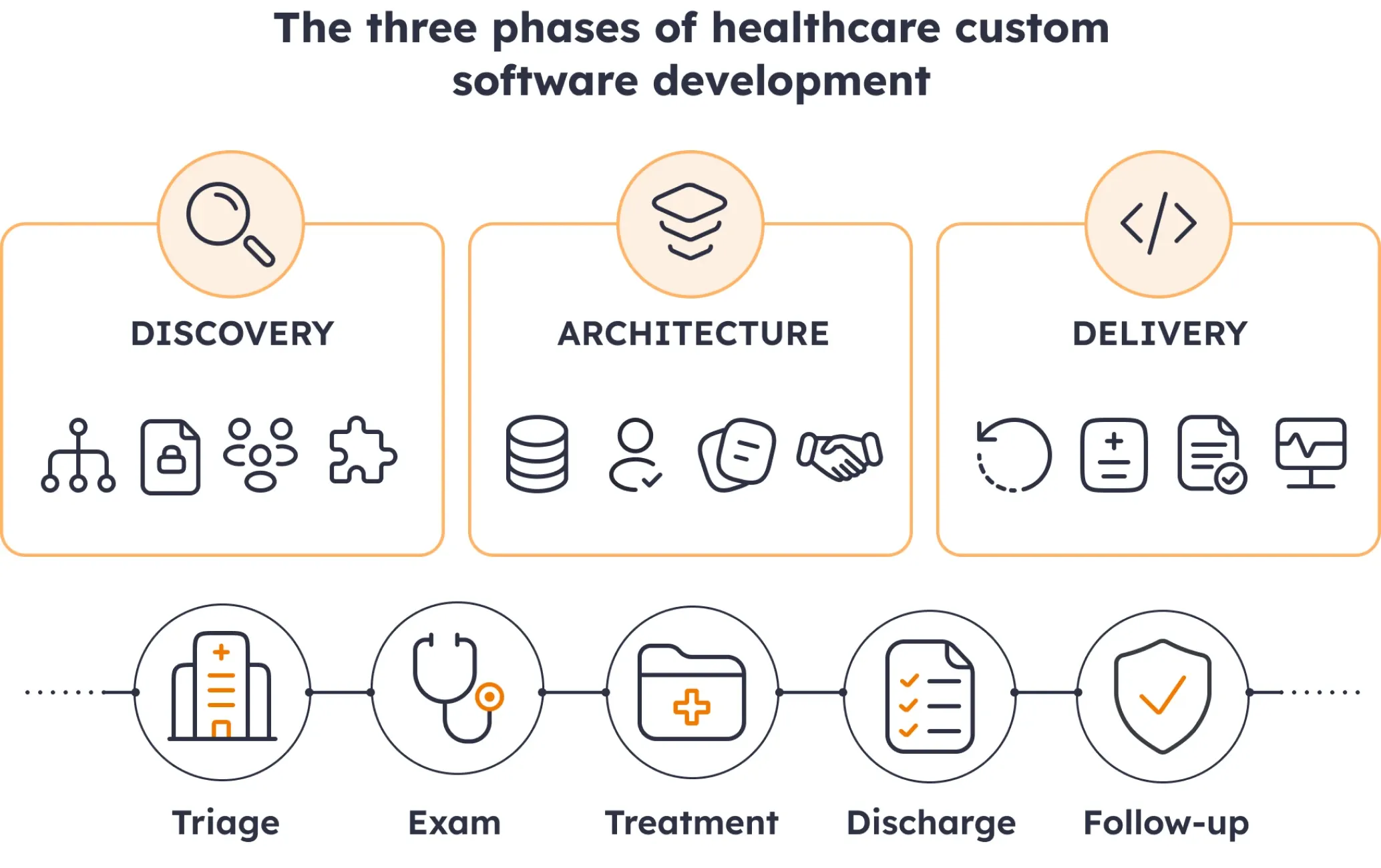
Discovery
Discovery is clinical process mapping: how a patient moves from triage to discharge, where the edge cases hide, and who touches the record at each step. It means charting PHI flows, so you know exactly where protected data lies and travels. It is defining user roles before any screen design, because a nurse, a physician, and a billing clerk see different slices of the same chart. And it means listing every integration up front, because each one is a project of its own.
Architecture
Architecture is where compliance is decided. Health Insurance Portability and Accountability Act (HIPAA) and General Data Protection Regulation (GDPR) requirements shape the data model. Encryption at rest and in transit is assumed. Role-based access control (RBAC) governs who sees what. Audit trails record every read and write, because in healthcare "who looked at this record" is a legal question. A Business Associate Agreement (BAA) defines liability between you and any vendor touching PHI.
Decisions made here are the hardest to change later.
Delivery
Iterations stay short, so clinicians can catch workflow problems early, before they are built into the product. Testing covers clinical edge cases. Compliance documentation is written as you go, because software development in healthcare treats the paper trail as part of the build. For the operational side once the software is live, our healthcare IT support 2026 guide covers what ongoing maintenance actually involves.
How much does healthcare software development cost in 2026
There is no single price for medical software development services, because cost follows scope – how much you build, how deep the integrations go, and how heavy the compliance load is.
Mid-size feature on an existing platform
~$40k–$120k
8–12 weeks
A new module on infrastructure that already exists
MVP of a new product
~$150k–$400k
4–8 months
A focused first version with the core workflow and its integrations
Full platform with EHR integrations
~$500k+
9–14 months
Multiple workflows, deep integrations, and the compliance work
The cost drivers may be:
compliance scope
the number and depth of integrations
any AI/ML
security requirements
how many distinct workflows exist
legacy systems
data migration
the testing and documentation that compliance demands
Software development services for healthcare carry an overhead that generic projects do not, and it lands in those last two items most.
One warning. "Too cheap" usually means something has been left out, and in healthcare the thing left out is expensive: security testing, compliance work, integration testing, real documentation, or post-launch support. A quote that undercuts the rest by half is a scope you will pay for later. A credible medical software development company will tell you what a low number leaves out before you have to ask. If you want an independent scope before committing, explore IT consulting services and solutions.
Get a realistic estimate for your 2026 stack
Tell us what you already run and what you need to build. Modsen team comes back with timelines & cost ranges.
Picking a medical software development company: checklist
Checking a medical software development company may be hard. But most of the signs, good and bad, show up in the first call.
Here is what a good vendor does:
1. It asks real questions about PHI flows and integrations.
2. It can show you a signed BAA. It explains how HIPAA and GDPR differ.
3. It gives you healthcare references you can actually call.
4. It has a security engineer on the team.
5. It knows audit logs, Health Level Seven (HL7), and Fast Healthcare Interoperability Resources (FHIR).
A good medical software development company does all of this without being pushed.
The red flags are just as telling:
1. "HIPAA-compliant in two weeks." Compliance is architecture; it is not a two-week sprint.
2. No healthcare references.
3. No security engineer on the team.
4. Everything handed to subcontractors you never meet.
5. A vendor that cannot draw your data flow on a whiteboard.
6. Compliance treated as a separate task bolted on after development.
When your own team needs to grow to support the build, IT team augmentation is the model that keeps control in-house while adding the specialists you lack. Between medical software companies that talk compliance and those that practice it, the checklist above is what tells them apart.
What AI adds to custom medical software development in 2026
AI is becoming an important layer in healthcare software development, but it is not a substitute for reliable data, sound software engineering, or well-designed clinical workflows. Several use cases are already finding practical applications, including documentation copilots that draft clinical notes for physician review, predictive models that flag patients at risk of deterioration, and natural-language interfaces that let staff query EHR data without manually building reports.
The underlying technology depends on the use case. Large language models (LLMs) are particularly useful for documentation and natural-language interaction with clinical data, while risk prediction typically relies on purpose-built machine learning or statistical models. When LLMs work with organizational data, retrieval-augmented generation (RAG) can retrieve relevant information from internal sources and provide it as context for the model.
But adding AI to poor-quality data or poorly understood workflows can produce unreliable outputs at scale. A medical software development company worth hiring starts with a clearly defined clinical or operational problem and uses AI where it can deliver measurable benefits, with appropriate validation, human oversight, and governance.
For a closer look at current developments, our AI in healthcare news 2026 covers the latest changes, while our AI development services page explains how we approach AI-powered software development.
FAQ
What does a medical software development company actually do?
How is medical software development different from regular software development?
Should we build custom medical software or buy SaaS?
How long does custom medical software take to build?
How do we vet medical software development companies?
What it all comes down to
Healthcare software buying is not a clean build-vs-buy choice, and treating it as one is how organizations overspend. Hybrid architecture is the practical answer for most: bought infrastructure carrying the commodity, custom development carrying the workflows that differentiate you. Compliance and security belong in the architecture from day one, never bolted on before launch. And vendor selection should follow, not precede, a clear read of your actual business and clinical requirements, which is where choosing the right medical software development company gets decided. If your team is planning to update its healthcare software stack in 2026, the most useful first step is a discovery call to map the requirements.
References
1.
Clutch. Top software developers for healthcare providers in Poland, 2026.
2.
3.
Eur-lex. Regulation (EU) 2016/679 (General Data Protection Regulation), 2016.
4.
5.
6.
7.
Congress.Gov. H.R. 1 – American Recovery and Reinvestment Act of 2009.
8.
9.
10.
HL7 international. About Health Level Seven International, 2026.

Get a weekly dose of first-hand tech insights delivered directly to your inbox