AI chatbot for hotels in 2026: use cases, costs, and guest experience
10 min read
Last updated: Aug 31, 2026
Summary
It is 11 p.m., a guest wants to know whether the pool is still open, but no one is at the front desk. Now imagine the same situation happening dozens of times every day. According to hospitality consultant Tommaso Maria Ricci, front‑desk and reservations teams spend 40–60% of their time answering the same routine questions.
This is exactly where an AI chatbot for hotels creates value. An AI chatbot for hotels is a guest-facing assistant that answers questions, manages bookings, suggests upgrades, and hands complex requests off to staff when needed. Available on your website, mobile app, or WhatsApp, it answers common guest inquiries, manages bookings, suggests upgrades, and transfers complex requests to staff when needed.
Since AI chatbots are among the fastest‑growing applications of AI in travel and hospitality, they are often the easiest and most cost‑effective way to start. In this article, we'll explore what hotel AI chatbots can do, how much they cost, where their limitations begin, and when partnering with a team specializing in custom software development for travel and hospitality becomes the smarter investment.
Key takeaways
AI chatbots for hotels reduce repetitive guest inquiries, allowing hotel staff to focus on requests that require judgment and personal service.
The biggest value comes from integration. Without connections to your PMS and booking systems, a chatbot can only provide generic answers.
Most hotels start with an off‑the-shelf chatbot, while custom solutions become worthwhile when integrations and workflows grow more complex.
Not every guest interaction should be automated. Complaints, payments, and exceptional situations still require human involvement.
Measure success by guest satisfaction, resolution time, and business outcomes rather than automation rate alone.

Olga Tsygan
Head of Strategic Partnerships at Modsen
What does an AI chatbot for hotels actually do?
A decade ago, most chatbots in hospitality industry were rule‑based. They could only answer questions that matched pre‑written scripts, so even a slight change in wording often led to “I don't understand.” Guests quickly learned not to rely on them.
The biggest shift came with generative AI in travel and hospitality. Large language models like GPT, Claude, and Gemini generate responses in real time instead of selecting them from a predefined list. That allows an AI chatbot for hotels to understand guest requests no matter how they are phrased.
But understanding a question is only part of the job. To give useful answers, a hotel AI chatbot must be connected to your property management system (PMS), where reservations, room assignments, and guest details are stored, as well as your channel manager, which synchronizes room rates and availability across booking platforms such as Booking.com and Expedia, and the booking engine behind your own website. One way to test whether a chatbot is truly useful is to ask questions that require access to your hotel's live data. For example, can it tell a specific guest when their room will be ready? If it cannot connect to your systems, it will only be able to give generic answers.
The key is knowing which tasks the chatbot should own and which are better handled by your staff.
The bot handles this well | Leave this to your team |
|---|---|
Rates, availability, and amenities at any time of day | Refunds, chargebacks, and billing disputes |
Booking changes, upgrades, and add‑ons | Complaints that require empathy and judgment |
Wi‑Fi, parking, late and mobile checkout | Requests involving legal or contractual decisions |
A simple rule: if the answer already exists in your systems, the bot can provide it. If the guest needs an exception, a refund, or human understanding, your staff should take over.
Where an AI chatbot for hotels still gets it wrong
Even the best AI chatbot for hotels has its limits. The good news is that most failures are predictable – and much cheaper to prevent during implementation than after guests experience them.
Conversations across multiple languages. While modern models support dozens of languages, switching between them in the same conversation can still lead to misunderstandings.
Emotionally charged complaints. An AI can explain a policy, but it cannot replace empathy. When a guest is frustrated or disappointed, the priority is a fast handoff to a member of your team.
Requests involving money. Refunds, billing disputes, discounts, and goodwill gestures should always include human review.
Sensitive guest data. Guests sometimes enter passport details or payment information into chat. Your chatbot should be designed to detect and protect sensitive data, while clear rules define where conversations are stored, who can access them, and how long they are retained.
Top AI chatbot use cases: before, during, and after the stay
AI has become a standard part of hotel operations. According to the Mews Hotelier Survey 2026, 98% of surveyed hoteliers have used AI in at least one operational area in the past six months, with AI involved in an average of 11 of the 19 tasks the survey tracked. For an AI chatbot for hotels, the biggest opportunities fall into three stages of the guest journey.
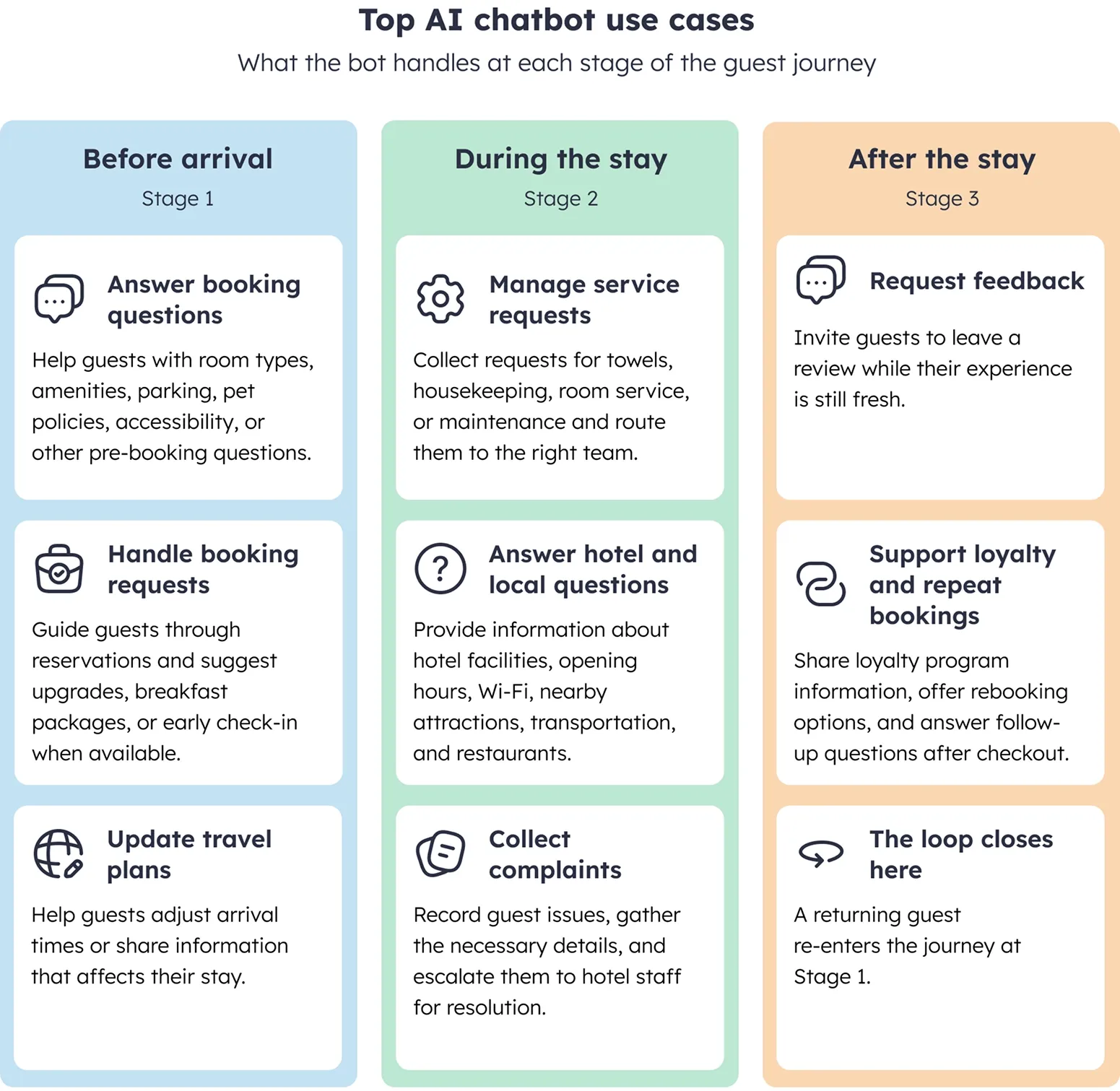
An AI chatbot for hotels is most valuable when it is connected to hotel systems, allowing it to provide accurate information and automate routine guest interactions throughout the entire stay.
The same approach also powers businesses offering AI‑powered customer support for the travel industry, including travel agencies, tour operators, and destination management companies (DMCs). If limited engineering capacity is slowing adoption, expanding your team through IT team augmentation can help accelerate implementation.
What powers an AI chatbot for hotels behind the scenes
An AI chatbot for hotels is only as good as the technology behind it. Reliable AI customer service for hospitality and hotels depends on more than a chat interface – it requires the right data, system integrations, and business rules. That's why chatbots are typically implemented as part of broader hospitality technology services, not as standalone tools.
The core components include:
Large language model (LLM). Understands guest requests and generates natural responses.
Knowledge base with retrieval‑augmented generation (RAG). Retrieves relevant hotel policies, FAQs, and other approved information before generating a response.
PMS connector. Gives the chatbot access to reservations, room availability, guest details, and other operational data.
Channel router. Delivers conversations across web chat, WhatsApp, SMS, and other guest communication channels.
Guardrails. Define what the chatbot can and cannot do, helping ensure compliance with business rules and policies.
Human handoff. Transfers conversations to hotel staff when human assistance is required, while preserving the chat history.
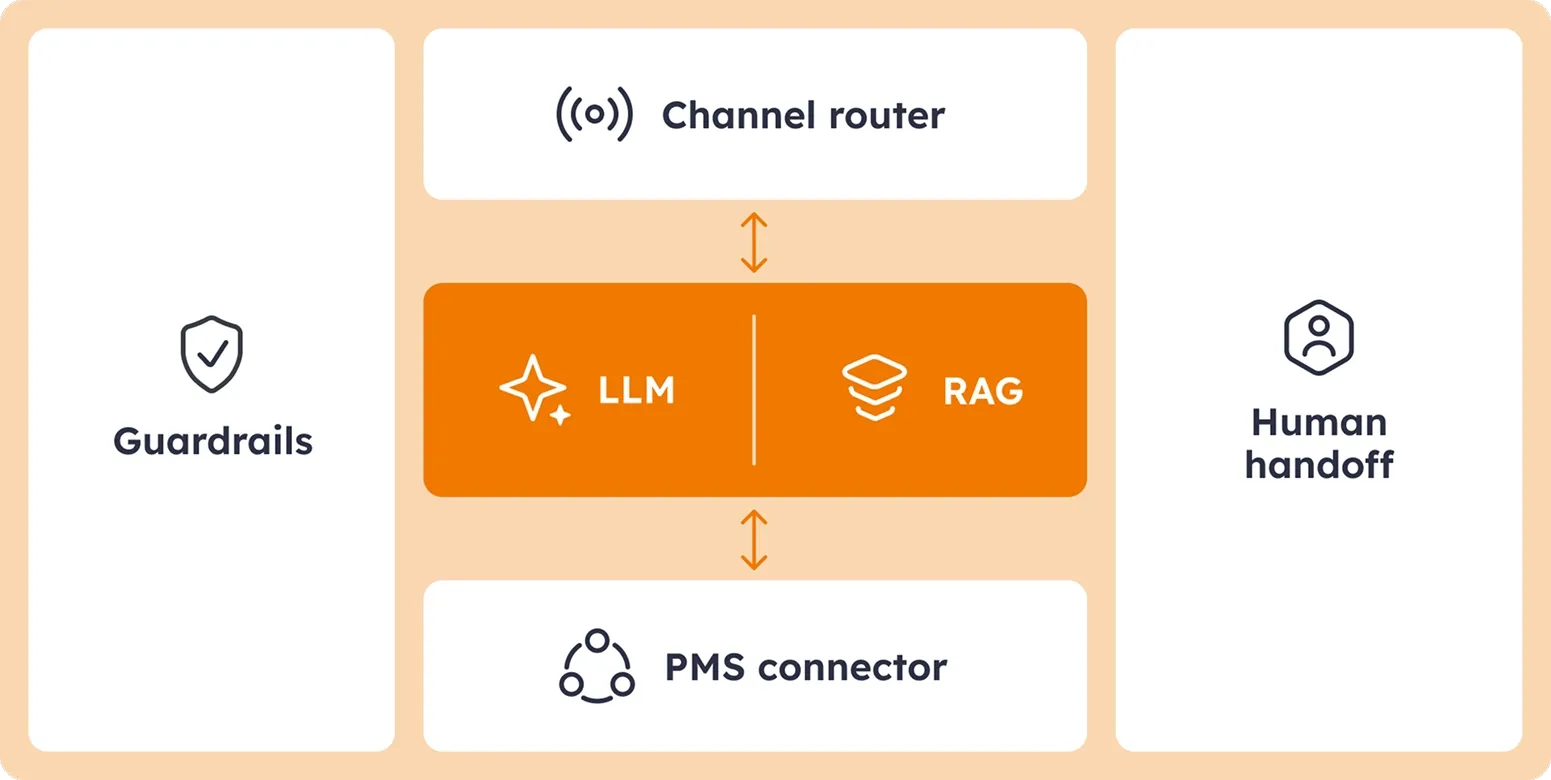
Unlike a traditional live chat solution for travel agencies, AI resolves routine requests automatically and escalates only complex cases to employees.
Successful implementations start with clean data and reliable integrations. Otherwise, the chatbot will simply repeat the same inconsistencies found in your systems.
Cost ranges and delivery timelines in 2026
According to Hotel Tech Report, subscription‑based hotel chatbots typically cost around $100–200+ per month, or $0–4 per room per month, depending on the vendor and property size. Hotel Tech Report notes there is usually no setup fee, but implementation still takes time and budget. In our delivery experience, most SaaS platforms can be configured and launched in about 2–6 weeks: connecting your PMS and booking engine, configuring workflows, importing hotel policies and FAQs, testing responses, and training staff.
A custom solution follows a different pricing model. Instead of paying for a packaged product, you invest in software designed around your operations, integrations, and long-term business goals. The final investment depends on your requirements rather than on a predefined package. Ongoing costs include hosting, maintenance, and AI inference – the fee the language model provider charges based on usage, measured in tokens.
The real decision is not price or delivery speed – it's whether an off‑the-shelf product fits your operations.
Off‑the-shelf platform | Custom solution |
|---|---|
Lower upfront cost and faster deployment | Higher return over time – the system adapts to how your hotel actually works |
Limited to the vendor's available integrations | Deep integration with your existing systems for reliable automation |
Good for standard guest communication | Ideal for hotels focused on operational efficiency, security, and premium guest experiences |
Subscription pricing that scales with usage | Ongoing costs focus on hosting, support, and AI usage |
Off-the-shelf platforms are often a starting point, but successful hotel businesses typically move to custom solutions as they scale. Waiting too long usually means accumulating operational inefficiencies, fragmented processes, and unnecessary subscription costs. If your chatbot needs advanced integrations, automation, or specialized features of AI personalization engine for travel and hospitality industry, a custom approach often provides greater long-term flexibility.
Every hotel has different systems, integrations, and operational needs, so there's no universal price for an AI chatbot. Defining those requirements first leads to a more accurate project scope and budget. To better understand how AI chatbots fit into the broader booking journey, explore our guide to reservation system in 2026. When you're ready to evaluate implementation options, see how Modsen AI development services help businesses build AI solutions around their operational needs.
Build or buy: a quick way to decide
Ask yourself three questions before choosing an AI chatbot for hotels.
1. How much growth are you planning? An off-the-shelf chatbot may be sufficient for small properties with simple operations. However, as guest expectations rise and competition increases, subscription platforms often become a limiting factor. A custom solution gives you greater flexibility, stronger automation, and the ability to differentiate your guest experience instead of adapting your business to the vendor's product.
2. How much guest communication do you handle – and how much are you not seeing? Subscription platforms are the cheaper option at low volumes, and as usage grows, it is worth checking whether the pricing model still works. But the bigger risk is invisible: when a chatbot supports only a narrow set of channels, languages, and request types, guests do not wait or call – they leave. The complaint that never reached your front desk becomes a public review on Booking.com or Google, and that costs far more than any subscription tier.
3. Who will manage the chatbot? Even the best AI chatbot needs regular optimisation and monitoring. An experienced implementation partner can handle this for you while continuously improving performance as your business grows. Book a consultation to learn how leading hotel brands approach long-term AI chatbot management.
For many hotels, the best approach is to start with an off‑the-shelf solution, measure its impact, and move to custom development only when clear business requirements emerge. If you're considering a broader travel or hospitality project, explore our guide to custom travel solutions to learn when custom software becomes the better choice.
Off‑the-shelf or custom AI chatbot for your hotel?
Share your requirements with us. Our experts will assess your current systems, recommend the approach that best fits your business, and estimate the cost and delivery timeline.
Guest experience: What actually gets better?
Guests are more open to AI than many hotels expect. According to Hotel Tech Report, 70% of surveyed guests found chatbots helpful for simple requests, while 58% believe AI can improve their hotel stay. The most common use cases are also the simplest – for example, 39% would use a chatbot to ask for the Wi‑Fi password.
At the same time, AI is not expected to replace every guest interaction. That view is reflected in the Mews data, where 59% of hoteliers believe the front-desk welcome and check-in should remain human-led. In practice, an AI chatbot for hotels works best when it supports staff rather than replaces them.
The same balance applies to agentic AI in the travel industry. Instead of only answering questions, agentic AI can perform actions such as changing a reservation or processing a booking. Even so, tasks involving payments, exceptions, or high-value decisions should still include human approval.
Rather than measuring chatbot success by the number of automated conversations alone, track metrics that reflect both guest and business outcomes:
Measure | Why it matters |
|---|---|
Guest satisfaction | Shows whether automation improves the guest experience |
Resolution time | Indicates how quickly guest requests are handled |
Escalation quality | Shows whether staff receive the full conversation context |
Upsell conversions | Measures whether the chatbot supports additional revenue opportunities |
Agentic AI is just one of the technologies reshaping hospitality. Our guide to travel and hospitality industry trends in 2026 explores the broader technology trends hotels should be watching.
FAQ
What determines the cost of an AI chatbot for hotels?
Do we have to connect it to our PMS?
What is the difference between a rule‑based chatbot and an AI chatbot for hotels?
Is agentic AI ready for hotels in 2026?
What should we measure after launching an AI chatbot for hotels?
Conclusion
An AI chatbot for hotels earns its place by taking repetitive requests off your team's plate, but it can only do that when it is connected to the systems where bookings, rates, and guest data actually live. The AI model itself is not the differentiator – the integrations, the guardrails, and the ownership model are.
So here is the clear answer. If your operations are small and simple and you just want to test the idea, an off-the-shelf platform will do it. In every other case, delay is the real cost: every month on a tool that cannot reach your PMS means manual work for your team, guests left unanswered, and reviews already being written. Growing hotels end up on a custom solution anyway – the only variable is how much they pay in the meantime.
Don't lose that time. Contact us – we'll assess your systems and tell you whether an off-the-shelf platform is enough or a custom chatbot integrated with your PMS is the better fit, with a clear budget and timeline.

Get a weekly dose of first-hand tech insights delivered directly to your inbox