
AI in financial services: how AI is used in fintech in 2026 (complete guide)
16 min read
Last updated: Jul 01, 2026
Summary
AI in financial services covers machine learning, generative AI, and emerging agentic systems used across fraud detection, customer experience, and product engineering. What was once experimental has already become core infrastructure: the AI in fintech market is projected to grow from $36.6 billion in 2026 to nearly $99 billion by 2031.
This guide breaks down where AI delivers the highest-ROI, how generative AI transforms customer experience, what it takes to build AI-first fintech products from MVP to scale, and how to choose the right engagement model – build, buy, or outsource.
Key takeaways
AI in financial services improves 3 critical development metrics, accelerating delivery, cutting total cost of ownership, and enhancing software quality in production.
Fraud detection and risk operations remain the highest-ROI use case, with AI significantly enhancing detection accuracy while reducing false positives and manual effort.
Generative AI transforms customer experience through conversational banking, document automation, advisor copilots, and faster dispute resolution.
AI-first fintech products embed AI into core product logic – MVPs typically take 4-8 months to build, with systems evolving over time through scalable architectures.
The choice of engagement model (in-house, team augmentation, or outsourcing) directly affects delivery speed, cost, and long-term scalability of AI initiatives.
Compliance and risk guardrails are a crucial constraint layer that determines how AI in finance functions in real-world conditions.

Dmitry Grishanovich
Head of .NET Department at Modsen
What is AI in financial services
AI in financial services refers to the use of intelligent systems that learn from data and support decision-making across financial workflows. It includes:
machine learning (ML)
deep learning
natural language processing (NLP)
large language models (LLMs)
retrieval-augmented generation (RAG)
generative AI
agentic systems
Together, these technologies help institutions process large volumes of structured and unstructured data, automate decisions, and improve accuracy at scale.
In practice, they are implemented across core business areas:
Risk and fraud operations – real-time fraud detection, AML monitoring, anomaly detection
KYC and compliance – identity verification, document processing, regulatory reporting
Credit and lending – credit scoring, underwriting, default prediction
Customer experience (CX) – chatbots, personalized recommendations, support automation
Software delivery – code generation, QA automation, faster product releases
Back-office and treasury – reconciliation, forecasting, liquidity, cash management
These are not experimental use cases – in 2025, over 85% of financial firms already applied AI across major functions such as fraud detection, risk modeling, and IT operations. Today, adoption continues to expand, driving growing demand for fintech development services.
AI vs generative AI vs agentic AI: practical differences
In 2026, AI in financial services includes several distinct categories, each representing a different level of capability:
Classical AI
What is it
Models trained on historical data
What it does
Scores, predicts, classifies
Example
Fraud detection system scoring transactions in real time
Generative AI
What is it
Models that produce new content
What it does
Writes, summarizes, answers
Example
AI assistant generating customer replies
Agentic AI
What is it
AI systems that perform tasks with minimal human input
What it does
Executes multi-step workflows
Example
AI agent processing loan applications end-to-end
Overall, each type:
solves a specific problem (makes predictions, generates content, or automates entire workflows)
operates at a different level of automation (supports decisions, assists workflows, or fully executes them)
How AI improves 3 core software development metrics in fintech
Fintech delivery is ultimately measured by 3 things:
how fast teams ship new features
what it costs to build and run them
how reliably systems perform in production
These are the core metrics that define competitiveness in modern financial products – and where AI delivers the most tangible impact.
To understand the real benefits of AI in software development, it’s worth examining each aspect in detail.
Speed: AI-accelerated engineering and time-to-market
At the engineering level, AI reduces the time spent on coding, testing, and review. In a controlled study by Microsoft Research, developers using GitHub Copilot completed coding tasks 55.8% faster than those without AI assistance.
This acceleration translates into shorter delivery cycles. In enterprise environments, developers leveraging AI coding assistants handled 26% more tasks on average, increasing throughput and enabling teams to ship features more frequently.
At the same time, faster delivery doesn’t compromise product quality or security. The gains come from specific improvements across the development lifecycle:
AI-assisted coding and scaffolding cut the time needed to implement new features.
Automated test generation speeds up QA and improves coverage.
AI-powered code review helps identify issues earlier and reduces review cycles.
Documentation and integration support removes repetitive engineering work.
Thus, integrating a KYC workflow or a payment processing module that previously took several weeks can now be completed in days. AI in financial services has shortened the path from idea to production, accelerated iteration, and increased release frequency, while keeping systems stable and reliable in production.

The impact of AI on software delivery speed
Cost: lower TCO across engineering and operations
Faster, AI-supported development directly affects engineering costs.
When teams spend less time on coding, testing, and review, they require fewer man-hours to deliver the same scope of work. This lowers the overall spend on feature development and ongoing maintenance.
At the same time, AI in financial services reduces expenses beyond engineering by improving how systems operate after release. Fewer QA cycles are needed due to better test coverage, and fewer issues reach production, which cuts post-launch bug-fixing overhead.
At scale, these benefits lead to a leaner total cost of ownership (TCO). According to Deloitte, AI tools will help save between 20% and 40% in software investments for the banking industry by 2028 – a trend that is likely to extend across the broader financial sector.
Take fraud detection as a practical example. AI automation in financial services enables teams to replace rigid rule-based systems with AI-based models, reducing manual tuning and operational overhead. Over time, this leads to lower infrastructure costs and fewer resources required to manage detection logic.

The role of AI in cost optimization across the software lifecycle
Quality: fewer defects, better security, higher reliability
One of the key benefits of AI in software development is enhanced quality.
At a high level, it allows teams to prevent defects before they reach production and makes systems more predictable and reliable in operation. In practice, quality improvements come from the following areas:
AI code review
AI adds an extra validation layer, continuously analyzing code for issues. It helps catch edge cases and hidden flaws before merge, not after release.
AI-driven testing
AI dynamically generates test scenarios based on actual system behavior, uncovering corner cases that are difficult to identify with traditional test scripts. Organizations already report significant improvements in test coverage and defect detection rates.
AI-powered security
Traditional static analysis is limited to known patterns, while AI extends detection across modern stacks and previously unsupported scenarios. This increases overall vulnerability coverage and enables teams to identify risks earlier in the development lifecycle.
With AI in financial services, these capabilities go even further. AI can automatically scan systems for compliance with regulations such as PCI-DSS, SOX, and GDPR. It continuously checks code, data flows, and configurations against regulatory requirements, resulting in less manual audit effort and reduced risk of non-compliance.
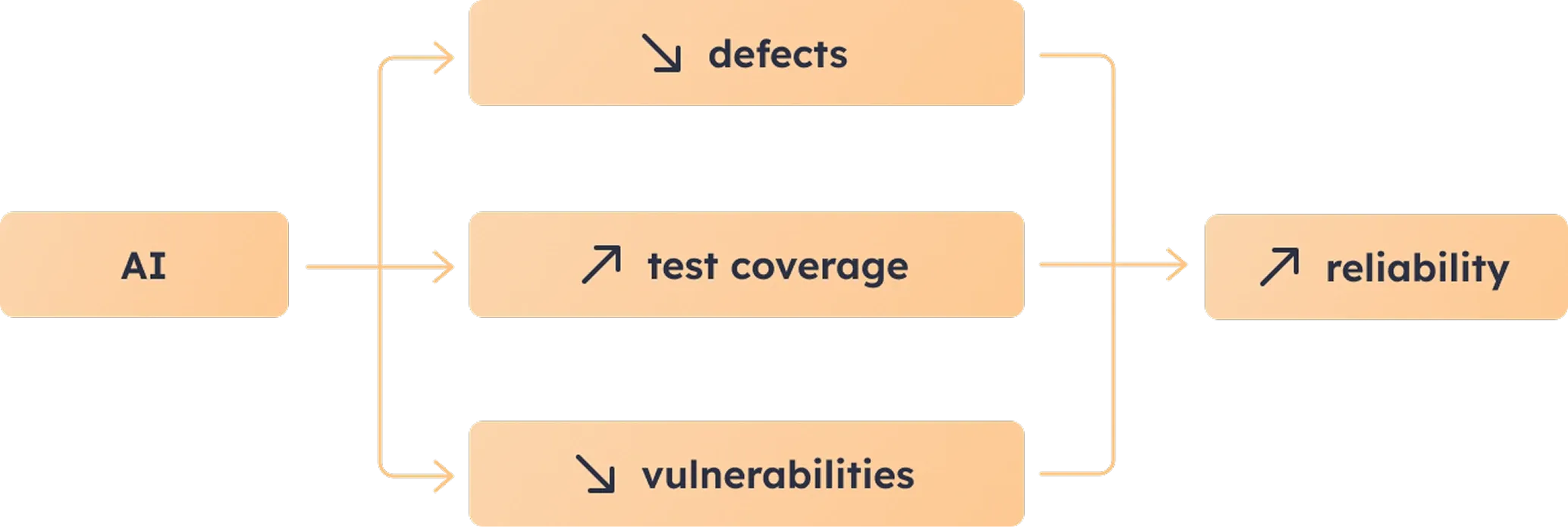
The effect of AI on software quality and reliability
From AI potential to measurable fintech results
Discover how Modsen can help you apply AI in financial services to shorten delivery time, optimize costs, and improve quality.
AI in risk and fraud operations: the highest-ROI use case
Among all implementations of AI in financial services, fraud detection and risk operations consistently deliver the highest return on investment. The connection is clear: even small improvements in detection accuracy drive meaningful financial impact at scale.
AI substantially outperforms rule-based approaches in this area. In recent research, AI-powered fraud detection systems achieved detection rates of 87-94% while reducing false positives by 40-60%, compared to traditional rule-based systems. These gains directly reduce fraud losses and operational effort required for manual review.
How does it work? AI is applied across several key workflows:
Payment fraud detection – real-time analysis of individual transactions to identify suspicious behavior
Transaction monitoring – continuous detection of anomalies across accounts and channels
Credit risk assessment – more accurate scoring based on broader data signals
Real-time decisioning – instant approval or blocking of transactions based on risk
Increasingly, these systems are powered by autonomous AI agents that can analyze signals, trigger actions, and adapt to new fraud patterns without manual intervention. This shifts risk operations from static rule management to dynamic, self-improving processes.
For more details, explore our AI fraud detection architecture and build guide.
Generative AI in customer experience and operations
Unlike traditional automation, generative AI works directly with unstructured inputs – conversations, documents, and requests – making it particularly effective in customer-facing and back-office scenarios.
The difference is most visible in areas where speed, accuracy, and personalization directly impact user experience and operational efficiency.
That’s why the main use cases of generative AI in finance include:
Conversational banking
AI in banking customer service enables natural, real-time interactions across chat, voice, and digital channels.
Document automation
GenAI supports the creation and validation of contracts, reports, and compliance documents with limited human involvement.
Advisor copilots
AI agents for banking, insurance, wealth management and other financial domains provide professionals with recommendations, summaries, and client insights.
Dispute resolution
Generative AI solutions automate the handling of customer claims and transaction disputes with faster response times.
A specific example is JPMorgan’s IndexGPT, a generative AI tool designed to analyze market data and support investment decision-making. For a deeper look at LLM and RAG implementation patterns, explore our generative AI in banking guide.
Overall, it vividly reflects a larger trend: financial institutions are moving from static tools to adaptive AI systems that can produce insights, interact with users in real time, and increasingly support agentic AI in financial services across customer and operational workflows.
Building AI-first fintech products: from MVP to scale
In fintech context, “AI-first” means building products where AI is a fundamental part of user experience and decision-making logic. It changes both how products are designed and how they evolve over time.
At the product level, this approach is reflected in:
Personalized recommendations – financial insights and product suggestions tailored to user behavior and context
AI assistants – conversational interfaces that support users with account management, queries, and financial decisions
Predictive notifications – proactive alerts based on user activity, risk signals, and upcoming events
From a delivery perspective, building AI-first products requires a different approach to development. The focus shifts from static features to continuous data-driven improvement, where models and workflows are refined over time. Yet, it requires a strong engineering foundation, supported by custom software development expertise tailored to fintech-specific requirements.
In real-world product development it comes down to:
Time to MVP – typically 4 to 8 months, depending on product complexity and integrations
Development cost – $80K to $500K, covering core features, AI deployment, and initial model configuration
From there, scaling AI in financial services products involves expanding data pipelines, improving model performance, and embedding it more deeply into critical user flows and operations. This is where long-term product value is created.
To get a deeper understanding of fintech app development specifics, see our features and costs breakdown.
Engagement models for AI fintech projects: build, buy, outsource
Choosing the right engagement model is crucial when implementing AI in financial services. The complexity of data, regulations, and systems architecture means that the delivery approach directly impacts both speed and outcomes.
Fintech teams typically choose between 3 models:
1. In-house development
AI capabilities are built entirely by the internal team.
This option works best when a company already has strong engineering expertise, access to data infrastructure, and long-term investment capacity. It’s most suitable for organizations building core products around AI or developing autonomous AI agents as a strategic capability.
2. Team augmentation
External specialists are added to an existing in-house team to accelerate delivery or fill specific skill gaps.
The approach is most effective when internal teams handle product ownership but need support with areas such as data engineering, model development, or agentic AI in finance. You make faster progress without fully outsourcing the project.
3. Full outsourcing
The entire product or a major part of it is developed by an external partner.
This model fits companies that want to move quickly, lack in-house AI expertise, or need to validate a product concept before building internal capabilities. It’s also common when implementing complex solutions (such as AI agents in financial services) across multiple workflows.
The comparison below summarizes the differences:
Internal expertise
In-house
High
Team augmentation
Medium
Full outsourcing
Low
Time-to-market
In-house
Slower
Team augmentation
Medium
Full outsourcing
Faster
Cost predictability
In-house
Medium
Team augmentation
Medium
Full outsourcing
High
Control over product
In-house
Full
Team augmentation
High
Full outsourcing
Medium
Scalability
In-house
High
Team augmentation
High
Full outsourcing
Medium
Best for
In-house
Core AI products
Team augmentation
Scaling teams
Full outsourcing
Fast delivery / MVP
In most cases, fintech companies combine these setups over time. Early stages often rely on outsourcing or augmentation, while mature products gradually move more capabilities in-house.
The right approach depends on your product goals, team capacity, and how central AI is to the business model.
Compliance, security, and risk guardrails for AI in fintech
With AI in financial services, compliance and risk management are not optional layers. They are built into the system from the start and shape how AI solutions are designed, deployed, and operated.
Financial institutions must comply with a range of regulatory requirements, including GDPR, PCI-DSS, SOC 2, and emerging frameworks such as the EU AI Act.
In addition to general regulations, AI systems are subject to specific requirements. For instance, standards such as SR 11-7 define expectations for model risk management, validation, and explainability in the US banking sector.
To meet all these requirements, AI solutions must include several essential guardrails:
Model governance – clear ownership, validation processes, and ongoing monitoring of model performance
Explainability – the ability to interpret model decisions and justify outcomes, especially in high-risk use cases
Bias testing – regular evaluation of models for systemic bias and fairness of outcomes
Audit trails – full traceability of decisions, including input data and system actions
Security is equally critical. AI systems must ensure secure data handling, access control, and protection against misuse or model manipulation. This is particularly important when working with sensitive financial and personal data.
In practice, these safeguards determine how AI in financial services operates in production. They reduce regulatory risk, improve trust, and make AI solutions reliable in real-world conditions.
FAQ
How is AI used in fintech in 2026?
What are the business benefits of AI in financial services?
What is the difference between AI, generative AI, and agentic AI in finance?
How much does AI integration cost for a fintech product?
What are the top regulatory risks for AI in financial services?
Can a small fintech team build AI features without an in-house ML team?
Conclusion
AI in financial services is no longer experimental. It directly impacts how products are built, delivered, and scaled across the entire lifecycle.
It improves development speed by shortening delivery cycles and reducing time-to-market. At the same time, AI optimizes costs by lowering engineering and maintenance effort across the product lifecycle. It also enhances quality, resulting in fewer defects, stronger security, and more reliable systems in production.
All in all, AI in fintech translates into better products, stronger performance, and measurable business outcomes.
And the challenge is no longer whether to adopt AI, but how to implement it effectively – with the right architecture, safeguards, and delivery model.
If you’re planning to build or scale AI-assisted fintech products, the right starting point makes all the difference. Let’s connect to discuss your use case and outline the best approach for your product.
References
1.
Mordor Intelligence. (2025). AI in fintech market – Growth, trends, and forecasts.
2.
Resources Global Professionals (RGP). (2025). AI in financial services 2025.
3.
4.
SSRN. (2024). The impact of generative AI on knowledge work.
5.
Deloitte. (2025). AI and bank software development: Financial services industry predictions.
6.
7.
GitHub. (2025). GitHub expands application security coverage with AI-powered detections.
8.
GSC Advanced Research Reviews. (2024). Artificial intelligence in software testing and automation.
Read more





Get a weekly dose of first-hand tech insights delivered directly to your inbox