Conversational Commerce in 2026: Chat, Voice and Messenger Sales
7 min read
Last updated: Jul 04, 2026
Summary
Most e‑commerce teams still build for a user who browses product pages, adds to cart, and checks out in four steps. That user exists – but they’re increasingly the minority. The majority of purchase decisions in 2026 happen inside a conversation: a WhatsApp thread, an Instagram DM, a voice command to Alexa. Conversational commerce has been a buzzword since 2015. What changed is the AI underneath it. Today’s AI chatbot ecommerce stack handles intent recognition, product lookup, and checkout in a single session without a human agent. Mordor Intelligence puts the AI ecommerce conversational segment at $12.6 billion in 2026 (Mordor Intelligence, 2026) – and that’s before you count WhatsApp-native checkouts in India and Brazil, voice reorders, or B2B quotes closing inside Slack. Here’s how it actually works under the hood.
Key takeaways
Conversational commerce means selling and supporting customers through chat, voice, and messenger – not static web pages.
AI (NLU, LLMs, RAG) is the engine underneath every channel that works at scale.
WhatsApp Business, Facebook Messenger, and Instagram DMs are the primary B2C channels in 2026.
Voice through Alexa and Google handles reorders and grocery well; it’s finally a real revenue line.
Conversational commerce sits between traditional e‑commerce and agentic commerce – it’s still human-in-the-loop, and that matters for compliance.

Aleksandr Yakovets
Head of PMO at Modsen
What is conversational commerce? Definition and channels
Conversational commerce is built on a straightforward idea: instead of sending customers to a product page and hoping they figure it out, you sell through dialog. A text chat, a voice command, a message on WhatsApp – the purchase happens inside the conversation, without the customer ever leaving it.
The channels doing this work in 2026 are ones you already know: WhatsApp Business, Facebook Messenger, Instagram DMs, web chat widgets (Intercom, Drift, Tidio), Apple Messages for Business, voice assistants (Alexa, Google Assistant, Siri). B2B teams run the same flows through SMS, Telegram, and Slack. The AI chatbot ecommerce layer underneath handles intent, product search, cart updates, and payment – often with no human agent in the loop at all.
What makes conversational commerce different from a support chat? A support chat fixes problems after a purchase. Conversational commerce drives sales before and during it. The session starts before the customer has fully decided what to buy and ends after the order is confirmed – that is a fundamentally different integration job than bolting a help widget onto a product page. Chris Messina, the designer who coined the term back in 2015, described it as “the intersection of messaging apps and shopping” (Medium, Messina, 2016) – and that framing still holds, even if the AI layer underneath has changed beyond recognition.
Conversational vs traditional e‑commerce vs agentic commerce
Worth placing this on a map before going further – the three models look similar from the outside but require very different architecture decisions.
Traditional e‑commerce puts product pages in front of users and expects them to search, filter, read, and decide on their own. Conversational commerce replaces or adds to that with dialog: the customer says what they want, the AI asks follow-up questions, finds the right product, and guides them to checkout.
Agentic commerce is the next step. An AI agent shops for the user – makes decisions, places orders, manages subscriptions – without the user doing anything. Conversational commerce still has a human in the conversation. Both use the same tools (LLMs, RAG, payment APIs), but the human’s role and the legal requirements are very different. For most teams building in 2026, this is where the real work is. Gartner predicted that by 2025 roughly 80% of customer service teams would move away from ticket-based support toward conversational engagement models (Gartner, 2024) – and from what I see in projects, that shift is already well underway.
So the question is not whether dialog-driven commerce belongs in your stack. The question is which channels to start with – and why the answer differs depending on your market. If you want the full picture of where e‑commerce architecture is heading, the e‑commerce trends 2026 breakdown covers all three shifts together.
Chat commerce: web chat, WhatsApp, messenger, Instagram
You probably already have one of these channels running. The question is whether it is generating revenue or just handling complaints.
Web chat is the oldest channel and still useful for pre-sales. Intercom, Drift, and Tidio all have LLM-powered agents now that answer product questions, compare items, and qualify leads before passing them to a human. Speed matters: replying within one minute significantly lifts conversion rates in assisted purchase sessions (Forrester Research, 2025). The AI chatbot ecommerce setups that perform best almost always have tight response time targets built into the design.
WhatsApp is the main channel for mobile B2C conversational commerce outside North America. Broadcasts get a 97% open rate in 2026; chat sessions convert at 45-60% – up to 12x higher than standard digital channels (Egrow,2026). If you sell in India, Brazil, South East Asia, or MENA, those numbers change how you think about customer acquisition costs.
Facebook Messenger and Instagram DMs cover discovery and the top of the funnel – product tags, DM-to-cart flows, drops tied to influencers. Instagram Shopping lets users check out inside a DM thread, which cuts the steps between interest and purchase for products people buy on impulse.
Web chat
Best for
Pre-sales, lead qualification
Key market
Global
Best for
Mobile B2C, full purchase flow
Key market
India, Brazil, MENA, SEA
Instagram DMs
Best for
Discovery, impulse categories
Key market
Global
Facebook Messenger
Best for
Top of funnel, retargeting
Key market
Global
Voice
Best for
Subscription reorders, grocery
Key market
US, UK, DE
A common mistake is building separate AI systems for each channel. Teams that do it well use one shared NLU and LLM backend with channel adapters on top. The scale of what is already running is striking: Gorgias' State of Conversational Commerce, based on data from over 16,000 brands and 350 million conversations, found that 84% of brands now treat AI as a core business priority, and 79% report that conversational AI has directly increased their sales (Gorgias, 2026).
WhatsApp commerce: catalog, checkout and payments
If your market includes India, Brazil, or Southeast Asia, pay close attention to this one – the mechanics here are different from anything else in conversational commerce.
WhatsApp Business Cloud API connects to a product catalog, starts checkout flows, and handles payments in some markets – directly in India and Brazil, via payment link elsewhere.
Here is how the flow looks in practice: a business sends a Meta-approved message template with a product link or catalog section, the user replies, the AI answers questions, and checkout starts inside the thread. Order confirmation, shipping updates, and support all stay in the same conversation. No app switch, no new browser tab.
CTWA (Click-to-WhatsApp Ads) brings users in from the top of the funnel – a user taps an ad on Facebook or Instagram and lands in a WhatsApp chat with the brand. The reason this format converts better than a standard landing page is structural: no form, no redirect, no friction between interest and conversation. The user is already in WhatsApp – the place where they talk to people they trust. That context does a lot of the selling before the AI sends a single message.
For the AI ecommerce personalization layer, WhatsApp sessions work well with a RAG-backed ecommerce recommendation engine: the model pulls catalog items that match what the user asked for and shows them inside the chat. The conversation log is also a data asset – every session is a record of what the customer actually wants, not what they clicked on.
Chat covers the text side of the picture. But there is a whole channel that most e‑commerce teams still underestimate – and it is already in millions of homes.
Voice commerce: Alexa, Google, Siri and reorder patterns
Think about the last time someone in your household said "Alexa, add that to the cart." That moment is a conversational commerce transaction – and most e‑commerce teams have no idea it is happening.
Voice commerce reached around $55 billion in 2026, growing at 17% per year (Easyappsecom, 2026). Google Assistant leads with roughly 92 million active users; Siri has 87 million, Alexa 77 million. These numbers look impressive until you ask what people are actually buying through voice – and the answer is much narrower than the market size suggests. Subscription reorders, grocery lists, add-to-cart, quick price checks. That is most of the volume. Voice conversational commerce works best when the customer already knows what they want and just needs the friction removed.
Ready to add conversational commerce to your stack?
Book a free consultation with Modsen – we will outline the architecture, channels, and costs.
That is actually a useful insight for where to invest. Alexa Shopping handles reorders well – “Alexa, reorder coffee” finds the last-ordered item, confirms, and charges the card. Voice-based subscription management is growing 42% year-over-year in 2026 (Ringly.io, 2026). That is the category with clear ROI. Open-ended browsing still happens on screens, and probably will for a long time – nobody wants to hear a voice assistant read out twelve product options with their dimensions.
Google Assistant Actions and Apple Siri Shortcuts extend this pattern beyond Amazon. Google’s Shopping Graph gives its assistant live product data across retailers; Siri depends more on setup by the merchant. The ecommerce automation logic is the same across all three: a well-configured skill handles the full reorder loop without any human step. The customer says three words. The order ships. It sounds trivial until you compare it to a five-screen mobile checkout.
One thing that consistently catches teams off guard: voice discovery does not work without schema markup. Product pages need Product, Offer, and Review structured data so voice assistants can actually find and read them out in results. A page without that markup is invisible to voice queries – and that is a gap no conversational commerce strategy survives intact. No AI in the back end changes that.
The good news is that schema markup is not complicated to add. The less good news is that it sits at the intersection of SEO, backend, and the voice integration layer – and when those three are owned by different people, it tends to fall through the cracks. Getting the technical setup right from the start saves a lot of "why is voice not converting" conversations three months later.
Now ask yourself: what is actually powering all of this – the chat sessions, the voice reorders, the WhatsApp checkouts? The answer is the same in every case, and it is worth understanding in detail.
AI backbone: NLU, LLMs and RAG for conversational commerce
Behind every working conversational commerce setup is an AI stack that most business owners never see – and never need to. It has three layers: one that understands what the customer means (NLU), one that finds the right product from your actual catalog (RAG), and one that turns all of that into a natural reply (LLM). When any of these breaks down, the whole experience falls apart – the AI either misreads the request, makes up product details, or gives answers so generic the customer stops trusting it. McKinsey’s research shows that getting this layer right drives a 5-15% revenue lift on average, with top implementations reaching 25% (McKinsey & Company, 2025). How the three layers work together – see the diagram below.
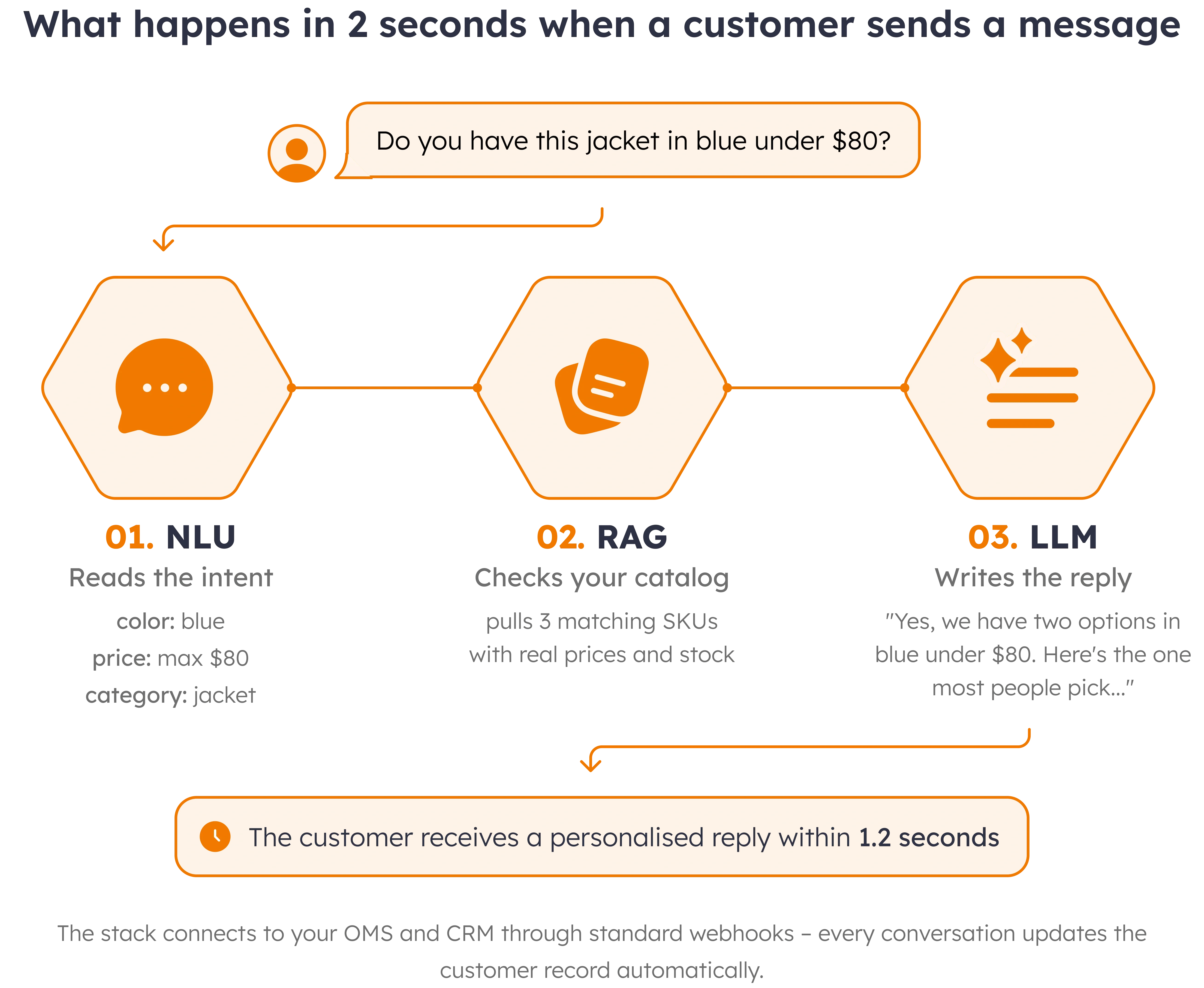
For RAG and LLM integration engineering, read more about our custom software development services. The next practical question is straightforward: how do you know whether it’s working, and what happens when compliance enters the picture? working, and what happens when compliance enters the picture?
Now ask yourself: what does "working" actually mean for conversational commerce? The AI stack is only as good as the numbers it produces. Here is how to measure it – and what gets in the way.
ROI, metrics and compliance for conversational commerce
To understand whether conversational commerce is delivering results, companies typically track three key metrics. The first is the conversation-to-purchase rate, which shows how many chat sessions result in a sale. The second is average order value (AOV) compared to non-chat sessions. And the last one is the support deflection rate, measuring how many customer questions the AI-powered ecommerce can handle without escalating them to a human agent. Cart recovery via WhatsApp or Messenger tracks separately – recovery rates of 15-30% are common, versus 2-5% for email. On the cost side, McKinsey’s contact center research puts the operational savings from AI-powered support at up to 30% (McKinsey & Company, 2023). The Gorgias report adds a detail worth noting: 60% of brands have already shifted to measuring success by AOV, not just customer satisfaction scores — which tells you where the industry thinks the real value is (Gorgias, 2026).
For B2B ecommerce, the pattern is different. The ecommerce CRM integration becomes a quote-to-cash flow inside a chat. Drift’s approach shows the model: a prospect lands on a pricing page, starts a chat, the AI checks intent, books a demo or builds a quote, and passes everything to a sales rep. The gap in conversion rate versus a plain contact form is consistent across setups.
Compliance is where teams get caught off guard. GDPR covers personal data in chat logs and purchase history. WhatsApp Business Policy has strict rules on message templates, opt-in consent, and how often you can send messages – break them and Meta can cut your API access fast. In the US, TCPA covers text channels; where WhatsApp fits is a legal question, not an engineering one. If payment data moves through the chat, PCI DSS applies.
CRM integration (HubSpot, Salesforce) closes the loop: every conversational commerce session creates or updates a contact record, saves the transcript, and starts downstream flows. A WhatsApp conversation that ends in a purchase should update lifetime value, start a post-purchase sequence, and feed the segmentation model. If it does not, you are running conversational commerce as a standalone channel – and leaving most of the value unused. How easily all of this connects depends heavily on your underlying architecture – if you are evaluating that decision in parallel, the composable commerce 2026 breakdown is worth reading alongside this one.
FAQ
What is conversational commerce in 2026?
What channels does conversational commerce include?
How does WhatsApp commerce work?
What is the difference between conversational commerce and agentic commerce?
Which AI stack powers conversational commerce in 2026?
What compliance requirements apply to conversational commerce?
Conclusion
Chat, voice, and messenger are where a real share of e‑commerce revenue is moving in 2026 – enough that how you build the stack matters from the start. WhatsApp handles mobile-first B2C in most global markets. Voice handles subscription reorders and grocery at scale. Messenger and Instagram DMs shorten the path from discovery to purchase for visual products. The AI layer – NLU for intent, LLM for conversation, RAG for catalog answers – is what makes conversational commerce work at volume without adding headcount in proportion.
Agentic commerce is the next step, but conversational commerce is where the integration work is happening right now. Teams that treat it as a channel add-on rather than part of the core architecture are the ones who have to rebuild later. If you are at the design stage, this is the moment to get the stack right.
If you are still figuring out which channel fits your market or how the AI stack should connect to your existing infrastructure, that is exactly the conversation our Modsen e‑commerce engineering team has every week. Or see how we have done it in practice in our e‑commerce portfolio.
References
1.
Mordor Intelligence. Conversational Commerce Market Report 2026–2031, February 2026.
2.
Messina, Chris. 2016 Will Be the Year of Conversational Commerce. medium.com/@chrismessina, 2016.
3.
Gartner. Predicts 2025: Customer Service and Support Technology, 2024.
4.
5.
Gorgias. The State of Conversational Commerce in 2026, February 2026.
6
easyappsecom. Shopify Voice Commerce Statistics 2026 – 25+ Data Points, March 2026.
7.
8.
McKinsey & Company. Unlocking the Next Frontier of Personalized Marketing, 2025.
9.
McKinsey & Company. The Next Frontier of Customer Engagement: AI-Enabled Customer Service, 2023.
Read more