Ecommerce trends 2026: Architecture, AI and customer experience
12 min read
Last updated: Jul 07, 2026
Summary
Ecommerce trends in 2026 are shaped by three changes: how online stores are built, how AI works inside them, and how customers buy. Retailers are moving from rigid all‑in‑one platforms to more flexible composable architecture. AI has moved from a bolt‑on feature to a core part of personalization, search, recommendations, and daily operations. Customers are also starting to buy through chat, voice, and AI agents, not only through product pages. As a custom ecommerce development company, Modsen helps product and engineering teams turn these changes into working e‑commerce systems.
Key takeaways
Architecture is moving from all‑in‑one platforms to composable systems made of separate, replaceable parts. This gives retailers more freedom to customize the storefront, launch updates faster, and sell across more channels.
AI‑powered ecommerce is no longer an optional add‑on. In 2026, personalization, smart search, and recommendation engines are becoming standard for competitive retailers.
Shopping is becoming more conversational. Buyers expect to complete purchases through chat, voice, and AI agents, not only through standard product pages.
B2B follows B2C ecommerce trends about 12‑18 months behind. Composable architecture is especially important here because wholesale buying often includes complex pricing, payments, approvals, and ERP integrations.
Agentic commerce is already alive in 2026, not just a future idea. Retailers need structured, machine‑readable product data so AI agents can find, understand, and buy from them.

Aleksandr Yakovets
Head of PMO at Modsen
What is driving ecommerce trends in 2026?
Ecommerce trends in 2026 are not short-term changes. They are driven by three bigger shifts that affect how online stores are built and how customers buy.
More sales channels. Retailers can no longer focus only on one website or app. Customers now come from mobile apps, social commerce, voice assistants, and AI agent interfaces. Some of these journeys may not include a standard product page at all. If an ecommerce platform is built for only one channel, it becomes harder to support these new buying paths.
AI is becoming a standard business tool. Over the past two years, AI tools have become easier and cheaper to add to ecommerce systems. Features such as product recommendations, smart search, and dynamic pricing used to require large machine learning teams. Now many of them are available through API services. The main question for retailers is no longer whether they can afford AI, but how quickly they can connect it to the rest of their platform.
Customers expect better digital experiences. Both consumers and B2B buyers now expect fast, simple, and personalized online journeys. Slow pages, generic offers, and complicated checkout can lead to lost sales. McKinsey research shows that companies strong in personalization grow revenue faster than their peers, with personalization often adding 10‑15% revenue uplift.
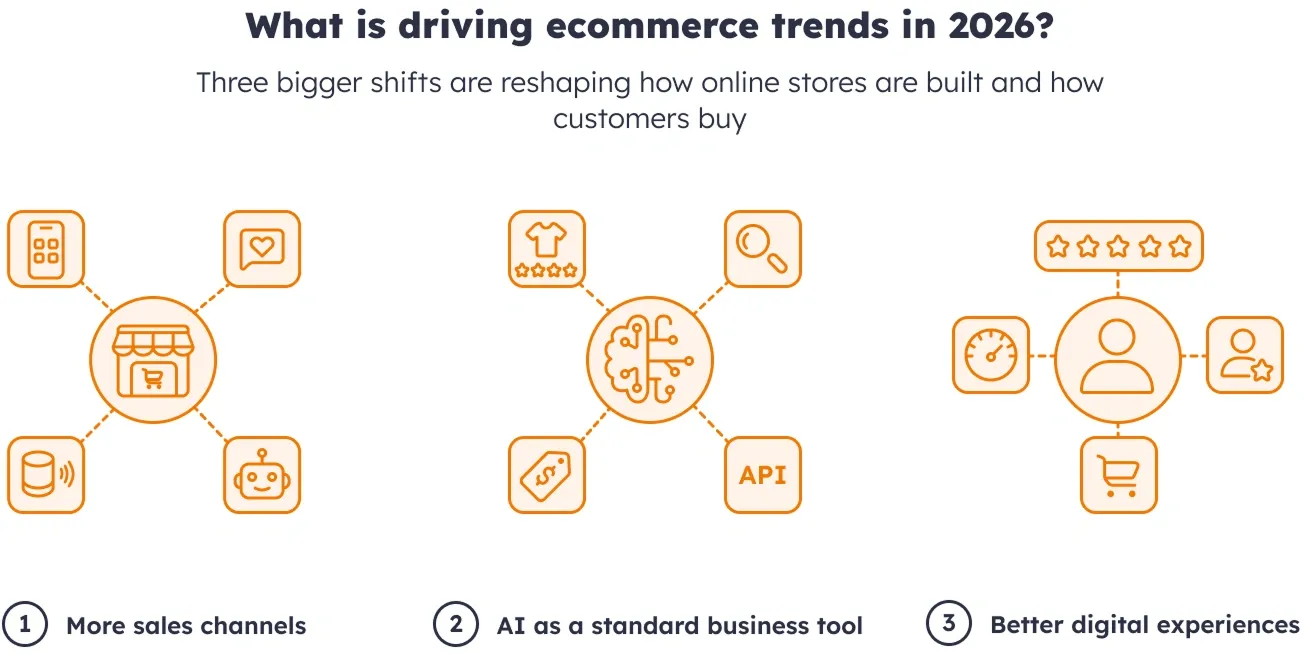
E-commerce in 2026 is moving from simple online stores toward connected, AI‑assisted, experience‑led commerce
These three forces are connected. Composable architecture helps retailers add AI faster. AI and flexible architecture together make better conversational customer experiences possible.
How trends in ecommerce differ from tactical marketing trends
Many articles about ecommerce trends focus on short-term marketing changes: new social platforms, creator commerce, or seasonal campaign ideas. These are useful for marketing teams, but they do not usually change how an ecommerce platform should be built.
The ecommerce trends covered here are different. They affect bigger decisions: which architecture to choose, which AI tools and APIs to connect, and how product, customer, and order data should be structured.
These choices matter for years. The right architecture gives the business room to grow and adapt. The wrong one creates limits that become harder to fix over time. A platform that worked well three years ago may now slow down AI adoption, new sales channels, and better customer experiences.
Architecture as a force: composable, headless and MACH in 2026
The first major force changing ecommerce in 2026 is architecture – the way the platform is built. Among the structural ecommerce trends covered in this article, the move from older all-in-one platforms to composable, modular systems has the longest implementation timeline and the biggest long-term impact. For mid-market and enterprise retailers, this is no longer an early-adopter idea – it is becoming part of mainstream platform planning.
Many ecommerce platforms still work as one large system. One vendor handles the catalog, checkout, search, content, loyalty, pricing, and other core functions together. This is the monolithic model.
Composable commerce works differently. Instead of relying on an all-in-one approach, the store is built from separate parts: search, checkout, payments, content, pricing, and more. Each part does one job and connects with the others. Because these parts are separate, a retailer can replace or upgrade one of them without rebuilding the whole store. For example, if the checkout is too slow, the team can improve or replace only the checkout layer while the rest of the platform keeps working.
This approach is often described as MACH – four design principles a platform should meet to be truly composable:
Microservices – each function, such as search, checkout, or payments, runs as a separate service instead of being locked inside one large system.
API‑first – services connect through standard APIs, so new tools can be added with less custom development.
Cloud‑native – the platform runs in the cloud and can scale as traffic, orders, and business needs change.
Headless ecommerce – the storefront customers see is separated from the commerce engine behind it. This allows teams to redesign the store visual layer without rebuilding the whole platform.
Industry data shows a 60% improvement in digital innovation speed for organizations that have moved to composable architecture, compared with 2022. The reason is simple: when the store is built from separate parts, teams can change one part without disrupting the rest. For retailers entering new markets or adding new sales channels, this can mean faster launches and lower costs when adding new technology.
For B2B ecommerce, composable architecture is especially useful because wholesale and manufacturing businesses usually have more complex buying processes. They may need different prices for different accounts, multi-step approvals, large buying teams, quote-to-cash workflows, and close integration with ERP systems such as SAP, Oracle, or Dynamics. These systems manage inventory, orders, finance, and other core operations.
A composable setup treats these needs as separate building blocks from the start. This is usually more flexible than adding them later to a platform designed for simpler, single-buyer online shopping.
Migration usually takes 9 to 18 months, depending on catalog complexity and existing integrations. For teams planning this type of transition, our custom software development services page explains how Modsen approaches the scoping and delivery of large‑scale platform migrations.
Composable vs monolithic platforms: when to migrate
The comparison that comes up most often is between all-in-one SaaS platforms – Shopify, BigCommerce, Salesforce Commerce Cloud – and API-first composable stacks like commercetools or Saleor.
The trade-off is simple: ease of use versus flexibility. All-in-one platforms are easier to manage because the business works with one system, one vendor, and a clear product roadmap. Composable platforms require more engineering work, but they give the team more control over each part of the ecommerce system.
Migration usually makes sense when the business is already large enough to justify the cost. A common benchmark is $50M+ in annual GMV – the total value of sales processed through the platform. It can also make sense if the catalog is complex, or if the company plans to expand across several sales channels soon. For smaller businesses, the added complexity may not be worth it. Managing several vendors can cost more than the flexibility brings back.
For a deeper look at architecture options, vendor choices, and migration timelines, see our composable architecture patterns and vendor comparison.
Evaluating a platform migration?
The decisions made at the scoping stage shape the cost, timeline, and flexibility of the new stack. Modsen helps teams plan the migration and move through execution with a clear roadmap.
Headless ecommerce: why front-end independence matters
Headless ecommerce means separating the storefront that customers see and interact with from the system that runs the store in the background. A customer may shop through a website, mobile app, or self-service screen in a physical store. Each channel can have its own design and interface, while using the same product data, prices, cart, and order system.
For retailers, this gives more flexibility. The team can redesign the website, improve the mobile app, or launch a new shopping channel without rebuilding the core commerce logic. The storefront and the underneath system can be changed independently.
The main business benefit is performance. Headless storefronts often make it easier to improve how fast pages load, how quickly they respond, and how stable they remain while loading. Audit data from 2024‑2026 headless migrations shows pass rates for these Google page experience checks 20–37% higher than equivalent all‑in‑one setups. This matters because Google uses these signals when evaluating pages for search. Better results can support stronger organic visibility, smoother mobile journeys, and fewer drop‑offs before checkout.
Speed also has a direct impact on sales. A one-second improvement in how quickly the main content appears is linked to a 2% lift in conversion. The effect is usually strongest on mobile, where heavy all-in-one storefronts can slow the buying journey down.
There is one important SEO risk. If a headless storefront builds pages only in the browser, Google may not read the content properly, which can hurt rankings. For retailers that depend on organic traffic, server-side rendering is not optional. It should be part of the architecture from the start.
AI as a force: from add-on feature to default layer
The second force is AI becoming a core part of the ecommerce platform. It is no longer limited to standalone tools such as recommendation widgets, chatbots, or separate pricing systems. When AI is built into the platform, it helps shape search results, personalize product pages, and prioritize back-office work.
AI ecommerce adoption numbers show this shift. Salesforce reports that 84% of retailers believe AI gives them a competitive edge. For most mid‑market and enterprise teams, the question is no longer whether to use AI. It is where AI should create value first, and how to connect it to the catalog, customer, and order data the business already has.
The main areas where AI now works as part of ecommerce infrastructure are personalization, search by meaning and image, recommendation engines, and ecommerce automation in back-office processes. That last area is easy to underestimate. AI can help reorder stock, forecast demand, trigger supplier messages, and flag possible fraud. This reduces manual work and helps teams catch patterns that would be difficult to track by hand.
The success of AI powered ecommerce depends heavily on data quality and freshness. A system trained only on past purchases may miss what a shopper wants today. Real-time behavior – what the customer searches for, clicks, compares, or adds to cart – helps AI understand current intent and adjust the experience in the moment. This is what makes search results, recommendations, and product pages more relevant during the same shopping session.
AI personalization and recommendation engines
AI personalization in ecommerce is no longer limited to basic “customers also bought” suggestions. There is a big difference between an ecommerce recommendation engine that relies only on past purchases and one that also reacts to the current session. Purchase history can be useful, but it does not always show what the customer wants today. Live behavior gives AI a clearer view of current intent, so recommendations can change in real time.
In large catalogs, AI can also help personalize product content. For example, it can highlight different product details depending on who is reading the page and what they seem to be looking for.
Visual search adds another layer of personalization. Instead of typing a query, a customer can upload a product photo or screenshot, and the system matches it with similar items in the catalog. This is already available as a ready-made service and is becoming common for mid-sized and large online stores.
For production AI‑driven ecommerce implementations and case examples, see Modsen ecommerce portfolio.
Customer experience as a force: conversational and agentic commerce
The third force is the way customers interact with online stores. Buying is moving beyond traditional product pages into chat, voice, and AI agents that can help complete a purchase for the customer.
Conversational commerce means that the buying happens through a dialogue instead of standard browsing. A customer may place an order through WhatsApp, buy by voice through a smart speaker, or complete checkout through an AI chat on a brand’s website. Global spend through these channels reached $11.4 billion in 2023 and is forecast to reach $43 billion by 2028, as AI becomes more common in messaging and voice apps.
For merchants, this requires more than adding a chatbot. The catalog has to work with natural‑language questions, not only category filters. Payments need to work inside the conversation. The AI also needs accurate product data, pricing, availability, and delivery information. Without that data, it can give wrong answers or fail to complete the purchase. For channel‑by‑channel mechanics, see how chat, voice and messenger drive online sales.
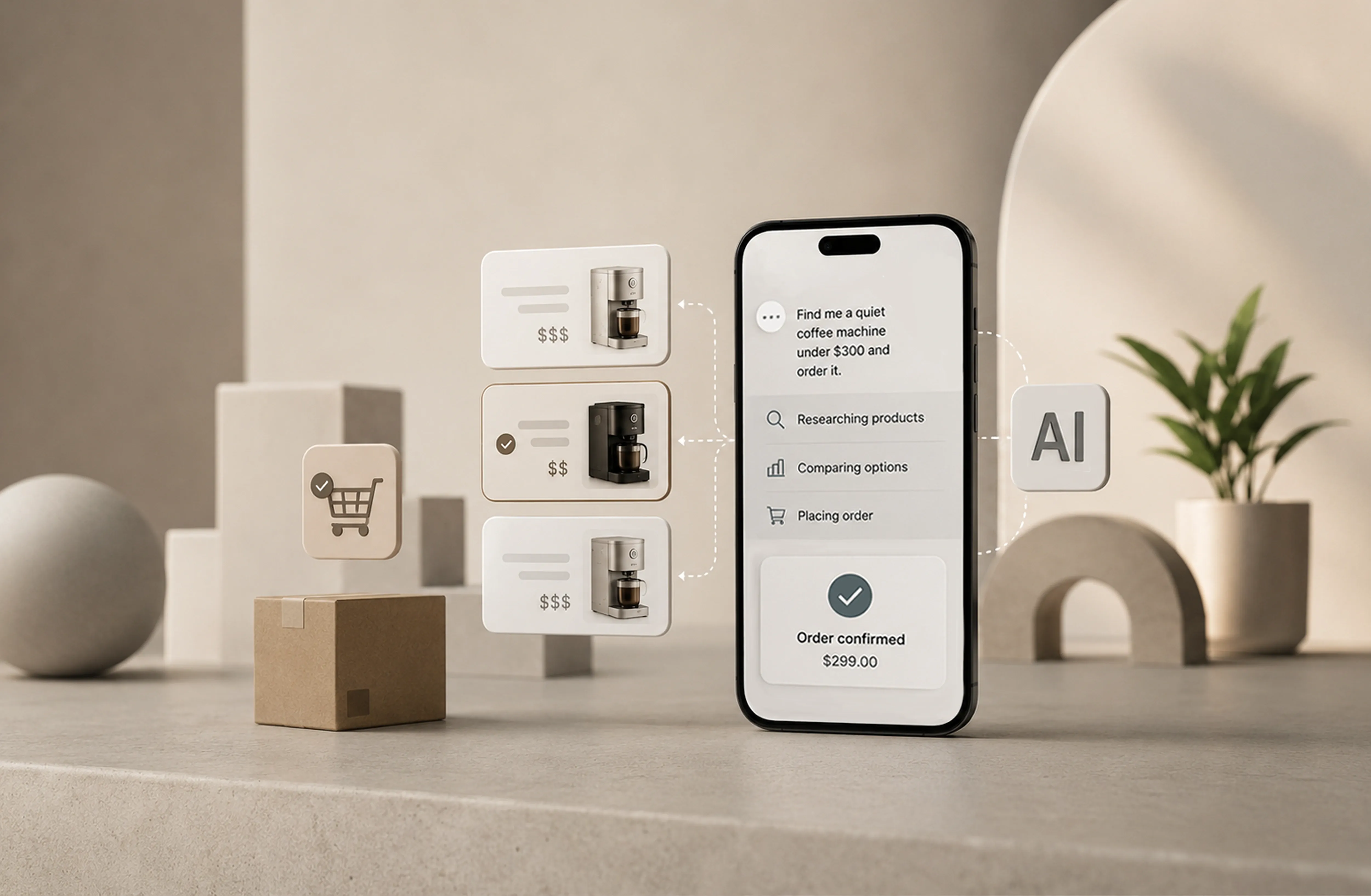
The agentic model goes one step further. In conversational commerce, the customer still makes the main decisions through a chat, voice, or messenger interface. In agentic commerce, an AI agent can handle more of the shopping process on the customer’s behalf. It can research products, compare options, check reviews, and, in some live implementations, complete checkout with limited human input.
This is no longer only a future scenario. In 2025 and 2026, major platforms started adding agentic checkout and in-platform purchasing features. ChatGPT launched Instant Checkout in September 2025, enabling purchases from partners including Walmart, Etsy, and Sephora. Microsoft Copilot Checkout went live in January 2026. Perplexity offers in-platform purchasing through PayPal integration. Google rolled out AI Mode shopping with agentic checkout capabilities in early 2026.
The key requirement is structured product data. AI agents do not respond to hero banners, popups, or visual merchandising. They read product information, schema markup, pricing, availability, reviews, and other validation signals. If this data is missing, unclear, or hard for machines to read, the retailer may be harder for AI agents to find, recommend, or buy from.
B2B trends in ecommerce 2026: how wholesale catches up with B2C
B2B usually follows B2C ecommerce trends with a 12‑18‑month delay. That gap is getting smaller as buyers bring the same expectations they have as consumers into business purchasing. Gartner research finds that 75% of B2B buyers prefer to buy without involving a sales rep.
For B2B ecommerce, this creates a specific architecture challenge: buyers expect the speed and convenience of B2C shopping, while B2B transactions still involve much more complex workflows than a typical consumer purchase. This is where all-in-one platforms can become limiting. Many of them are built for simpler B2C purchases: one buyer, one visible catalog, and one checkout. B2B commerce often needs the opposite: account-specific terms, controlled catalog access, approval workflows, quote-to-payment logic, and direct ERP integration. When these requirements are added as custom workarounds, the platform becomes harder to change and maintain over time.
Composable architecture fits B2B better because these workflows can be built as separate services from the start. Pricing, approvals, catalog access, payments, and ERP integration can each be handled as their own part of the system.
On the experience side, conversational and agentic buying is moving more slowly in B2B than in B2C. Procurement rules, compliance checks, approvals, and multiple stakeholders make B2B purchasing more complex. But the direction is the same. Expect wholesale businesses are likely to take conversational and agentic buying more seriously around 2027‑2028.
What comes next: agentic layer and the machine-readable web
Looking past mid‑2026, the next major shift is AI agents acting as buyers. They will not just help people shop. They will be able to research products, compare options, check reviews, and complete purchases on a customer’s behalf. McKinsey projects AI powered ecommerce could reach $1 trillion in US retail revenue by 2030 and $3‑5 trillion globally.
For now, getting ready isn’t about building a new AI agent but making the existing store readable for agents. This means schema markup, product feeds, current pricing, API‑accessible catalogs, and pages that render on the server so they can be crawled. In simple terms, agents need to understand what the product is, how much it costs, whether it is available, how it is rated, and how to buy it. Our detailed breakdown of how AI agents will reshape online shopping explains this in more detail.
Merchants without this foundation risk losing more than agent‑driven traffic. They may become invisible in a new discovery layer where AI systems decide which products to show, compare, and buy. ChatGPT accounted for more than 20% of referral traffic to Walmart and Etsy storefronts by mid‑2025. Amazon, which blocked AI agent crawlers, received less than 3% from the same channel. This shows the trade‑off for retailers: protect existing traffic and ad models or make the catalog accessible for agent‑era discovery.
Is your catalog readable by AI agents?
Modsen can review your catalog structure to identify what may prevent AI agents from finding your products, understanding them, or completing a transaction.
FAQ
What are the top ecommerce trends in 2026?
What is composable commerce and why is it growing in 2026?
How does AI change ecommerce in 2026?
What is the difference between conversational and agentic commerce?
Will B2B follow the same 2026 ecommerce trends as B2C?
How should merchants prepare their site for AI agents and machine‑readable commerce?
Conclusion
The three forces shaping ecommerce trends in 2026 are connected. Composable architecture makes it easier to add AI across the platform. AI ecommerce personalization depends on clean catalog, customer, and order data. That same data also helps conversational and agentic channels find, understand, and sell products.
For B2C and B2B teams, the roadmap should start with architecture. Architecture defines how easily the business can connect AI tools, structure product data, and support new buying channels. These ecommerce trends may look like separate workstreams, but they often depend on the same foundation: clean APIs, structured product data, and flexible platform components.
Companies that combine composable commerce with AI readiness and agent-ready catalog infrastructure will be better positioned through 2026 and the next stage of ecommerce.
Getting there usually requires a sequence of decisions, not one large initiative. The Modsen ecommerce engineering team works with companies across architecture, AI integration, and catalog infrastructure. Contact us to start with an assessment of your current setup.
References
1.
WP Engine. (2023). The State of Headless: Global Research Report. WP Engine Resources.
2.
3.
Gartner. (2023). Composable Commerce: Gartner Thought Leadership. Commercetools Resources.
4.
Salesforce. (2024). State of Commerce. Salesforce Research Reports.
5.
6.
Gartner. (2022). The B2B Buying Journey. Gartner Sales Insights.
7.
McKinsey & Company. (2013). How Retailers Can Keep Up With Consumers. McKinsey Industries / Retail.
8.
9.
10.
Read more





Get a weekly dose of first-hand tech insights delivered directly to your inbox