Generative AI in banking: LLM and RAG use cases and development guide
8 min read
Last updated: Jul 08, 2026
Summary
Bank of America's virtual assistant Erica passed 3 billion client interactions in 2025. That number is the clearest signal: generative AI in banking has moved from pilot projects to infrastructure that millions of customers touch daily.
This guide covers what generative AI in banking actually means, six LLM use cases that are in production today, the RAG architecture that makes them safe for regulated environments, how to integrate them into existing systems, and what the whole thing costs.
Key takeaways
Generative AI in banking is AI that reads and writes language (answers questions, summarizes documents, drafts reports).
Six LLM use cases deliver measurable ROI today: customer service copilots, KYC document processing, marketing personalization, internal knowledge search, compliance copilots, and data analyst assistants.
RAG (Retrieval-Augmented Generation) is the architecture that makes LLM output safe for regulated finance. It grounds answers in the bank's real documents and produces an audit trail.
Most deployments are built in two stages: a low-risk internal pilot first, then a customer-facing production rollout.
Risk controls – model governance, red-teaming, prompt injection defense, PII scrubbing, and EU AI Act compliance.

Dmitry Grishanovich
Head of .NET Department at Modsen
What is generative AI in banking?
Generative AI refers to models that produce new content – text, summaries, code, structured data – rather than just classifying or predicting from existing data.


Generative AI in banking means a system that can read a customer's question and write an answer, summarize a 40-page loan application into three bullet points, or draft a compliance report from raw transaction logs.
The foundation is NLP in finance – natural language processing, the field that taught computers to parse human language. Earlier banking systems used rule-based NLP: keyword matching, decision trees, rigid intent classification. The shift came in late 2022, when large language models (LLMs) made it possible for software to handle language it was never explicitly programmed for – understanding context, handling ambiguity, and generating coherent responses.
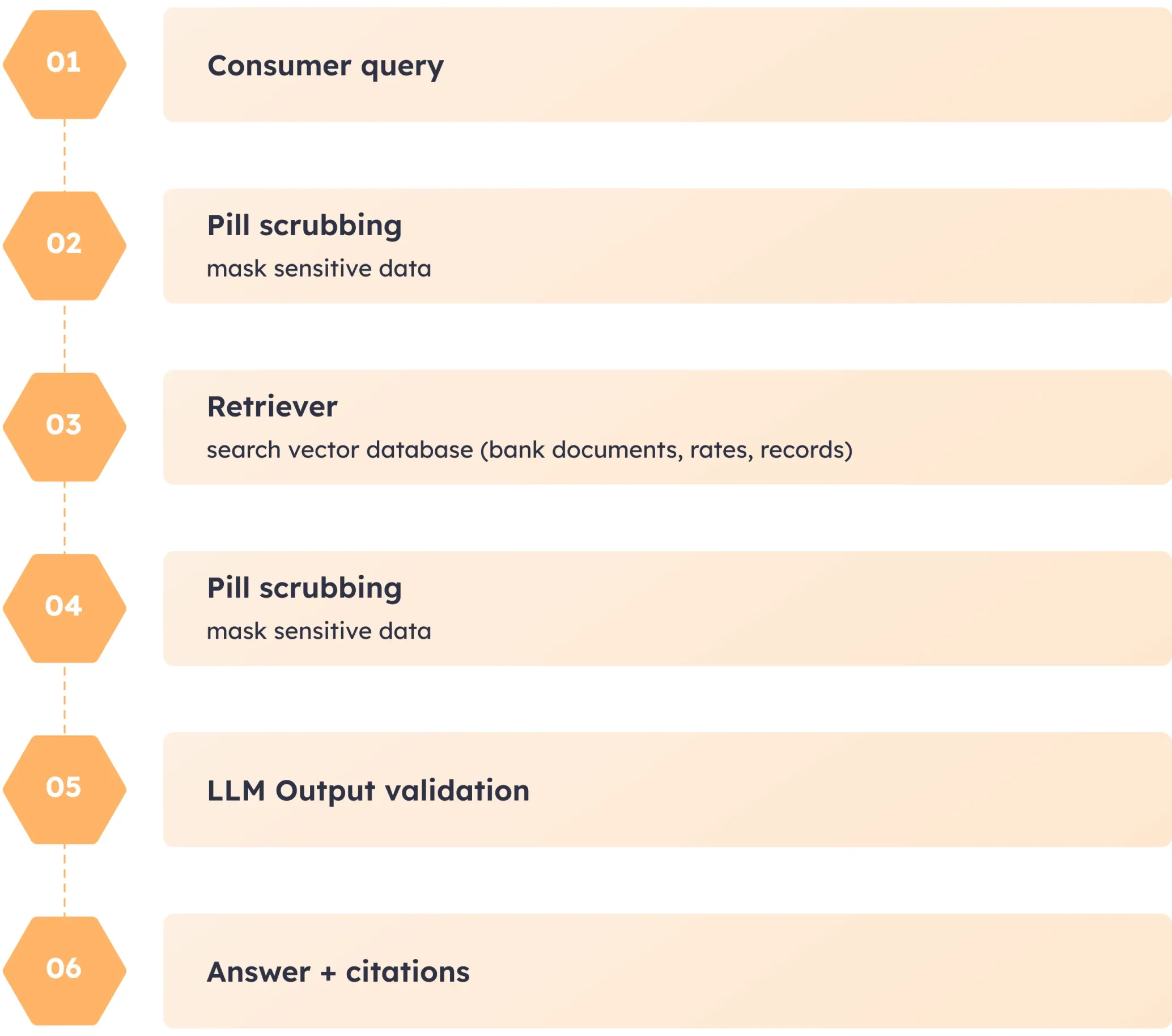
Generative AI processes a request in banking
What makes generative AI in banking different from other industries is the constraints. Banks operate on regulated data. Every AI output that touches a customer decision needs an audit trail. Explainability isn't a nice-to-have – regulators require it. And personally identifiable information (PII) has to be protected at every step, which rules out naively sending customer data to a third-party model.
For the broader context on how these systems fit into the wider sector, see our AI in financial services hub.
Conversational AI in banking and AI customer service
The most visible application of generative AI in banking is customer service. Conversational banking handles Tier-1 support – the high-volume, repetitive requests that make up the bulk of a bank's contact center load: account balance inquiries, transaction lookups, card activation, password resets, branch hours.
The business case is straightforward. A well-built conversational AI in banking deployment can deflect 40–60% of tier-1 tickets before they reach a human agent. At Bank of America, Erica now handles around two million consumer interactions a day – which the bank estimates saves the equivalent of 11,000 staffers' daily work.
The value isn't only cost. Response time drops from minutes (waiting in a queue) to seconds. The service runs 24/7. And a single system can handle dozens of languages without staffing a multilingual support team.
AI chatbots for banking vs conversational AI: what's the difference
The terms get used interchangeably, but they describe different technology.
A traditional AI chatbot for banking follows a script. It can answer only the questions it was explicitly programmed to handle, using decision trees and keyword matching. Ask it something slightly outside its script and it fails – or routes you to a human. | Conversational AI is LLM-powered. It's context-aware, handles multi-turn dialogue (remembering what you said three messages ago), and can answer questions it was never directly trained on by reasoning over the information it has access to. |
So how does generative AI in banking improve customer experience? The difference shows up exactly here: a customer can phrase a question naturally, change the subject mid-conversation, and still get a coherent, relevant answer as with human agent.
6 LLM use cases for banks and neobanks
Most of the value in generative AI in banking comes from a handful of well-defined applications. In the Modsen team's experience, these are the six LLM use cases in banking that deliver measurable results in production.
1. Customer service copilot – sits beside a live human agent, surfacing relevant policy documents and account context in real time during a call. The agent stays in control; the model handles the lookup.
2. Document processing and KYC summarization – document processing automation in banking is one of the highest-ROI applications. The model extracts structured data from unstructured documents (passports, utility bills, financial statements) and summarizes them for KYC and onboarding review, cutting manual data entry dramatically.
3. Marketing personalization – generates personalized product recommendations based on transaction history, tailoring offers to individual spending patterns rather than broad segments.
4. Internal knowledge search – lets employees query internal policy documents, regulatory updates, and product manuals in natural language instead of digging through a wiki. Bank of America's AskGPS does exactly this for its payments staff.
5. Compliance copilot – flags potential policy violations in real time and generates audit-ready summaries, giving compliance teams a first-pass review at scale.
6. Data analyst assistant – helps the bank's internal analysts and engineering teams query data in plain language, build reports, and debug data pipelines.
The same grounding techniques that make these safe also power adjacent systems like real-time fraud monitoring – see our breakdown of AI fraud detection architecture for how that connects.
RAG architecture for financial services: patterns and pitfalls
An LLM on its own answers from memory. These patterns it absorbed during training. In banking, the model might confidently state an outdated interest rate or invent a policy that doesn't exist. RAG (Retrieval-Augmented Generation) fixes this.
RAG in financial services works in two steps. First, the system retrieves relevant documents from a vector database – the bank's actual policies, current rates, real customer records. Then the LLM generates an answer grounded in those retrieved documents. The output can cite its sources, which is what makes it auditable and compliant.
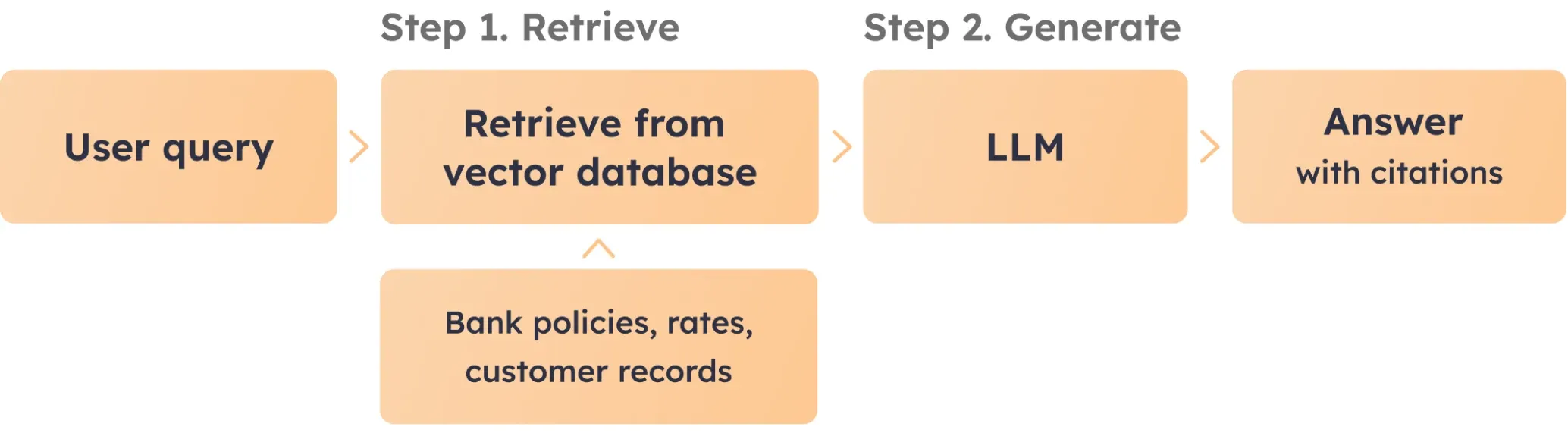
How RAG works in financial services
A reference architecture looks like this:
Vector database – Pinecone or Weaviate, storing document embeddings
LLM – Claude (Anthropic) or GPT-4 (OpenAI), generating the response
Reranker – Cohere or a cross-encoder, sorting retrieved results by relevance
Orchestration – LangChain or LlamaIndex, wiring the pieces together
The data flow is linear: a user query goes to the retriever, which pulls candidate documents from the vector database; the reranker sorts them; the LLM reads the top results and generates a response with citations.
The pitfalls are real and worth budgeting for:
Stale data in the vector index – if the index isn't refreshed, the model cites outdated information.
Prompt injection – malicious input crafted to override the system's instructions.
Hallucinations when retrieved context is ambiguous or contradictory.
PII leakage through embeddings, if customer data isn't scrubbed before indexing.
Standard RAG vs hybrid search vs agentic RAG
Not every RAG in financial services deployment needs the same pattern. There are three, and the right choice depends on query complexity.
Standard RAG
How it works
Single retrieval step, then the LLM generates an answer
Best for
FAQ bots, policy search
Hybrid search
How it works
Combines vector search with keyword search
Best for
Mixed structured and unstructured data
Agentic RAG
How it works
The LLM decides when and what to retrieve, and can take multi-step actions
Best for
Complex compliance queries, multi-document synthesis
Integration with core banking systems and mobile apps
A generative AI in banking layer rarely replaces the bank's core systems – it sits on top of them and connects through standard interfaces.
In practice, the AI layer “talks” to the core banking system through an API (a standard way for two pieces of software to exchange data) with a secure login step (OAuth2) controlling who gets access to what. The hardest requirement is speed. For customer-facing conversational banking, the whole round trip needs to happen in under 800 milliseconds, or the chat starts to feel sluggish. Teams hit that target by caching common answers, streaming the reply word by word as it's generated, and keeping the document lookup fast.
Adding generative AI in banking to an existing mobile app doesn't mean rebuilding the app. The AI is exposed as a single endpoint that the app calls; the answer streams straight into the chat screen, and the underlying banking system is never touched. For the broader architecture this plugs into, see our fintech app development guide.
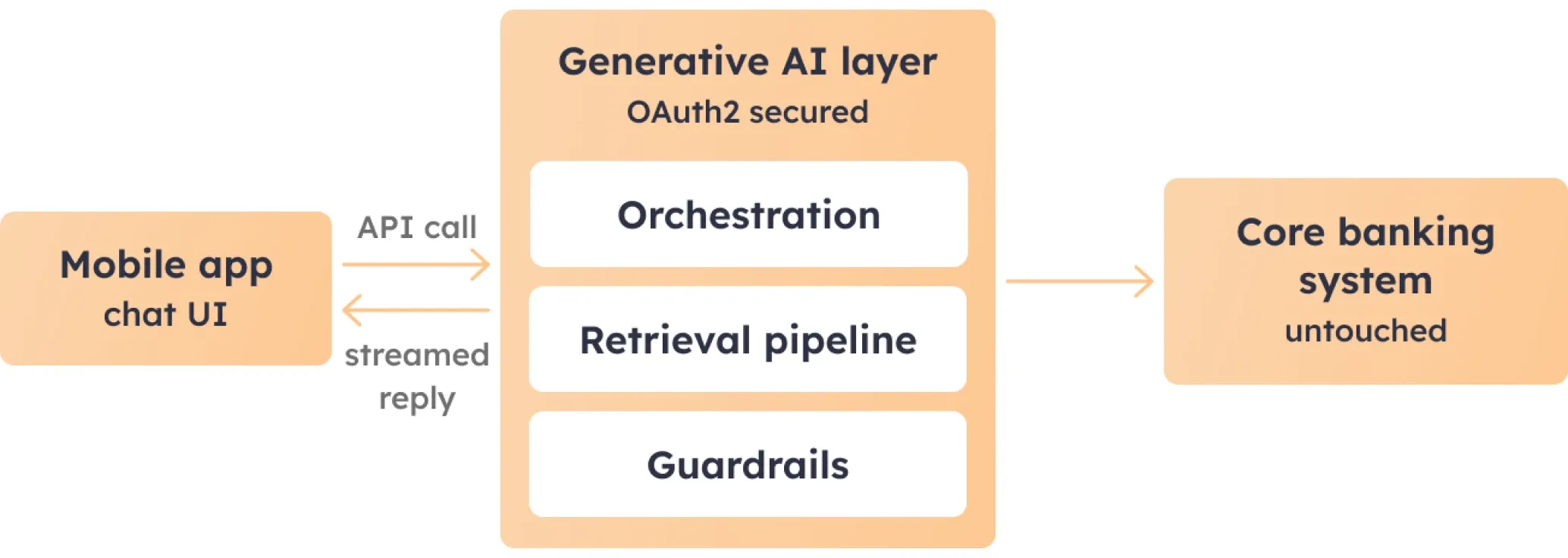
Generative AI integration architecture
The development itself is specialized work that few in-house teams have done before. Many banks bring in custom LLM application development services to stand up the first production system, then take over day-to-day maintenance once it's running.
Build phases, costs and risk controls
Most generative AI in banking projects are built in two stages.
Stage 1 – Pilot. You pick one simple, low-risk task – usually something internal, like letting staff search company documents in plain language. The goal is to prove the technology works and measure the result before spending big.
Stage 2 – Production. Once the pilot proves its value, you scale it up to real customers. This is where the work gets more serious (and more expensive) because anything customer-facing in a bank has to be safe, accurate, and approved by regulators. To see the engineering behind these systems, explore our fintech portfolio.
Before a bank can put AI in front of customers, it needs a set of safety checks:
Model governance – keeping track of every version of the AI, so you can roll back if something goes wrong.
Red-teaming – deliberately trying to break the system before launch, to find weak spots first.
Prompt injection defense – stopping bad actors from tricking the AI with malicious inputs.
PII scrubbing – removing customers' personal data before it ever reaches the AI.
EU AI Act compliance – most customer-facing banking AI is legally "high-risk" and needs a formal review.
Want to know what this would cost for your bank?
Tell us your use case and the Modsen team will scope the build and send a budget estimate within 48 hours.
FAQ
How does AI help banks improve customer experience?
What are the top LLM use cases in banking in 2026?
How does generative AI improve customer experience in banking?
What is RAG and why is it critical in financial services?
What to do with generative AI in banking
Generative AI in banking is past the proof-of-concept stage. The question for most banks is no longer whether to deploy but how to do it without taking on regulatory and operational risk. The answer, in nearly every case, is RAG: grounding model output in real documents is what makes the technology auditable, explainable, and safe for regulated data.
The foundation built on NLP in finance is mature, the architecture patterns are well understood, and the cost ranges are knowable. If you're scoping a deployment, the Modsen fintech team works with banks and neobanks on production LLM and RAG systems.





Get a weekly dose of first-hand tech insights delivered directly to your inbox