
MVP development guide: from idea to launch – costs, process, timeline
10 min read
Last updated: Apr 24, 2026
Summary
90% of startups don’t fail due to bad ideas. They fail because they build the wrong product or take too long to build it (Startup Genome, Marmer et al.; CB Insights, 2026). MVP development is the fastest and safest way to test assumptions before those mistakes become expensive.
This guide covers the practical side of MVP – timelines, costs, process, and the decisions to help you stay in control of scope, budget, and outcome – the core purpose of minimum viable product.
Key takeaways
MVP development helps you test core assumptions early – before time and budget are locked into the wrong direction.
Most failures come from poor feature prioritization, not engineering quality.
Production-oriented MVPs typically take 2-6 months, depending on complexity and scope, while early validation can happen much faster.
MVP development cost often falls in the range of $15K-$100K+ for production-ready products, but the actual cost depends on features, integrations, team setup, and development approach.
Product-market fit comes after launch – an MVP only provides the first reliable signal.
The right development partner helps keep scope focused, align decisions with budget constraints, and avoid building more than the product actually needs.

Eugene Kalugin
CTO at Modsen
What an MVP is and why it matters for startups
For startups, an MVP (Minimum Viable Product) is a risk management tool. It gives you data, not assumptions. You validate demand, observe user behavior, and understand whether your core idea holds before scaling the product or the team.
In practice, even the definition of MVP is not always interpreted the same way. I’ve seen teams refer to it both as minimum viable product and minimum valuable product – depending on whether the focus is on speed of validation or delivering immediate user value.
This reflects a broader reality: an MVP is not a fixed format. In some cases, it can be a lightweight version built quickly to test a single assumption. In others, it is a production-oriented solution designed for real users, stable performance, and further growth.
The difference is defined by the goal: rapid validation or building a foundation for scaling. If you're unsure how to approach custom development for a startup, it's important to align your tech decisions with business goals early on.
In 2026, this matters even more. As Deloitte points out, users now expect AI to be an intuitive guide, not just a tool. Markets are moving faster, competition is higher, and tolerance for poorly executed products is lower. As a result, MVP development is no longer just about launching something minimal – it is about choosing the right level of quality, speed, and scope for a specific stage.
But to avoid confusion in execution, it’s important to clearly distinguish MVP from other early-stage artifacts.
MVP vs prototype vs proof of concept: key differences
I bet you've struggled with these terms at least once, too. Let’s figure them out for good, because in practice, they solve different problems.
Prototype – a visual or interactive model used to demonstrate how the product will work. No real functionality behind it. Useful for early validation and stakeholder alignment.
Proof of Concept – a technical validation. It answers one question: can this idea be built with the chosen technology? No focus on users or UX.
MVP – a working product with real users. It solves a core problem and collects actual usage data.
The key difference is in the outcome:
Prototype → feedback on concept
PoC → validation of feasibility
MVP → validation of demand
Prototype
Main goal
Visualize the concept
Functionality
Low/None (Mockup, clickable wireframe)
Audience
Stakeholders / Design team
Key question
"What will it look like/feel like?"
Core outcome
Concept feedback
Proof of Concept
Main goal
Validate technical feasibility
Functionality
Core logic only (Backend, no UI)
Audience
Engineers / Technical leads
Key question
"Can we build this with this tech?"
Core outcome
Technical validation
MVP
Main goal
Validate market demand
Functionality
Working core feature(s) (Real users, real data)
Audience
Early adopters / Real users
Key question
"Will anyone actually use this?"
Core outcome
Usage data / Demand
Understanding the distinction between MVP vs prototype vs proof of concept is critical before moving into the MVP development approach itself.
Lean startup approach to building an MVP
The way most effective MVPs are built follows a simple cycle: build → measure → learn (The Lean Startup, Eric Ries). Which in practice means:
You don’t try to get everything right from the start
You release early versions with limited functionality
You rely on user behavior, not opinions
The approach comes from the lean startup methodology, which focuses on reducing uncertainty through rapid, data-driven iterations rather than long development cycles.
One important detail many teams miss: speed alone does not help if you validate the wrong thing. For example, launching fast with a poorly defined value proposition gives you noise instead of insights. You may get traffic, but no clear signal on whether the product solves a real problem.
A good MVP isolates one core hypothesis:
a target user
a specific problem
a single value proposition
Everything else is secondary – and this is where most teams fail. They build a “small version of the full product” instead of a focused validation tool. The result is higher cost, longer timelines, and unclear feedback.
Well, at this point, the concept of an MVP should be clear. The next step is to look at how it is actually built.
Step-by-step MVP development process
MVP development is a structured process that reduces uncertainty step by step. Each phase has a specific goal: remove assumptions, narrow scope, and move closer to a product that users actually need.
Skipping or compressing these steps usually leads to wasted budget, unclear requirements, and rework later.
The 4 pillars of MVP success

The MVP development process is not a linear sprint to the finish line, but a strategic cycle of reducing risk.
Phase 1: Idea validation and market research
This stage is closely related to what happens during the discovery phase, where initial assumptions are tested before development begins. Your goal here is to answer one simple question: does this problem actually exist, and does it matter enough for users to care? This is the first step toward achieving product-market fit:
Who the target user is
What problem they have
How they currently solve it
Why existing solutions are not enough
Typical mistake: teams start building based on internal belief instead of external validation.
In practice, the phase includes:
Competitor and market analysis
Customer interviews or surveys
Basic demand validation (landing pages, waitlists, early outreach)
You don’t need perfect data. You need enough signal to justify moving forward. If there is no clear problem or urgency, MVP development should not start.
Phase 2: Feature prioritization and scoping
Once the problem is validated, the next step is defining what to build – and more importantly, what not to build. Focus the MVP scope on a single, high-impact use case. Here is how it works in practice:
Identify the main user journey
Define the minimum set of features required to support it
Remove everything that does not directly contribute to that flow
A useful rule: if removing a feature does not break the core value, it should not be in the MVP. Typical mistake – trying to include “future features” early, which increases cost and delays launch without improving validation.
The MVP feature prioritization phase directly impacts both timeline and budget. Over-scoping at this stage is the most common reason digital products fail before they even launch.
Phase 3: Design, build, and iterate
This is where the MVP takes shape as a real product. The priority shifts from ideation to high-speed, controlled execution. The key principles of how to build MVP are:
Simple, functional UX over polished design
Fast development cycles with regular check-ups
Early testing instead of post-release fixes
In practice:
UI/UX design aligned with the core flow
Backend and frontend development
Continuous QA and internal testing
One vital detail: iteration (the cycle of testing and refining) starts now, not after the launch. Teams that delay feedback until release usually face expensive rework. Teams that test early adjust faster and spend less.
Phase 4: Launch, test, and measure
Just when it feels like the dust is settling – it isn't. Launch is not the end of MVP development. It is the point where real validation begins. At this stage, teams rely on MVP validation techniques based on real user behavior, not assumptions.
So, what to track:
User activation (do users reach the core value?)
Retention (do they come back?)
Conversion (are they willing to pay or commit?)
Typical mistake: focusing on vanity metrics (traffic, downloads) instead of actual usage.
After launch, there are only three realistic paths:
Continue with the current direction
Iterate based on feedback
Pivot if the core hypothesis is not confirmed
Now you have the data to determine whether the MVP evolves into a full-scale product or remains a valuable experiment.
How much does MVP development cost in 2026
Now for the part everyone’s thinking about – cost. There is no standard price for MVP development. In some cases, a basic MVP can be built in days using no-code tools or internal resources. In others, even an early version requires weeks of engineering work, integrations, and custom architecture. The difference comes down to one thing: what exactly needs to be validated.
If you're planning your software budget for 2026, it's important to understand how scope, team setup, and technical decisions directly affect total cost. Two MVPs that look similar on the surface can have completely different costs depending on backend logic, data processing, and integrations. Because of this, any numbers should be treated as reference ranges, not fixed estimates.
From a practical standpoint, MVP development cost in 2026 often falls between $15,000 and $100,000+ – but the actual cost is defined by the decisions made at the scoping stage.
Cost breakdown by MVP type and complexity
A simplest way to estimate MVP development cost is to map it to product complexity. At the same time, cost varies widely depending on how the MVP is approached. Early validation can be done with simplified tools and minimal investment, while production-ready products require a different level of effort and engineering.
The ranges below reflect production-oriented MVPs and should be treated as market benchmarks, not fixed pricing.
Experimental MVP
Typical scope
No-code tools, internal resources, quick validation
Market reference range
Minimal / variable
Simple MVP
Typical scope
Single core feature, basic UI, no complex backend
Market reference range
$15,000 – $40,000
Medium MVP
Typical scope
Multiple user flows, integrations, admin panel
Market reference range
$40,000 – $100,000
Complex MVP
Typical scope
Complex logic, custom, high-load architecture
Market reference range
$100,000+
Experimental MVPs operate outside standard cost models and are used for quick validation rather than long-term use. The listed ranges apply to MVPs intended for real users, stable performance, and further scaling.
Complexity is not defined by the number of screens. It is driven by backend logic, integrations, and data processing. Two products with similar UI can differ in cost by 2-3x depending on what happens under the hood.
Factors that drive MVP development costs
Several variables have the biggest impact on MVP development cost:
1. Scope and feature set
The more features included, the higher the cost. The biggest cost driver is not development itself, but incorrect prioritization.
2. Team structure and region
US / Western Europe – leading the globe in the cost of MVP for startups
Eastern Europe – balanced cost-to-quality ratio
Asia – lower cost, but often higher management overhead
Choosing a cheaper team can reduce upfront cost but increase coordination time and risk.
3. Technology stack
Some technologies allow faster MVP development (e.g., ready-made frameworks), while others require custom engineering.
Trade-off: faster stack → lower initial cost, but possible limitations later.
4. Design complexity
Simple, functional design is faster and cheaper. Custom UI/UX with animations and detailed interactions increases both time and cost.
5. Integrations and third-party services
Payments, APIs, external systems – each integration adds complexity, testing, and potential failure points.
From a strategic standpoint, MVP development cost is a result of trade-offs:
Faster delivery → higher cost
Lower cost → narrower scope
More features → longer timeline
The rational approach is not to avoid these trade-offs, but to manage them consciously.
Need an accurate MVP cost estimate?
Leave your email, and we’ll calculate a realistic MVP cost range based on your product, scope, and requirements.
Realistic MVP development timeline
The time required to build an MVP depends on product complexity, scope, and team setup. In most cases, it ranges from a few weeks to several months.
The deciding factor is not speed itself, but how clearly the scope is defined and how efficiently decisions are made during development. For example, cross-platform mobile app development can significantly reduce time-to-market for MVPs targeting multiple platforms. And there are many other factors to consider.
Timelines by product complexity
Development timelines generally scale with product complexity. The more backend logic, integrations, and user flows involved, the longer it takes to build and validate an MVP.
But not all MVPs are built the same way. Some are designed for rapid concept validation and can be assembled in days or weeks. Others are built as production-oriented products for real users and require a more structured development cycle.
The ranges below reflect both scenarios and should be treated as reference points, not fixed deadlines.
Experimental MVP
Example use case
No-code validation, simplified prototype flow
Typical timeline
Days – weeks
Simple MVP
Example use case
Landing platform, basic SaaS tool
Typical timeline
1-3 months
Medium MVP
Example use case
Marketplace, mobile app with backend
Typical timeline
3-5 months
Complex MVP
Example use case
Fintech, AI-driven product, SaaS platform
Typical timeline
5-6+ months
Even small changes in scope – such as adding integrations, refining business logic, or expanding user flows – can significantly affect development time.
Timelines by industry specifics
In addition to complexity, timelines are influenced by industry requirements and technical constraints. Two products with similar scope can take different time to build depending on compliance, security, and integration needs.
Fintech
Timeline impact
Longer
Why it takes longer / shorter
Compliance (KYC, AML), security, payment systems
Healthcare / Medtech
Timeline impact
Longer
Why it takes longer / shorter
Data protection (HIPAA/GDPR), certifications, testing
Marketplaces
Timeline impact
Medium → Longer
Why it takes longer / shorter
Multi-sided logic, payments, matching algorithms
SaaS
Timeline impact
Medium
Why it takes longer / shorter
User roles, workflows, integrations
AI-based products
Timeline impact
Medium → Longer
Why it takes longer / shorter
Data availability, model complexity, training
E-commerce
Timeline impact
Short → Medium
Why it takes longer / shorter
Fast with templates, slower with custom logic
Internal tools
Timeline impact
Shorter
Why it takes longer / shorter
Simple logic, fewer UX and scalability requirements
The same product idea can shift between these categories depending on how it is implemented.
How to achieve product-market fit after MVP launch
Once the MVP is launched and initial validation data is collected, the next step is to understand whether the product actually fits the market. Product-market fit is achieved when users consistently find value in your product and continue to use it without external pressure.
An MVP does not guarantee market resonance. It only provides the first real signals needed to move toward it. From this point, the focus shifts from building features to analyzing user behavior and refining the product based on real usage. Now your decisions are driven by data, not assumptions.
Metrics that signal product-market fit
There is no single metric that confirms product-market fit. It is a combination of signals that show users find ongoing value in your product. The most important ones are:
User activation – users reach the core value of the product (they complete the main action)
Retention – users return and continue using the product over time
Conversion – users are willing to pay or commit to the product
Engagement – users actively interact with key features
Churn rate – users stop using the product (lower is better)
A strong signal: users come back without reminders and integrate the product into their workflow.
A weak signal: users try the product once and do not return.
When to pivot, iterate, or scale
After analyzing user behavior, there are only three viable directions.
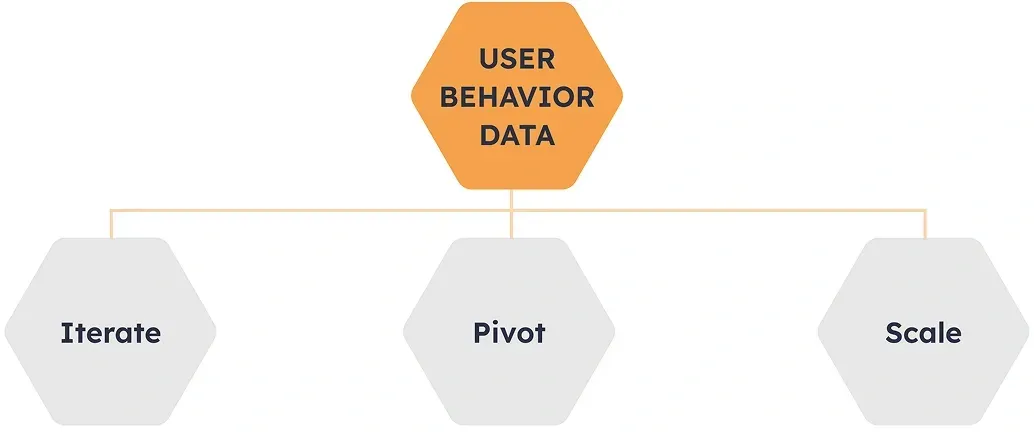
1. Iterate
If users see value but face friction, improve the existing product: simplify flows, fix UX issues, refine features, etc. This is the most common path.
2. Pivot
If users do not engage or the core hypothesis is not validated, change direction:
target a different audience
redefine the problem
adjust the value proposition
Pivoting early reduces losses and increases the chance of finding a working model.
3. Scale
If key metrics are stable and improving, invest in growth: expand features, scale infrastructure, increase marketing efforts.
Scaling too early is a common mistake. Without product-market fit, growth only amplifies existing problems.
However, even with the right data, success hinges on execution. Transitioning from a validated hypothesis to a scalable product requires a team that understands both the lean methodology and coding.
Choosing the right MVP development partner
Not every development team is suited for MVPs. Early-stage products require a different mindset – focused on speed, flexibility, and validation. At this stage, the challenge is not only execution but making the right trade-offs – how to structure the MVP so it fits current business goals, budget, and the level of validation required.
Managing this internally can become difficult, especially when time and resources are limited. This is where working with an experienced custom software development company helps structure the process and reduce execution risk.
A strong partner does not just execute requirements; it also provides guidance and support in addressing common startup challenges in software development. They help define the right scope, choose the appropriate level of implementation, and ensure that effort and budget are aligned with the actual business needs at this stage.
To assess whether a team is the right fit for your MVP, focus on the following criteria:
1. Product thinking, not just delivery
The team should challenge assumptions, refine scope, and focus on solving the core problem.
2. Experience with MVP development and startup environments
Early-stage products require fast iteration and constant adjustments. This is different from enterprise development.
3. Transparent communication and process
You should always understand what is happening, what decisions are made, and why.
4. Ability to work with changing requirements
Scope will evolve. The team should handle it without losing control over timelines and budget.
5. Balanced technical decisions
The goal is to avoid both overengineering and short-term solutions that break later.
At the early stage, execution risk is just as real as market risk. The right team won't eliminate uncertainty – but they'll make sure your decisions are informed, your scope is controlled, your budget is spent wisely, and your product is built to learn from.
If you're exploring different ways to structure your team, we’ve also put together a detailed guide on staff augmentation and outsourcing to help you compare available options.
FAQ
How much does it cost to develop an MVP?
What is the difference between an MVP and a prototype?
How long does it take to build an MVP?
What features should an MVP include?
How do you achieve product-market fit with an MVP?
Should a startup hire an MVP development company or build in-house?
Conclusion
MVP development shapes the entire product. Most issues start here: unclear direction, weak validation, decisions without reliable data. The result is predictable: delays, budget overruns, and ongoing rework. The fix isn't more planning – it's better decisions earlier. If you're at that stage, let's define what your MVP actually needs to prove, and build only that.
References
1.
Marmer, Max, Bjoern Lasse Herrmann, Ertan Dogrultan, and Ron Berman. Startup Genome Report Extra on Premature Scaling. Startup Genome, 2012. startupcompass.co.
2.
CB Insights. "The Top 12 Reasons Startups Fail." CB Insights Research, 2026. cbinsights.com.
3.
Deloitte. "2026 Technology, Media & Telecommunications Predictions: Narrowing the Gap Between the Promise of AI and Its Reality." Press release, New York, November 18, 2025. deloitte.com.
4.
Ries, Eric. The Lean Startup: How Today's Entrepreneurs Use Continuous Innovation to Create Radically Successful Businesses. New York: Crown Business, 2011.
Read more






Get a weekly dose of first-hand tech insights delivered directly to your inbox