
Technical Staff Augmentation: What it is and when to use it
7 min read
Last updated: May 08, 2026
Summary
Your product roadmap is set. Your deadline is real. However, your engineering team lacks the headcount and the specific skills required to deliver on time. Senior developers are hard to find, full-time hiring takes months, and the backlog keeps growing while you wait. Technical staff augmentation is the model that closes this gap: it puts vetted engineers inside your team fast, flexibly, and under your direct control. This guide breaks down exactly what technology staff augmentation is, how it differs from other types of staff augmentation, when it makes strategic sense, and how to run it so that blended teams consistently ship on time.
Key takeaways
Technical staff augmentation embeds external engineers – developers, QA specialists, DevOps, and architects – directly into your team under your management.
It differs from general staff augmentation by focusing exclusively on technical roles requiring deep domain expertise.
The model is best suited for skill gaps, project spikes, tight deadlines, and niche use cases such as embedded software development.
Effective onboarding, shared tooling, and clear task ownership are the three pillars that make blended teams outperform expectations.
Choosing the right IT staff augmentation firm requires evaluating portfolio depth, communication practices, timezone overlap, and cultural alignment, not just hourly rates.

Paul Kirikov
Head of Business Development Department at Modsen
What is technology staff augmentation
Technology staff augmentation is a flexible workforce strategy in which a company temporarily adds external technical specialists to its existing in-house team. Unlike hiring a vendor to deliver a finished product, this model keeps ownership, priorities, and day-to-day direction firmly with the client. The external engineers attend your meetings, work inside your systems, follow your workflows, and report to your engineering leads.
According to Statista's IT outsourcing market data, the global IT services market continues to grow year-over-year, with staff augmentation and flexible resourcing models capturing an increasingly large share as companies prioritize speed-to-market over fixed workforce structures
The model has seen rapid adoption because it addresses a structural challenge in modern product development: the need to scale technical capacity quickly without permanently expanding headcount. As a result, contingent and augmented talent models are taking an increasing share of enterprise technology spending. This shift is largely driven by persistent shortages in critical skill areas such as cloud architecture, data engineering, and cybersecurity – a gap that continues to widen, as outlined in the Lorien report.
How it differs from general staff augmentation
General staff augmentation covers a wide spectrum of roles – administrative support, project coordinators, marketing specialists, finance analysts, etc. Technical staff augmentation is specifically about engineering: every placement involves a technical role that requires hands-on expertise in code, infrastructure, or systems design.
The key practical difference is the screening standard. When you augment an administrative function, communication skills and process knowledge usually dominate the assessment. When you augment a backend engineering team, the provider must evaluate system design judgment, code quality, familiarity with your tech stack, and the ability to contribute to production codebases from day one. The bar is higher, the talent pool is narrower, and the cost of a wrong fit – measured in refactoring time and delayed releases – is substantially larger.
This distinction also affects how you structure the engagement. Technical team augmentation, as well as staff augmentation consulting services, typically requires a discovery phase in which the provider maps your stack, current architecture, and code conventions before placing candidates – a step that general augmentation arrangements rarely need.
Key roles in technical team augmentation
Technical team augmentation covers a wide range of specialists. The most frequently requested profiles include:
Full-stack, frontend, and backend developers
Mobile engineers
QA automation engineers and performance testers
DevOps and cloud infrastructure engineers
Data engineers, ML engineers, and AI specialists
Solution and enterprise architects.
The breadth of this list is what makes the model so adaptable. Technical augmentation can supply virtually any role your engineering project requires, enabling you to scale and diversify your team on demand.
When to use technical augmentation for your engineering team
Not every capacity challenge requires the same solution. If you need people long-term, you should hire full-time. If you build a product over a long period with changing requirements, a dedicated team might be a better fit. Technical augmentation works best in a specific case: when the need is real, the timeline is tight, and it doesn’t make sense to hire someone permanently.
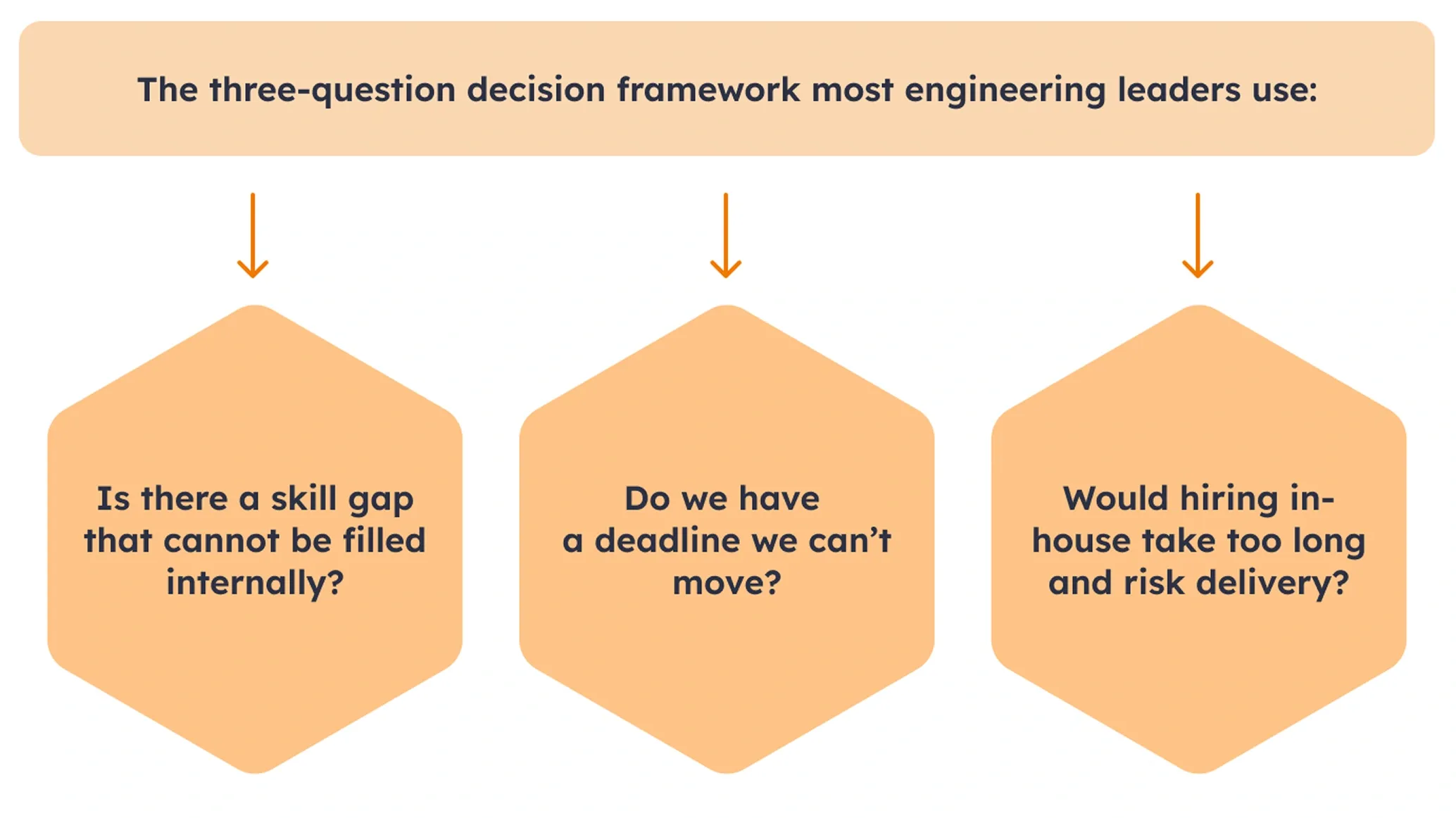
If the answer to any of these is yes, IT augmentation deserves serious consideration.
Engineering staff augmentation use cases
Let’s illustrate a few concrete use cases:
New product feature: A company that just launched a web platform needs to build a mobile app quickly. Its core team is fully booked, and hiring a full-time developer would delay the launch. Instead, they augment with a mobile developer and a QA tester. The augmented staff join the agile team for the next few sprints, doubling development capacity and meeting the deadline.
Legacy modernization: A firm must update an aging software system but lacks appropriate in-house expertise. Through technical augmentation, they bring in specialists experienced in that legacy technology alongside their existing engineers. The legacy experts work with in-house developers until the transition is complete.
Product pivot or rapid prototyping: A startup wants to experiment with new AI features, but can’t recruit a data scientist in time. They use staff augmentation to hire a machine learning engineer on a short-term contract. This expert helps build and test the prototype, enabling the startup to validate the idea quickly.
These scenarios show that whenever speed, flexibility, or specialized skills are critical, staff augmentation can be the answer. It’s a way to accelerate development without a full-hiring cycle or giving away control to an outside vendor.
Embedded software and niche expertise
Some engineering projects require extremely specialized knowledge – for example, embedded systems, firmware for IoT devices, robotics, or deep domain expertise like aerospace or automotive protocols. These roles are hard to fill quickly through normal recruiting. Staff augmentation shines here by providing access to niche expertise.
For instance, you can augment with an embedded software engineer who knows C/C++ on microcontrollers or a real-time systems expert for your hardware project. Similarly, if you need a security architect to implement advanced encryption or a blockchain developer to audit smart contracts, augmentation firms can source those specialists. In each case, the expert works alongside your regular engineers, sharing knowledge and integrating designs.
How to hire augmented IT resources effectively
The quality of an IT resource augmentation engagement is determined less by the contract and more by the process that precedes it. Companies that treat augmentation as a simple body-shopping exercise – send a job description, receive a CV, start billing – consistently underperform compared to teams that invest two to three additional weeks in structured selection and onboarding.
This matters more than ever: skills gaps remain the top hiring challenge for technology functions globally, meaning the competition for the right engineers is intense regardless of hiring model.
Vetting and onboarding augmented engineers
IT augmentation vetting goes beyond a technical screen. A strong process includes four layers:
Technical assessment. Live coding exercises, system design walkthroughs, and code review tasks calibrated to your actual stack.
Domain interview. A conversation with one of your senior engineers to validate that the candidate understands the domain context – security constraints, data privacy requirements, performance expectations.
Communication evaluation. Written tasks and a structured video interview that reflect how the work actually happens across time zones, in written English, and with status updates.
Culture and process fit. A direct conversation about how the candidate prefers to work. Engineers who align with your team’s norms on ownership and feedback tend to integrate smoothly; those who don’t create friction that slows everyone down.
Onboarding for external engineers should follow your internal process, but at a faster pace. They need to get up to speed quickly because the project is already in motion.
The engagement structure – including how pricing, SLAs, and scope are defined – matters just as much as the vetting itself. For a deeper look at how these engagements are typically framed, see staff augmentation model explained.
Managing blended teams for maximum output
Tech staff augmentation creates what practitioners call a blended team – a mix of permanent employees and augmented engineers working under a single delivery mandate. The management challenge is cohesion: preventing the "us vs. them" dynamic that erodes trust and slows delivery.
Four practices consistently distinguish high-performing blended teams:
One Jira/Linear board. Augmented engineers are assigned tickets exactly as internal engineers are.
Daily meetings with everyone present. Visibility is the primary antidote to coordination failures.
Clear code ownership. Define which modules or services each engineer – augmented or internal – is responsible for. Ambiguous ownership leads to both duplicated effort and unchecked bugs.
Structured retrospectives. Invite augmented engineers to sprint retrospectives. Their external perspective on process friction is valuable, and inclusion builds the team identity that sustains long engagements.
Choosing the right IT staff augmentation firm
The market for IT team augmentation services is large and unevenly distributed in quality. Some IT staff augmentation companies maintain deep benches of pre-vetted engineers across multiple disciplines; others operate as thin staffing intermediaries who source from public job boards. The selection decision is high-stakes: a poor choice means delayed starts, engineer mismatches, and the hidden cost of re-engagement mid-project.
Key criteria for evaluating providers
Use this checklist when assessing candidate firms:
Technical portfolio depth. Look at their portfolio with a specific question in mind: have they worked on projects similar to yours? Relevant case studies – same industry, comparable tech stack, or matching scale – are a much stronger signal than a long list of logos.
Talent pipeline transparency. Ask how candidates are sourced and vetted. Firms that can describe their internal screening process in detail and allow you to add your own interview round are more reliable partners.
Timezone and communication overlap. Time zone distance is manageable – many successful teams work across large gaps – but it requires deliberate structure: agreed overlap windows, written-first communication norms, and clear escalation paths for blockers. Confirm upfront how the firm handles this and what their clients in similar situations actually do.
Culture and values fit. Augmented engineers who do not align with your engineering culture – attitudes toward code quality, documentation, and on-call responsibility – create friction disproportionate to their technical contribution.
Replacement and exit SLAs. What happens if an engineer underperforms? A quality firm should guarantee a replacement fast enough and provide a structured handover process, not just an open-ended "we'll find someone."
Pricing model clarity. IT staff augmentation services typically bill on a time-and-materials basis. Ensure the rate card distinguishes seniority levels clearly, and that there are no ambiguous "management fees" bundled into the hourly rate.
FAQ
What is technical staff augmentation?
When should a company consider engineering staff augmentation?
What roles are commonly hired through IT augmentation?
How do you manage augmented engineers alongside in-house staff?
What is the difference between tech augmentation and IT outsourcing?
Conclusion
Technical staff augmentation exists because the software industry's pace of change has outrun the traditional hiring model. When your product needs a Rust systems programmer, an AWS migration architect, or three senior React developers next month, augmentation is the mechanism that makes delivery possible without permanently restructuring your organization.
The model works best when it is treated not as a stopgap but as a deliberate capacity strategy. That means investing in selection quality, structuring onboarding, and managing blended teams with the same intentionality you would bring to a permanent hire. When those conditions are met, augmented engineers become some of the highest-leverage contributors on the team, bringing deep expertise, external perspective, and zero organizational debt.
For companies exploring IT staff augmentation services, the decision often comes down to one question: which provider has already placed engineers in situations similar to yours? Modsen has delivered IT team augmentation services across fintech, healthtech, logistics, and other domains with teams scaling from one embedded specialist to multi-disciplinary teams. Talk to our team to discuss your engineering capacity needs – no commitment required, just a direct conversation about what's possible.
References
Read more






Get a weekly dose of first-hand tech insights delivered directly to your inbox