
Travel and hospitality industry trends in 2026: tech outlook for operators
15 min read
Last updated: Aug 27, 2026
Summary
Every technology decision a travel business makes today affects revenue tomorrow. The wrong reservation platform creates operational bottlenecks. Poor integrations frustrate guests. AI without governance becomes expensive experimentation. Meanwhile, operators investing in connected, cloud‑first architectures are gaining efficiency and improving guest satisfaction. In this article, we examine the travel and hospitality industry trends shaping those decisions in 2026 and where custom software development services creates measurable business value.
Key takeaways
Cloud-first, API-driven platforms have become the industry standard, replacing fragmented legacy systems and enabling real-time operations.
AI delivers measurable value only in targeted use cases: guest service, personalization, pricing, and automation, when paired with strong governance.
The winning architecture is platform + custom development: buy standard capabilities, build the workflows that create competitive advantage.
Integrations, standalone software, now determine operational performance, connecting reservations, payments, guest data, and corporate systems into one ecosystem.
Technology strategy now starts with roadmap planning, not vendor selection, reducing integration risks and avoiding costly platform decisions.

Olga Tsygan
Head of Strategic Partnerships at Modsen
What actually changed in travel and hospitality technology since 2023
The recovery is over, and traveller behaviour reset rather than bounced back. Four shifts since 2023 reshaped how operators run, and they underpin the travel and hospitality industry trends that follow.
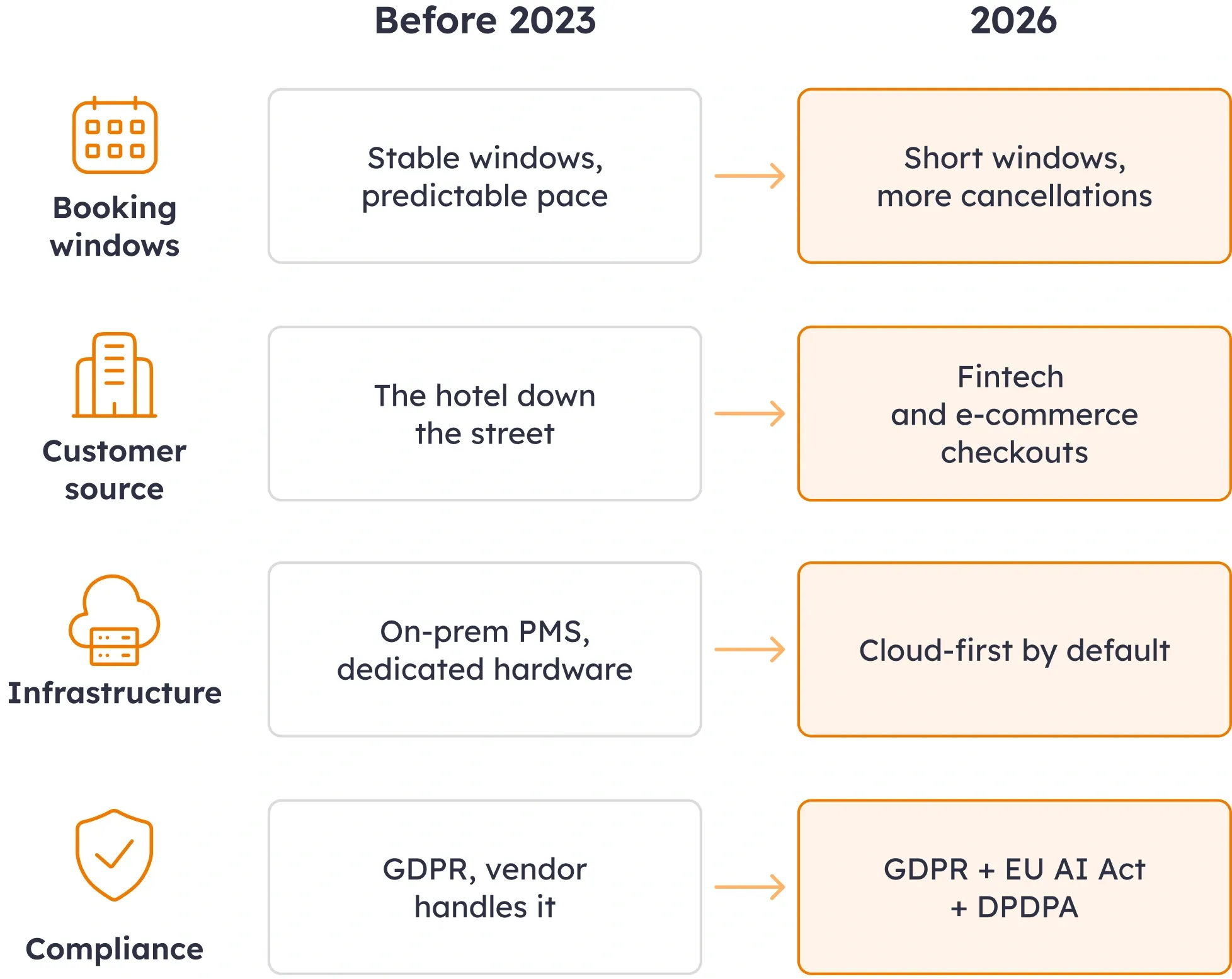
First, people book late and cancel more. It used to be easy to predict how full you would be. Now demand swings at short notice, so a hotel can end up with empty rooms or oversold ones. One resort group we work with saw direct‑booking cancellations roughly double.
Second, guests compare you to apps (not to the hotel next door). They are used to paying in one tap, like on a banking or shopping app. If your booking page asks for a card twice or loads slowly, they treat it as broken and leave.
Third, software moved to the cloud. Older systems ran on hardware inside the building – expensive to maintain, patched by hand, and reconnected every time you add a new tool. A cloud‑based property management system (PMS) updates itself and is now the default choice.
Fourth, the rules on guest data got stricter. New laws – General Data Protection Regulation (GDPR) in Europe, the EU AI Act, and India's Digital Personal Data Protection Act (DPDPA) – govern how you store personally identifiable information (PII) like names and card details. Fines can reach a share of a company's total revenue, and "our software vendor handles it" no longer holds up in an audit.
These four shifts drive most of the trends in travel and hospitality industry conversations we have with operators today, and most of the travel & hospitality software development services we take on.
AI in travel and tourism: Where it earns its keep in 2026
AI in travel and hospitality moved from demo to production over the past two years, and it sits near the top of most operators' shortlist of travel and hospitality industry trends worth funding. The useful question now is where it pays for itself. Four areas carry the weight:
conversational guest service
personalization
dynamic pricing
operational automation
Before the specifics, two terms worth pinning down.
GenAI or generative AI refers to models that produce text, images, or code on demand – the technology behind a chatbot that writes a reply instead of picking from scripted answers. | Agentic AI refers to AI agents that carry out multi-step tasks on their own, such as checking availability, modifying a booking, and sending a confirmation without a human. |
The first is now common in hospitality; the second is early but moving fast.
On guest service, the payoff is measurable. Chatbots and virtual concierges answer the routine questions: is a room free, when is check‑in, what's included. That leaves the front desk and call centre to handle only the cases that need real judgment. Personalization is where AI in travel and tourism shows up in the numbers: when the system tailors offers to each guest, average spend per guest goes up, as long as the data behind it is clean.
A small hotel chain we work with used a model to send each guest the right add‑on at the right moment – a room upgrade, breakfast, or a late checkout, matched to whether they were travelling for work or leisure. More guests took the offers, and the extra revenue covered the cost of building it within one season.
Dynamic pricing and operational automation round out the picture. Pricing models now ingest competitor rates, local events, and pace data to adjust in near real time, and automation handles the unglamorous work (housekeeping schedules, energy management, demand‑based staffing) that quietly erodes margin when done by hand.


Of all the travel and hospitality industry trends here, AI is the one that earns its place strictly and stays a science project everywhere the return can't be measured.
For a deeper build‑level view of guest‑facing AI, our AI chatbot for hotels – deep‑dive walks through use cases and costs, and teams planning a build can start with our AI development for travel and hospitality.
Where AI still misses in hotels and travel apps
Honesty about the failure modes saves money, and it separates the operators who adopt travel and hospitality industry trends well from those who get burned by them.
First, booking‑context hallucination is the sharpest risk: a model that confidently quotes a rate, a cancellation policy, or a room type that does not exist creates a commitment your staff then has to honour or walk back, and both options cost you. Guardrails and retrieval against a source of truth reduce this, but they do not remove it, so any AI touching price or policy needs a verification layer.
Second, multilingual failures: a guest-service chatbot that handles English cleanly can produce subtly wrong output in a guest's native language (a mistranslated fee or an inverted policy) and the guest will not flag it until checkout.
Third, the escalation gap: when a bot cannot resolve an issue, a clumsy hand‑off to a human that loses context frustrates the guest more than no bot at all. Design the escalation path as carefully as the happy path, because that seam is where guest trust is won or lost.
Reservation and booking systems: the platform underneath everything
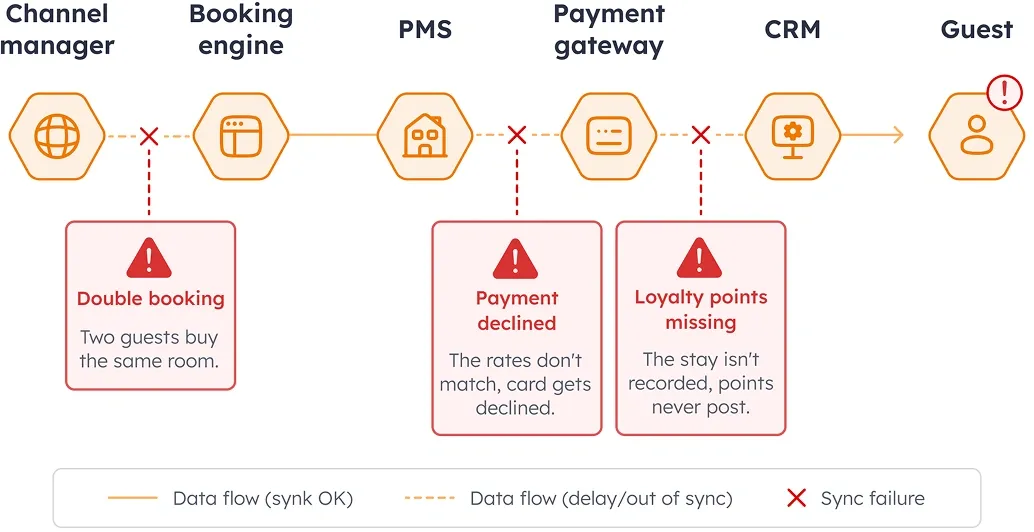
To a guest, booking a room is one button. Behind it sit four systems that must agree within seconds:
channel manager that pushes your inventory to Booking.com and Expedia
PMS that stores every reservation and guest profile
payment gateway
guest database
For example, if the channel manager updates once an hour instead of on every booking, two guests can buy the same room in that window. If the payment gateway and PMS disagree on a rate, the card gets declined at check‑in. If the CRM misses a stay, the loyalty points never post. The guest hits the error before your staff does.
This is why booking systems sit in the hospitality technology services category and reward being treated that way. What you pay for is the sync interval. A hotel that updates availability on every transaction can sell its last room across its website at the same time without overselling. A hotel that reconciles once a night, by batch, faces a worse choice: hold rooms back to stay safe (lost revenue) or oversell (walked guests, refunds, a one‑star review about being turned away at 11pm).
One regional group Modsen worked with ran four hotels on three separate PMS instances, synced by staff exporting spreadsheets between them. We consolidated them onto one cloud PMS with a single channel manager pushing to all channels in real time. Overbooking incidents dropped by more than half in the first quarter, and for the first time they could pull one guest record across all four properties instead of four disconnected lists. This kind of consolidation is one of the travel and hospitality industry trends paying off fastest right now – our reservation system guide breaks down how properties set this up.
Refreshing your reservation stack in 2026?
Get a tailored estimate from an engineering team that integrates platforms for a living.
Hospitality technology providers: platforms, vendors, and partners
Choosing a hospitality technology company in 2026 means understanding that the market splits into three distinct kinds of player, each solving a different problem. Sort the providers on your shortlist by role before you compare them on price.
Legacy PMS vendors (for example Oracle Hospitality, Amadeus)
Best fit for
Large chains needing deep, established feature coverage and enterprise support
Main limitation
Slower to adapt, heavier integration effort, often on‑prem heritage
Modern cloud platforms (for example Mews, Cloudbeds)
Best fit for
Independent and mid‑market properties wanting fast setup and open APIs
Main limitation
Cover roughly 70% of any given operator's process out of the box
Custom partners (Modsen)
Best fit for
Operators whose differentiating processes fall outside standard SaaS
Main limitation
Best used alongside a platform, rarely as a full replacement
Large operators already split their stack this way. Marriott is replatforming its property management, central reservations, and loyalty systems onto cloud‑native, API‑first platforms while building custom capabilities in‑house. Accor has moved more than half its application stack to AWS and layers its own generative‑AI tools on top. Both keep a platform for the common systems and commission custom work for what sets them apart.
Modsen team typically enters as the custom partner that connects a platform to an operator's corporate tools and closes the workflow gaps a general‑purpose product cannot. Getting this split right is one of the travel and hospitality industry trends that separates operators who spend well from those who pay twice.
Platform or custom: How they work together
A custom partner works alongside your platform, and the platform stays your main system. The split of responsibilities is clean:
The platform covers the standard work every property needs:
| The custom partner builds the smaller set of things that make you different:
|
The test is simple. Buy the standard modules. Build the ones that win or keep your best accounts – the auto‑enforced corporate travel policy, the loyalty tier competitors can't match, the integration your operation runs on. No platform ships those, and the operators who build them pull ahead.
Emerging trends in custom travel solutions and corporate travel (2026 signals we're tracking)
Some of the most durable travel and hospitality industry trends never make a keynote slide because they live inside custom builds. Five emerging trends in custom travel solutions show up repeatedly in the briefs landing on our desks, and all five sit in territory that off‑the‑shelf products do not reach.
The first is sustainability tracking. Corporate travellers and, increasingly, leisure ones want to see how much CO₂ a trip will produce even before they book. That means building the carbon calculation right into the booking system, so the figure updates as the traveller changes flights or dates. Most off‑the‑shelf booking tools can't show this, so it has to be added as a custom layer.
The second is corporate and crew travel, quietly one of the hardest problems in the sector. A system here has to juggle trips with several connecting flights, daily allowances that follow different rules in each country, and links to the company's HR system, its payroll, and the databases that hold airline seat inventory. No ready-made product does all of that at once, so large companies build their own – and often bring in a dedicated travel-tech team to hit their financial deadlines.
The third is identity‑first design. Operators are consolidating fragmented guest logins into a single identity that follows the traveller across web, app, and property, built on single sign‑on (SSO) and passkeys – the FIDO2 standard that replaces passwords with device‑based authentication. In practice this pairs a customer identity and access management (CIAM) platform with a custom layer that connects it to the PMS and the loyalty system, so a guest checking into a Meetings, Incentives, Conferences and Exhibitions (MICE) event is recognised the same way as a leisure guest.
The fourth is payment orchestration. A traveller in Tokyo pays by local wallet, a corporate account settles by virtual card, a family splits a booking across two cards, and every rate crosses a currency line. A custom orchestration layer routes each transaction to the right acquirer and method, prices in multiple currencies, issues virtual card numbers (VCNs) for supplier payments, and reconciles it all to one ledger. Payment service providers (PSPs) each cover a piece; combining them into one flow that fits an operator's markets is custom work.
The fifth is dynamic packaging. Selling a flight, a room, and an activity as one price in real time, with margin and availability rules applied on the fly, lifts both conversion and yield. Off-the-shelf booking engines sell those components separately; a custom packaging engine pulls live inventory from several sources, applies business rules per market, and presents one bundle the guest books in a single transaction.
Get your custom layer scoped free
Walk us through the workflow and we'll size the build, flag the integration risks, and ballpark the effort on the call.
Hospitality in the travel and tourism industry: buyer patterns for 2026
The clearest shift in how travel and hospitality services get bought is the order operators do things in. For years the pattern was the same:
pick a platform → sign a multi-year contract → start the integration work.
Problems with the corporate tools you already run showed up months later, well after the deal was locked.
That order is expensive. The real cost of the wrong platform lands later, in the two years of integration work and the migration you end up paying for anyway. By the time a mismatch surfaces, you're a year into a three-year term with little room to move.
In 2026 the operators getting good outcomes changed the sequence. They map the problem before they shop. That is where IT consulting comes in – an independent audit of what you already run, a three-year roadmap, and only then a vendor chosen to fit it. Of all the travel and hospitality industry trends covered here, this shift in order is the one that most reliably prevents an expensive mistake, and it is why hospitality in travel and tourism industry planning now tends to open with an advisor.
Independence is what makes it work. The platform you're already on will always recommend more of itself, so the audit has to come from someone with nothing to sell you. Mapping the travel hospitality stack first is what keeps a mismatch from surfacing a year into the contract. If you're weighing options now, get an independent IT consulting roadmap before you sign anything with a three-year term.
FAQ
What are the biggest travel and hospitality industry trends in 2026?
Is AI actually being adopted by hotels or is it still hype?
What's the difference between a hospitality technology company and a hospitality technology provider?
Should we buy off‑the‑shelf or build custom for hotel and travel software in 2026?
Who are typical hospitality and tourism companies adopting these trends first?
What role does IT consulting play in choosing hospitality technology services?
Where all this leaves you
The travel and hospitality industry trends that matter in 2026 are connected parts of one shift rather than a list of separate bets. Cloud‑first reservation stacks make integration the main event; AI earns its place in guest service and personalization while demanding guardrails; the provider market splits into platforms and custom partners; sustainability, corporate travel, and identity push work into custom territory; and consulting moves to the front of the buying process. Read together, they point to the same conclusion: your advantage in 2026 lives at the seams between systems, and that is exactly where planning pays off. If you are refreshing your stack this year, the most useful first step is a roadmap, not a purchase order. Talk to Modsen team about the travel and hospitality services build behind these trends and book a consulting call before you commit.
References
1.
2.
3.
4.
5.

Get a weekly dose of first-hand tech insights delivered directly to your inbox