
What is IT staff augmentation? Full guide to the hiring model in 2026
11 min read
Last updated: May 07, 2026
Summary
The global tech talent shortage is not easing. In 2026, experts predict that 90% of organizations will experience IT skills shortages. Hiring full-time engineers takes months; project deadlines do not wait. That's why IT staff augmentation services have become one of the most widely adopted solutions in the technology industry – a flexible, cost-effective way to extend your team without sacrificing control.
This guide covers everything you need to know about what IT staff augmentation is, how the model works, what types exist, when to use it, and how to select the right vendor for your project.
Key takeaways
What is IT staff augmentation: a model where you temporarily expand your in-house team with external IT specialists who work under your direct management.
How it works: You define a skill gap → a vendor sources candidates → you interview and onboard → augmented specialists integrate into your workflows.
Types: Short-term and long-term engagements; technical and non-technical roles; nearshore, offshore, and onshore delivery.
Best for companies facing skill gaps, rapid scaling needs, or temporary workload spikes.
Control stays with you: unlike outsourcing, IT staff augmentation means your team leads execution – the vendor supplies talent, not decisions.

Paul Kirikov
Head of Business Development Department at Modsen
What is IT staff augmentation in simple words
There is no shortage of buzzwords in the tech hiring space, but staff augmentation's meaning is worth defining precisely – because it is often confused with outsourcing, managed services, or freelance contracting.


What is IT staff augmentation? It is a workforce strategy where a company supplements its existing internal team with external professionals on a temporary or project-based basis.
The augmented specialists work as an extension of your team – attending your standups, using your tools, following your processes, but are legally employed or contracted through a third-party vendor.
It distinguishes itself from other models by one principle: management stays with the client. The client company retains full control over task assignment, priorities, workflows, and delivery standards. The vendor's role is to find, vet, and supply the right talent, but not to run the project.
Staff augmentation definition and core principles
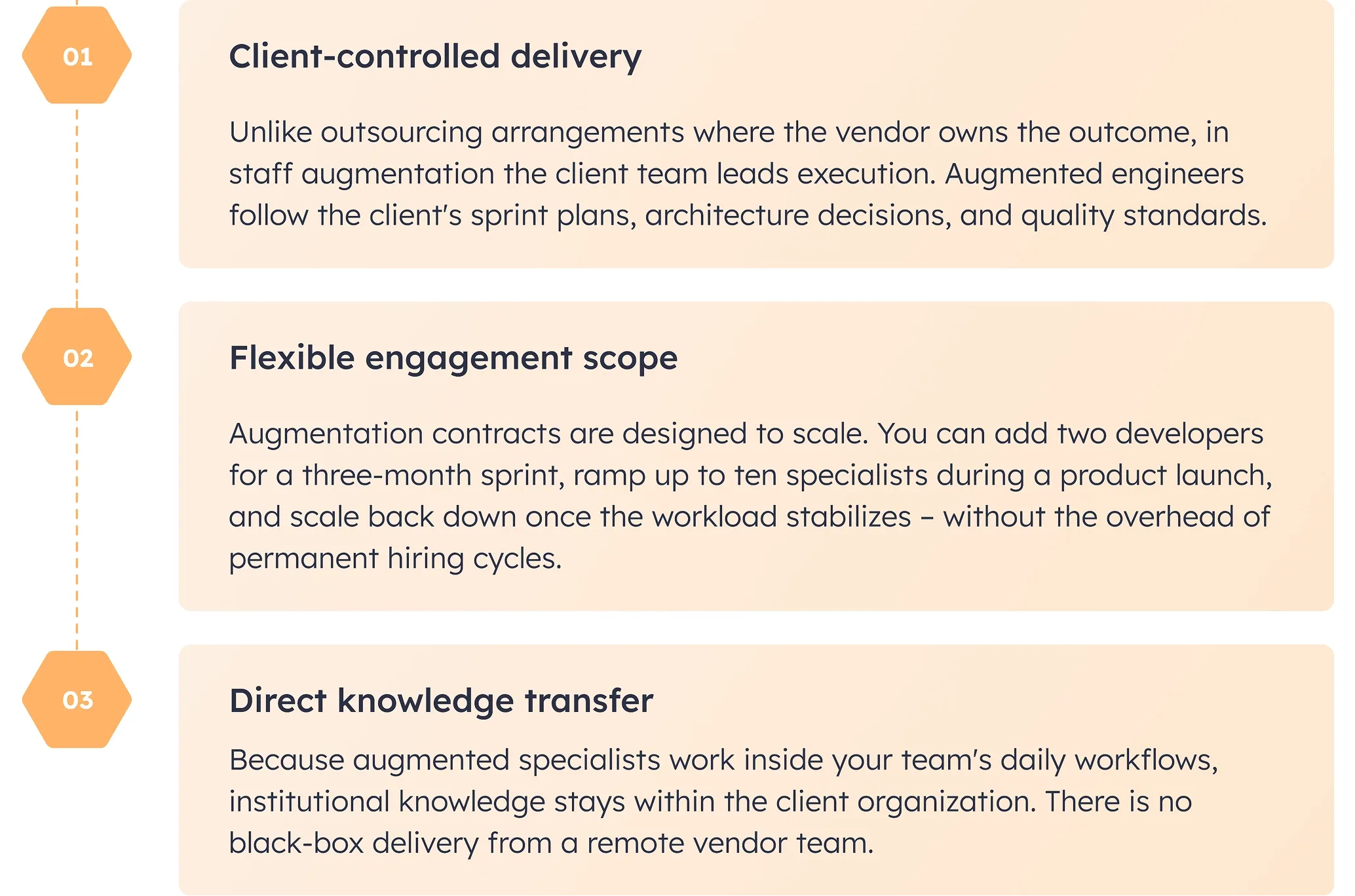
The meaning of staff augmentation can be broken down into three core principles:
Nearly 62% of enterprises adopt staff augmentation to manage dynamic workloads, while 58% prioritize it for rapid access to specialized skills.
Understanding what IT staff augmentation at this level is makes it clear why so many technology companies that need to move fast, maintain control, and avoid long-term HR commitments have adopted it as a core workforce strategy.
How staff augmentation differs from outsourcing and dedicated team
The distinction between what is IT staff augmentation and what is IT outsourcing is frequently misunderstood – but it matters enormously for how projects are structured, managed, and delivered.
Management
Staff augmentation
Client manages augmented staff
Full outsourcing
Vendor manages the project
Dedicated team
Shared: client defines goals, vendor executes
Client's control over process
Staff augmentation
Full control
Full outsourcing
Minimal
Dedicated team
Partial
Talent visibility
Staff augmentation
Client interviews and select
Full outsourcing
Vendor assigns team
Dedicated team
Client approves the team
Knowledge ownership
Staff augmentation
Stays with client
Full outsourcing
Often siloed with vendor
Dedicated team
Depends on contract
Flexibility
Staff augmentation
High – scale up/down quickly
Full outsourcing
Low – contract-bound scope
Dedicated team
Medium
Best for
Staff augmentation
Filling specific skill gaps
Full outsourcing
Defined deliverables with fixed scope
Dedicated team
Long-term product development
Communication overhead
Staff augmentation
Low – direct integration
Full outsourcing
High – interface via PM or account manager
Dedicated team
Medium
The key distinction between a dedicated development team vs outsourcing: in staff augmentation, the client is the manager. In outsourcing, the vendor is. In a dedicated team model, responsibility is shared, but the team is ring-fenced for a single client over an extended period.
Choosing between these models depends on your project's maturity, the clarity of requirements, and how much operational control you need to retain.
How the staff augmentation model works
How does staff augmentation work? The process follows a consistent pattern across most vendors, though timelines vary.
Step 1. Needs definition
The client identifies the specific skills, seniority levels, and engagement duration required. The more precise the brief (tech stack, team structure, project context), the faster and more accurate the sourcing – and the clearer the answer to what is IT staff augmentation delivering for this particular project.
Step 2. Vendor sourcing
The staff augmentation partner searches its talent pool or recruits externally. Reputable vendors typically present pre-vetted candidates within 3–7 business days for standard roles; niche specializations may take longer.
Step 3. Client interview
Unlike traditional outsourcing, the client interviews and approves every candidate before engagement begins. You assess cultural fit, technical depth, and communication skills – the same way you would for an in-house hire.
Step 4. Contract and compliance
The vendor handles employment contracts, payroll, taxes, and local compliance in the specialist's jurisdiction. The client signs a service agreement defining scope, rate, and IP ownership.
Step 5. Onboarding
The augmented specialist goes through the client's standard onboarding: access to tools, codebase orientation, introduction to the team. Effective onboarding at this stage determines how quickly the specialist becomes productive.
Step 6. Integration and delivery
The specialist works within the client's sprint cycles, attends team calls, and delivers tasks according to the client's standards – the day-to-day reality of what is IT staff augmentation looks no different from working with a permanent team member. The vendor remains available for HR escalations, replacement requests, or team expansion.
Step 7. Offboarding or extension
At the end of the engagement, access is revoked, knowledge is documented, and the contract closes or is extended based on project needs. The staff augmentation model and engagement structure behind each of these steps matters as much as the process itself.
Roles and responsibilities in a staff augmentation setup
Clear role definition is fundamental to what is IT staff augmentation in practice – it prevents the most common friction points in augmentation engagements.
Role | Responsibilities |
|---|---|
Client | Define requirements, interview candidates, manage daily work, assign tasks, evaluate performance, run sprints |
Vendor | Source and vet talent, handle employment/payroll, ensure replacement if needed, manage HR issues |
Augmented specialist(s) | Execute tasks as directed by client, follow client's processes and quality standards, communicate proactively |
The client's project manager or tech lead is the primary point of contact for the augmented specialist.
Types of IT staff augmentation
The types of staff augmentation vary along several dimensions: duration, geography, and the nature of the roles being filled.
Short-term vs long-term augmentation
Short-term augmentation | Long-term augmentation |
|---|---|
Short-term augmentation typically spans one to six months. It is most appropriate when you need to cover a temporary capacity gap – a developer on leave, a sudden feature deadline, a product launch sprint. Short-term engagements require rapid onboarding and clear, bounded deliverables. | Long-term augmentation runs from six months to several years. In this model, the augmented specialists become deeply embedded in the client team – they understand the product history, codebase conventions, and team culture. The engagement starts to resemble permanent employment from a practical standpoint, though the contractual flexibility remains. |
Choosing between them depends on the nature of the work: if the need is episodic, a short-term is appropriate. If the company is growing and simply cannot hire fast enough to keep pace, long-term augmentation is a more sustainable solution. Either way, the answer to what is IT staff augmentation remains the same – a flexible engagement that scales with your project.
For a detailed breakdown of engagement models, we compared different augmentation approaches.
Technical staff augmentation explained
Tech team augmentation refers specifically to the placement of software engineers, architects, data scientists, DevOps specialists, QA engineers, and other technology professionals into client teams.
Technology staff augmentation differs from general staff augmentation in its depth of technical vetting.
Vendors in this space typically assess candidates through code reviews, architecture discussions, and live technical challenges. The client team's tech leads are usually involved in the interview process to validate stack-specific knowledge.
Common roles filled through technical staff augmentation include:
Front-end and back-end engineers
Mobile engineers
Data engineers and ML specialists
Cloud architects
QA automation engineers
DevOps and platform engineers
Solution architects and tech leads
Nearshore, offshore, and onshore options
The geographic delivery model affects cost, timezone overlap, and communication dynamics.
Onshore augmentation
Onshore augmentation places specialists in the same country as the client. It offers maximum timezone alignment and cultural proximity, but at a significantly higher cost for senior engineering roles.
Nearshore augmentation
Nearshore augmentation sources talent from nearby countries with overlapping or adjacent timezones. Eastern Europe for Western European clients, Latin America for US clients. Cost is lower than onshore.
Offshore augmentation
Offshore augmentation taps talent in regions with significant timezone differences. Coordination overhead increases and real-time communication windows narrow.
The optimal model depends on your team's communication style, the complexity of the work, and your budget envelope. For teams still weighing the options, comparing different augmentation approaches across geo-models often surfaces trade-offs that are not obvious at first glance.
When to use team augmentation for your IT project
Staff augmentation is not a universal solution, it performs best under specific conditions. Team augmentation delivers the most value in these scenarios:
Scaling a product team faster than internal hiring allows. The average time to fill a technical role is 66 days – 50% longer than for non-technical positions. Staff augmentation can deliver vetted candidates in under two weeks. For companies in a growth phase, this speed differential is critical.
Bridging a specific technology skill gap. If your product requires expertise in a technology your current team does not have – a new cloud platform, a machine learning pipeline, a niche framework – augmentation lets you access that expertise without a permanent hire or extended recruitment cycle.
Managing workload spikes. Software releases and seasonal traffic surges create temporary demand for engineering capacity. When asking ‘what is IT staff augmentation’ in a business context, the answer lies in its ability to cover these spikes without inflating the fixed cost base.
Maintaining project continuity during attrition. When a key engineer leaves mid-project, augmentation provides a faster path to replacement than internal HR processes typically allow.
Running parallel workstreams. When the roadmap requires simultaneous progress on multiple features or products, augmentation lets you staff parallel teams without competing for the same internal resources.
Signs your company needs augmented staff
Use this checklist to assess whether your organization is facing conditions where staff augmentation would deliver measurable value:
Your current team is at full capacity but the backlog continues to grow
You need a specific technical skill that no current team member has
A key developer position has been open for more than 45 days
You have a fixed project deadline with insufficient current headcount to meet it
You are launching a new product line that requires temporary ramp-up capacity
Your budget does not support a permanent hire, but the work is immediate
You need to validate a technology before committing to long-term investment in it
Remote team management is already part of your operating model
If three or more of these apply, staff augmentation is worth evaluating as a primary or supplementary hiring strategy.
Ready to close your skill gap?
Get a free consultation with Modsen augmentation team. We'll assess your current bottlenecks, define the roles you actually need, and outline an engagement structure that fits your timeline and budget.
Paul Kirikov
Head of Business Development



Benefits and risks of IT staff augmentation
Every hiring model involves trade-offs, and what is IT staff augmentation is no exception. A clear view of both sides prevents over-reliance on augmentation in situations where it is not the right fit.
What are IT staff augmentation benefits?
Speed of access to talent. Staff augmentation vendors maintain pre-vetted talent pools. Time-to-hire for augmented roles is consistently 3–10x faster than internal recruitment for equivalent positions.
Cost efficiency. When client accounts for recruitment costs, benefits, employer taxes, and onboarding overhead, augmented specialists at hourly rates often cost less in total than permanent hires – especially for short or mid-term engagements.
Retention of project control. Unlike outsourcing, team augmentation keeps management responsibility with the client. You set priorities, define quality standards, and own the delivery process.
Flexibility to scale. You can add or remove capacity in response to project needs without restructuring employment contracts or running redundancy processes.
Access to global talent. Augmentation removes geographic constraints on hiring – a US-based team can access German backend engineers, Brazilian mobile developers, or Polish QA specialists without establishing legal entities in those markets.
Common challenges and how to mitigate them
Communication gaps. Remote augmented specialists can be slower to surface blockers or misalignments than co-located team members. Mitigation: establish daily async check-ins, use shared project management tooling, and build explicit escalation paths.
Onboarding time. Even experienced specialists require time to understand your codebase and product context. Mitigation: invest in documentation, pair augmented specialists with senior in-house engineers in the first two weeks, and define clear initial deliverables rather than open-ended responsibilities.
IP and data security risks. External specialists have access to proprietary code and systems. Mitigation: ensure NDAs and IP assignment clauses are in place before access is granted; follow least-privilege access principles.
Cultural and process fit. Specialists from different organizational backgrounds may have different norms around code review, documentation, or meeting culture. Mitigation: conduct cultural alignment conversations during the interview stage; include augmented specialists in team rituals from day one.
Vendor dependency. Over-reliance on a single augmentation vendor creates supply risk and can obscure the core question of what IT staff augmentation is actually delivering for your team. Mitigation: diversify across two vendors for critical roles; maintain internal hiring capability in parallel.
How to choose a staff augmentation partner
Selecting the right vendor is as consequential as the model itself. For companies that have already understood what IT staff augmentation is and decided to adopt it, a poor partner can deliver candidates that look good on paper but fail to integrate, or disappear at the first sign of a difficult conversation.
Evaluate potential partners against these criteria:
Technical vetting rigor. Ask how candidates are assessed. Look for vendors that use structured technical interviews, code reviews, or assessment platforms – not just CV screening. Request sample candidate profiles and ask who conducts technical evaluation.
Domain expertise. Vendors who specialize in your technology stack or industry have deeper pre-vetted talent pools and better calibration of what "senior" means in your context. A generalist IT staffing firm and a specialist software augmentation partner are not interchangeable.
Replacement guarantees. Confirm what happens if an augmented specialist underperforms or leaves. Reputable vendors offer free replacement within an agreed timeframe.
Legal and compliance infrastructure. Verify that the vendor handles employment contracts, local payroll taxes, and statutory benefits in the specialist's jurisdiction. Gaps here create risk for the client.
Communication transparency. Assess how the vendor communicates during the sourcing process. Vendors that provide detailed candidate summaries, explain their screening rationale, and respond to feedback promptly will be better partners in delivery.
References and case evidence. Request references from clients in a similar sector or of similar scale. Ask specifically about how the vendor handled problems.
For technical team augmentation projects specifically, prioritize vendors who involve your tech leads in the candidate assessment process and who understand the difference between a developer who can answer technical questions and one who can contribute meaningfully from week two. To see how consulting firms leverage augmented teams in practice, including how they structure vendor relationships and manage delivery accountability, that cluster article covers the specifics in depth.
FAQ
What is IT staff augmentation in simple terms?
How does staff augmentation work step by step?
What is the difference between staff augmentation and outsourcing?
What types of staff augmentation exist?
When should a company use staff augmentation?
Conclusion
IT staff augmentation has moved from a niche tactic to a mainstream workforce strategy because it solves a real problem: technology projects need to move faster than traditional hiring allows. Understanding what IT staff augmentation is makes the choice clear – the model gives you speed, flexibility, and control simultaneously, a combination neither outsourcing nor permanent hiring can reliably offer.
The companies that get the most out of augmentation share one thing: the right vendor. If you are looking for a partner with rigorous technical vetting, transparent engagement structures, and a track record of integrating seamlessly into product teams – let's talk.
References
Read more






Get a weekly dose of first-hand tech insights delivered directly to your inbox