
E-commerce development company for the US market
Modsen provides custom e-commerce development services in the USA for retailers, DTC brands, and B2B sellers, building and scaling storefronts that handle state-level sales tax logic, PCI DSS-ready payments, and zero-downtime platform migrations on Shopify Plus, BigCommerce, Salesforce Commerce Cloud, and Adobe Commerce.

Why US e-commerce organizations choose Modsen
15+
US e-commerce projects delivered
14+ years
of senior-level commerce engineering experience
6+ years
working with US retailers
Accredited partner
Microsoft, Google Cloud & OpenAI Select Partner
How we support US e‑commerce businesses
Whether you need to validate a technical decision, build a commerce solution from the ground up, or add missing expertise to your existing team, we adapt the engagement to your current setup.
Custom e-commerce development
Build or modernize your commerce software end to end, backed by our custom software development expertise. Modsen full-cycle team covers business analysis, UX/UI, engineering, integrations, QA, DevOps, launch, and post-release support.full-cycle team covers business analysis, UX/UI, engineering, integrations, QA, DevOps, launch, and post-release support.
custom platforms
e‑commerce SaaS
mobile commerce
checkout & payments
integrations
replatforming
E-commerce team augmentation
Add experienced e-commerce engineers to your existing product team without extending your internal hiring cycle. We provide IT specialists matched to your stack, domain, and delivery needs who integrate into your workflows and processes.
delivery acceleration
temporary capacity
hard-to-find expertise
team scaling
skill gaps
E-commerce consulting
Get expert guidance through our IT consulting services before making major technology investments. We assess your current e-commerce ecosystem, identify technical and operational gaps, and define a practical roadmap for architecture, platforms, integrations, security, and scaling. technical and operational gaps, and define a practical roadmap for architecture, platforms, integrations, security, and scaling.
platform selection
technology strategy
architecture assessment
replatforming
modernization
compliance validation
AI-enabled engineering
Bring AI agents into your e-commerce delivery workflows using our AI-augmented software delivery model. Senior-level engineers set up and integrate agents for testing, code review, and release processes while keeping engineering oversight in place.
automated testing
code review
release workflows
engineering productivity
US e-commerce software development case studies
Value
100K+ downloads in 3 months
30% lower cart abandonment
47% higher checkout completion


E-commerce app for a US retailer
Android · Checkout & payments · Inventory integration
Challenge
High cart abandonment, slow mobile performance, and inventory discrepancies were limiting completed purchases and creating friction across the shopping journey.
Solution
We built a scalable Android commerce app with streamlined checkout, secure payments, real-time inventory synchronization, CRM integration, and personalized customer notifications.
Value
100K+ downloads in 3 months
30% lower cart abandonment
47% higher checkout completion



Talk to our US e-commerce team
Planning a new commerce product, replacing a legacy platform, or trying to remove bottlenecks from an existing store? Bring us the business problem first. We’ll help define the architecture, integrations, team, and delivery model around it.
Built around US sales tax and secure payment processing
Selling across the United States adds operational complexity that generic storefront development does not solve. Sales tax obligations vary by state, nexus status, transaction volume, and product type, while card payments introduce PCI DSS requirements and additional fraud, checkout, and data-security considerations. Our approach combines sales tax calculation software, secure e-commerce payment gateway integrations, and commerce architecture designed around the operational requirements of US retailers.
Your custom software development partner for complex commerce





Platform development for Shopify Plus, BigCommerce and Salesforce
Platform choice should follow the operating model of the business. We work with established commerce platforms as well as custom components where standard functionality becomes a constraint.
Shopify Plus development company
As a Shopify Plus development company, Modsen can support storefront development, custom integrations, checkout-related workflows, migrations, ERP and CRM connectivity, and performance optimization for growing commerce businesses. Shopify Plus is often a strong fit when speed of operation and a mature SaaS ecosystem matter more than deep control over every layer of the commerce stack.
Salesforce Commerce Cloud Development
Salesforce Commerce Cloud development is suited to organizations where commerce is tightly connected to a broader Salesforce ecosystem. Modsen engineers can work across storefront functionality, integrations, customer data flows, APIs, and supporting enterprise systems. The trade-off is that the platform’s enterprise capabilities also bring greater implementation and operational complexity.
Magento and Adobe Commerce Development in the USA
For businesses that need extensive customization and control, our Magento and Adobe Commerce development can cover architecture, extensions, integrations, performance, migrations, and custom B2B or B2C workflows. The additional flexibility comes with additional ownership: infrastructure, upgrades, extensions, and technical maintenance need to be managed deliberately.
BigCommerce development company
Our BigCommerce development work covers storefronts, headless implementations, APIs, catalog and inventory integrations, B2B workflows, and third-party commerce services. BigCommerce can provide a useful middle ground for organizations that want SaaS operations while retaining substantial flexibility around integrations and front-end experiences.
Zero-downtime e‑commerce replatforming and migration
E-commerce replatforming is the migration of an online store from one commerce platform to another while preserving critical business data and customer journeys. For US retailers, the challenge is not simply moving products. Orders, customer accounts, integrations, payments, analytics, redirects, SEO signals, and operational processes need to move together – ideally without disrupting revenue.
E-commerce replatforming services for US retailers
Our e-commerce replatforming services cover full data migration, 301 redirect mapping, structured data preservation, and parallel environment testing. We build automated data verification tools to ensure that customer profiles, order history, and active subscriptions transfer with zero loss.
MACH architecture and composable commerce
MACH architecture gives growing e-commerce teams more control over how individual components evolve. We build around microservices, API-first services, cloud-native infrastructure, and headless frontends, so one weak component can be replaced without a full replatform.
AI-powered commerce for US online stores
AI in e-commerce earns its place when it improves product discovery, conversion, or operating efficiency. Implementing specialized AI development services enables US retailers to build personalization systems and AI agents around those outcomes – from predictive search and recommendations to customer service and agent-ready commerce infrastructure. enables US retailers to build personalization systems and AI agents around those outcomes – from predictive search and recommendations to customer service and agent-ready commerce infrastructure.
Agentic and conversational commerce infrastructure Agentic commerce allows AI systems to participate directly in product discovery, comparison, and purchasing decisions. That requires more than adding a chatbot. Product data, availability, pricing, policies, APIs, checkout logic, and structured information need to be accessible and reliable enough for both customers and software agents. |
E-commerce personalization software and tools E-commerce personalization software can adapt recommendations, search results, offers, content, and merchandising based on customer context. The useful metric is whether personalization improves discovery and conversion without creating opaque or difficult-to-control customer journeys, regardless of how much AI sits behind it. A small catalog on a single storefront usually does not need this level of composability, and we say so rather than selling unneeded architecture. |
AI agents for e-commerce customer service We deploy custom AI agents for e-commerce customer service that handle post-purchase inquiries, order status tracking (WISMO), returns, and product recommendations. Our agentic workflows integrate directly with Gorgias, Zendesk, and OMS backends with human-in-the-loop escalation rules. |
Agentic commerce integrations Agentic commerce integrations prepare commerce systems to interact with AI-driven discovery and purchasing channels. This may involve structured catalogs, real-time product and inventory APIs, pricing services, authentication, checkout endpoints, and controlled access to transaction-related actions. |
Schema markup and product feed optimization Schema markup for e-commerce gives search engines and AI systems explicit data on products, prices, availability, ratings, and other commerce entities. We structure product feeds, APIs, metadata, and schema for a cleaner machine-readable catalog, the core of AI shopping agent optimization. It removes technical ambiguity that keeps products from being read correctly, though visibility in AI-generated results still depends on other factors. |
TCPA-compliant SMS and conversational commerce SMS commerce in the United States needs consent and opt-out workflows to be treated as product requirements, not marketing afterthoughts. We design software workflows that support TCPA compliant SMS marketing, capture verifiable consent timestamps, enforce quiet hours, and automate instant opt-out requests. Legal requirements and campaign eligibility should be confirmed by the client’s legal counsel. |
Technologies and platforms we work with
We leverage modern programming languages, cloud infrastructure, and headless frameworks to build performant, enterprise-grade e-commerce software.
E-commerce platforms
 Shopify
 Magento
 Bigcommerce
 Woo Commerce
 Salesforce Commerce Cloud
 Commercetools
 Spryker
 Shopify Plus
 Adobe Commerce
 SAP Commerce
 PrestaShop
 Sylius
 Shopware
Java
 Java 8/11/17/21
 J2EE
 Spring Framework
- Kotlin
 Ktor 3
 Quarkus 3
- Vert.x 4
JS
 React
 Angular
 Vue.js
 Next.js
 Node.js
 NestJS
 Express
 React Native
QA/AQA
- BDD
 CI/CD
 Selenium
 Selenide
 Playwright
- Selendroid
 Appium
AI/ML
 Python
 TensorFlow
 Keras
 PyTorch
- MatLab
- Google Cloud Platform
.NET
 C#
 Visual Basic
 F#
- Linq
 .NET Core
- Entity Framework
 Hibernate
 ASP .NET MVC Core
 WPF
- MAUI
Mobile
- Objective-C
- Swift
 SwiftUI
- Java
- Kotlin
 Jetpack Compose
 Flutter
 KMM
Business Analysis
- Requirements elicitation
- Requirements traceability
- Change management
- Diagramming
- Stackeholder management
- Prototyping
- Benchmarking
- Data analysis, SQL
System Analysis
- Requirements management
- Decomposition & Alignment
- Impact analysis
- Modeling
- Technical documentation
- Traceability
- System & Integration analysis
DevOps
- Cloud Platforms
- CI/CD
- Container Orchestration
- Infrastructure as Code (IaC)
- Configuration Management
- Monitoring & Observability
- Log Management
Payments
 Stripe
 PayPal
 Braintree
 Authorize.net
 Adyen
 Apple Pay
 Google Pay
 Affirm
 Klarna
 Afterpay
Tax & Compliance
 Avalara
 TaxJar
 Vertex
Why US businesses choose Modsen as their e‑commerce development company
US commerce businesses need a development partner that understands the operational environment around the software, the constraints that shape it as much as the code itself. Our work starts there: payments, tax logic, integrations, traffic peaks, data security, migration risk, and the systems your commerce operation already depends on.
US tax and payment-focused discovery process
Our discovery phase starts with how you currently handle sales tax, whether that is dedicated sales tax calculation software, a platform default, or a manual process, then payment gateways and backend systems, before coding begins.
PCI DSS-Ready engineering practices
We apply secure SDLC protocols across all payment integration workflows, utilizing PCI DSS compliant software development principles, threat modeling, code reviews, and strict environment isolation to protect sensitive payment boundaries.
AI-Augmented delivery for faster US e-commerce releases
Nearshore team with US time-zone overlap
Our development centers operate with a 5 to 6-hour daily overlap with US Eastern and Central working hours. This enables real-time daily standups, rapid issue resolution, and synchronous collaboration with your internal product owners.
Our e-commerce development process
We follow a structured lifecycle built around US e-commerce requirements, from multi-state tax and payment security to peak-load readiness and low-risk migrations. AI supports routine research, documentation, and test scaffolding under engineer supervision without replacing architecture or security decisions.
Discovery & US requirements
Business goals, multi-state tax, payments, compliance, integrations, and platform constraints.
Architecture & design
Scalable architecture, customer journeys, checkout flows, security boundaries, and integration design.
Development & QA
Iterative development with automated testing, payment and integration validation, security checks, and performance testing.
Launch & migration
Data validation, production cutover, payment checks, and peak-load readiness.
Support & scaling
Performance monitoring, optimization, new integrations, and scaling as traffic and operations grow.
What our US e-commerce clients say

“What impressed us most was the combination of exceptional technical expertise and an outstanding work ethic.”
CTO · Enterprise
U.S. bank · US
Clutch · Verified

“Their strong eCommerce expertise and architectural approach helped us make well-considered technical decisions and bring new AI features to market quickly.”
Ethan Calloway, CTO · Retail & eCommerce
Oakridge · US
TechBehemoths · Verified
“They are just so reliable. We have asked them for some hard technical input and they always rise to it.”
Executive · Software & Globalization
Lingoport Inc · US (Colorado)
Clutch · Verified
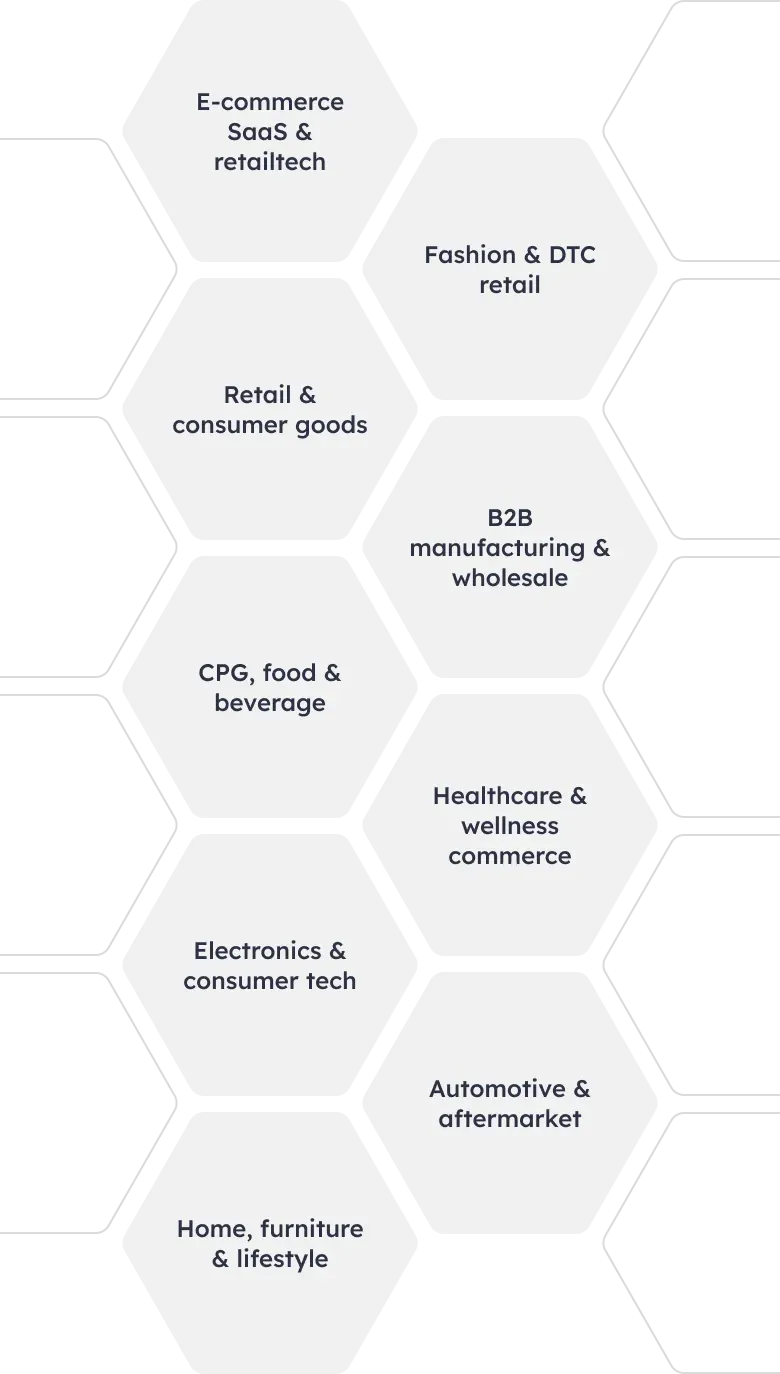
Industries we serve

E-commerce development for US businesses – FAQ
What makes e-commerce development for US businesses different?
How does US sales tax calculation software work for online stores?
Is PCI DSS compliance mandatory for US online stores?
Which e-commerce platforms do you develop on: Shopify Plus, BigCommerce, Salesforce?
Can you migrate our store without losing SEO rankings?
How do you prepare a store for AI shopping agents like ChatGPT or Amazon Rufus?
What is TCPA compliance and why does it matter for SMS marketing?
How much does US e-commerce software development cost?

Ready to build e‑commerce software wired for the US market?