Reservation system in 2026: How modern hotels handle bookings and payments
10 min read
Last updated: Sep 15, 2026
Summary
A hotel guest checks in with a QR code instead of queuing at a desk. A room shows as free on one site while it is already sold on another. Behind both moments sits the same kind of software: a reservation system. It keeps track of what's available, what it costs, and who has already booked it, everywhere a hotel sells rooms. This guide covers what an online hotel reservation system actually does and when hoteliers decide to build their own instead of renting one, drawing on our work in travel & hospitality software development services.
Key takeaways
A reservation system is the operational core behind every booking. The form a guest fills out is only the visible tip of it.
An online hotel reservation system stitches the property management system, the channel manager, payments, and guest records into one working pipeline.
4 setups cover almost every case: an all-in-one rented platform, a connect-anything open system, a mix-and-match setup, and a rebranded platform built by someone else.
For small hotels, a ready-made rented platform gets running faster. For chains, a custom build usually costs less over a 3-year horizon.
A handful of features are not optional: real-time inventory, multi-currency support, and PCI DSS compliance, the standard for handling card payments securely.
Hotels anchor this guide, but the same reservation logic runs tour operators, car rentals, and other bookings across travel and hospitality.

Olga Tsygan
Head of Strategic Partnerships at Modsen
What is a reservation system, and what was its original purpose?
A reservation system has one job: to be the single source of truth for what's available and at what price, so a hotel never sells the same room twice. That is what was the main purpose of the reservation system from the very beginning, and it goes back further than most people expect, to an airline booking system called SABRE, built in the early 1960s. Hotels adopted the same core idea decades later, once electronic reservation systems became affordable enough for a single property rather than only a national airline.
The two terms, electronic and digital, get used loosely, but there is a real difference. Electronic describes the older category: dedicated terminals, closed networks, a specialist needed to make a change. Digital refers to today's systems: running in a browser or an app instead, syncing in real time across every channel a hotel sells through.
How a digital reservation system differs from a paper one
Paper logs and phone calls could not stop two people from booking the same room, could not update in real time when a wholesaler sold a block of rooms, and left no record of who confirmed what, and when. The first electronic reservation systems solved that first problem by putting inventory into a shared database instead of a ledger. Modern systems go further: continuous synchronization across every booking channel, an audit trail for every change, and compatibility with PCI DSS, the payment card industry's data security standard for handling card details safely.
That explains where the system came from. What does it actually look like on the market today?
Types of online hotel reservation systems in 2026
Several broad types cover almost every hotel today, whether it is a boutique property or a link in a two-hundred-room chain.
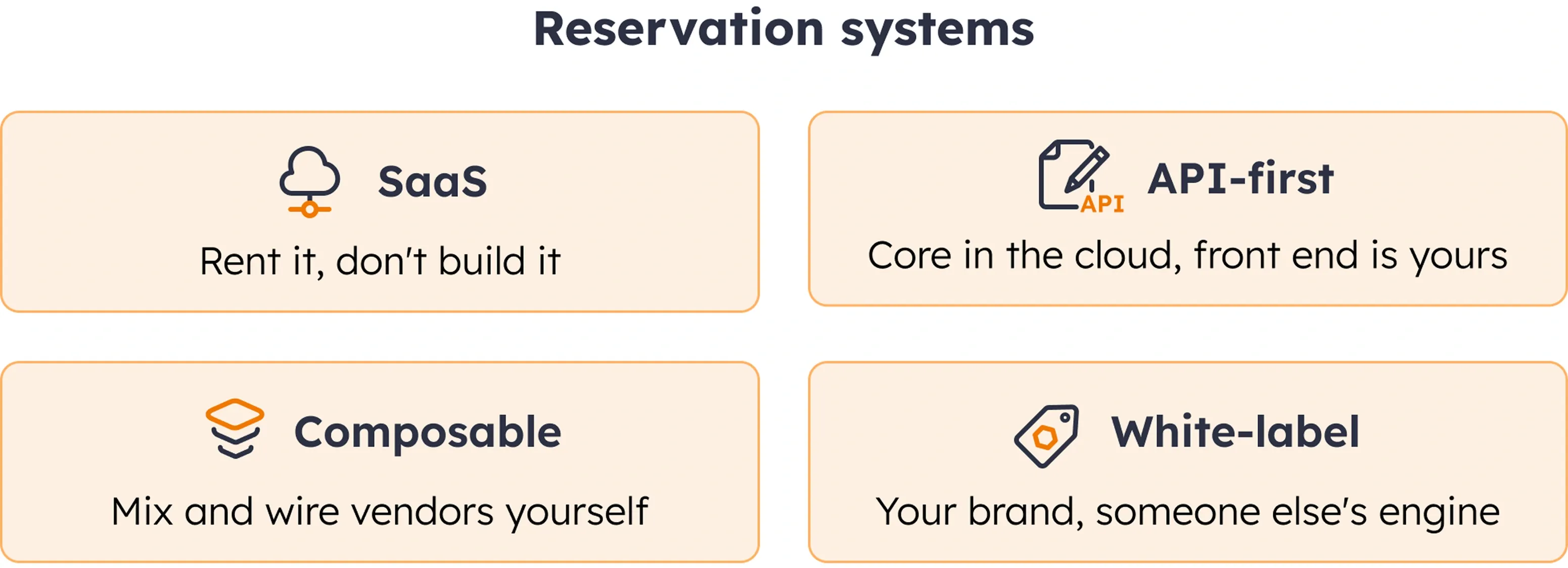
An all-in-one SaaS platform, meaning a hotel rents the software monthly rather than buying and running it, bundles reservations, a basic property management system, and payments into one package, built for a hotel that wants to be live in weeks, not months. An API-first platform keeps the core booking logic in the vendor's cloud but exposes everything through an API, a direct link that lets two pieces of software exchange information automatically instead of a person retyping it twice, so a hotel's own developers or a partner can build custom software development for booking engines on top of it. A composable system goes further, letting a hotel mix inventory, pricing, and payment providers from different vendors and wire them together itself. A white-label booking engine sits at the other end: a hotel's own booking widget on its own domain, running on someone else's systems underneath.
Small, independent properties usually start with SaaS, since speed matters more than control at that stage. Multi-property chains tend to migrate toward API-first or composable setups as soon as a single, generic property management system stops matching how the business actually runs. That migration point is usually where a reservation system stops being generic software bought off a shelf and starts being infrastructure built around one specific business.
The same four types show up outside hotels too. A European travel company added tour and activity bookings across a wider footprint when its old system could not handle the flood of customer data from an expansion into Asia. After a rebuild spanning web and mobile, the company landed in the top 15 travel and hospitality apps in its category and grew yearly revenue by 28%. The architecture question is the same one a hotel faces: which of the four types fits the number of suppliers, currencies, and integrations this specific business actually has. across a wider footprint when its old system could not handle the flood of customer data from an expansion into Asia. After a rebuild spanning web and mobile, the company landed in the top 15 travel and hospitality apps in its category and grew yearly revenue by 28%. The architecture question is the same one a hotel faces: which of the four types fits the number of suppliers, currencies, and integrations this specific business actually has.
Types sorted. But which features actually separate a system that protects revenue from one that just processes bookings?
Features of hotel reservation system that actually move revenue
A system that only takes bookings differs from one that actually protects revenue, and the difference usually shows up first in the numbers nobody checks until something breaks.
Feature | Why it matters |
|---|---|
Real-time inventory | The one number every other feature depends on. Wrong here, wrong everywhere. |
Dynamic pricing | Adjusts rates automatically with demand, so a slow Tuesday doesn't carry a sold-out Saturday's price. |
Multi-currency and multi-language | Lets a guest book and pay in their own currency and language, once bookings come from more than one country. |
Channel manager sync | Keeps rates and availability identical across every online travel agency, such as Booking.com or Expedia, and the hotel's own site, so nobody sells the same room twice. |
Upsell prompts | Offers a better room, early check-in, or breakfast at the exact moment a guest is already committed to booking. |
Group bookings | Handles multiple rooms under one reservation, with its own pricing and cancellation rules. |
Loyalty integration | Recognizes a returning guest and applies their rate or points automatically. |
Payment gateways | Processes deposits, holds, and full payments across the cards and wallets guests actually use. |
Tax rules | Applies the right local tax and tourism levy automatically, since these vary by city and change often. |
Audit logs | Records who changed a rate, a booking, or a refund, and when, which is the first thing anyone asks for after a dispute. |
Airlines proved the dynamic-pricing math first. A 1999 study by Subramanian, Stidham, and Lautenbacher in the journal Transportation Science found that planning ahead for cancellations could lift revenue by up to 9%, and hotel revenue-management systems run on the same logic today, just applied to rooms instead of seats.
A European hotel network with 160 properties across 19 countries learned how much the last one matters by adding a feature many systems treat as an afterthought: letting guests unlock their room and check in with a QR code instead of queuing at a desk. Check-in errors dropped by 90%, and positive guest reviews rose by 40%, once that single feature started working with the rest of the system properly.
None of these factors live in isolation. A hotel online reservation system earns its cost only when they work as one pipeline, not as separate settings screens that happen to share a login.
Features explain what a system should do. Why can some systems actually deliver on them, while others only claim to?
How to design a hotel booking system: architecture and data model
Strip away branding, and most modern platforms share the same five moving parts: a booking engine that runs the actual reservation flow, an inventory service that tracks what is available, a pricing service, a payment gateway, and a connector linking back to the property management system. How well those five pieces talk to each other, more than any single one of them, decides whether the system feels fast or feels like waiting. Baymard Institute's research backs that up with a real number: design changes alone can recover up to 35% of the bookings a hotel would otherwise lose, often more than any single new feature adds. Booking.com's own engineering team has written publicly about exactly this: a ranking system that blends pre-calculated data with live pricing and availability the instant a guest searches.
The data underneath follows a simple hierarchy: a property contains room types, each room type has one or more rate plans, and each rate plan carries its own availability calendar. Get that hierarchy wrong early, and every feature built on top of it, pricing, channel sync, group bookings, inherits the mistake.
For a hotel comparing platforms, online hotel reservation system design increasingly means an API-first approach: the booking logic lives behind a documented API, so a hotel's own design team can build the guest-facing experience separately, without waiting on the vendor's own release schedule. That same connector layer is also where AI is starting to show up. Google added AI-powered hotel booking to its own products in May 2026, letting a guest describe what they want in a sentence and have an AI agent match that request to the right rate plan before a human ever gets involved.
We cover the guest-facing side of that shift in our piece on AI chatbots for hotels, and the engineering side through our AI development services.
Common pitfalls in reservation system design
Three mistakes show up again and again, even in systems built by capable teams.
The most common one is a double booking or a double charge. It happens two ways: either two different guests try to book the same room within the same few seconds, and both get confirmed before either request checks the other, or one guest's own payment gets sent twice, because their browser retried a slow connection or a channel manager accidentally resent the same booking. A well-built system checks whether that exact room, or that exact payment, was already claimed before confirming anything a second time.
Currency rounding causes small, compounding errors: a rate converted across three currencies rarely lands on the same number twice, and guests notice fifty-cent discrepancies faster than most support teams expect. Tax calculation causes the quietest damage: a local tourism levy applied incorrectly does not show up as a bug report. It shows up months later as an accounting problem nobody can trace back to its source.
Architecture explains how the big reservation systems get built. What actually fits a ten-room property that will never need any of this at full scale?
Does your reservation system scale with your growing business?
Share where your business is headed in a free consultation. Let's assess whether your current setup can keep up for whatever comes next.
Online reservation system for small hotels: what fits under 30 rooms
Below roughly thirty rooms, the math for an online reservation system for small hotels almost always favors a subscription. A SaaS platform in this range typically runs $50 to $200 a month, live within one to two weeks, with no engineering hire required. Custom development rarely makes sense at this scale: booking volume is not enough to earn back a build that costs tens of thousands of dollars before it processes a single reservation.
If the property grows, adds a second location, or needs an integration a SaaS vendor simply will not build, that is usually the first honest signal to bring in a partner for a quick consult on the right size, the kind that helps a hotel choose rather than sell.
Custom-built systems start earning their cost the moment a business needs rules a generic platform cannot support. Take a rail passenger company we have worked with (see the full case study), which started with a simple goal: sell train tickets and run a loyalty program. Over time that grew into something no off-the-shelf booking tool could have supported, a single app that books trains and hotel stays together and even sells a subscription for a fixed, reduced ticket price. A generic booking tool can sell a room well enough. It has no way to combine that room with a train ticket and a loyalty discount, because that combination belongs to one specific business, not to a shared platform built for thousands of customers at once.
Whichever direction a hotel leans, the same question applies before signing anything: what to look for in online hotel reservation system software is less about the length of the feature list and more about which of the ten features from earlier the vendor can prove with a live client, not a demo environment.
FAQ
What is a reservation system in simple terms?
What was the main purpose of the reservation system historically?
How much does an online hotel reservation system cost?
What are the must-have features of a hotel reservation system?
Can a small hotel use the same reservation system as a chain?
Conclusion
A hotel can check every box on the features table above and still fail the moment two systems disagree about what a room actually costs right now. The real test comes down to architecture, not how long the feature list runs, because every guest who books a room is trusting that the system behind it will actually keep its word.
That is the conversation worth having before choosing a platform or a partner, not after, since architecture is far easier to get right at the start than to rebuild once staff and guests already depend on it every day. If your hotel or group is weighing that decision, contact us and we're glad to help think it through. and we're glad to help think it through.

Get a weekly dose of first-hand tech insights delivered directly to your inbox