
AI FRAUD DETECTION: SOFTWARE ARCHITECTURE, KEY FEATURES, AND DEVELOPMENT GUIDE
10 min read
Last updated: Jul 13, 2026
Summary
The fight against payment fraud is far from over, but recent data suggests that banks are making progress. According to the Nilson Report, global card fraud losses fell by 1.2% in 2024 to $33.41 billion despite total card transaction volume reaching $51.9 trillion – the first meaningful decline after years of steady growth. However, the same report projects losses will rise again to approximately $48.5 billion by 2034 as digital payment volumes continue to expand. This highlights a growing challenge for financial institutions: fraud prevention must improve faster than transaction growth.
Industry data points to AI as a major reason for that progress. Mastercard reports that AI-powered fraud prevention systems can significantly reduce both fraud losses and false declines compared to traditional rule-based approaches.
This guide explains how modern AI fraud detection works in practice – from machine learning models and real-time architectures to implementation timelines, costs, and operational requirements. If you are looking for practical approaches to reducing fraud without overwhelming analysts with false positives, this is where to start.
Key takeaways
Effective AI fraud detection combines real-time scoring, behavioral biometrics, device intelligence, graph analysis, case management, and continuous feedback loops.
No single model used in fraud detection catches everything – effective systems combine a few types, each tuned to a different kind of fraud.
A real-time fraud detection system checks each payment in a fraction of a second – gathering context, scoring the risk, deciding to approve or block, and learning from the result – fast enough that the customer never notices.
Most implementations progress through discovery, MVP, pilot, and scale-out phases, with production deployment typically taking four to six months.
Costs generally range from $80K to $200K for an MVP and from $150K to $500K for a fully governed production system.

Dmitry Grishanovich
Head of .NET Department at Modsen
What is AI fraud detection in banking?
AI fraud detection is the use of machine learning to score transactions and account activity in real time, flagging behavior that deviates from a customer's normal patterns and the patterns of known fraud. Unlike a fixed checklist, it learns from outcomes and adapts as criminals change tactics. In practice, an effective anti-fraud system evaluates hundreds of signals per event – amount, location, device, velocity, and merchant category – and returns a risk score in milliseconds.
Most institutions face three broad categories of fraud, and fraud detection in banking has to cover all of them. Payment fraud involves unauthorized transactions on a legitimate card or account. Identity fraud uses stolen or synthetic identities to open new accounts. Account takeover happens when a criminal gains control of a genuine customer's credentials. Each leaves a distinct fingerprint, so a credible anti-fraud system blends models rather than relying on a single universal classifier.
AI fraud detection vs traditional rules engines
Traditional rules engines work on predefined conditions: if a transaction exceeds a certain amount or comes from a flagged country, it is automatically declined. They are easy to implement, transparent, and effective for simple policies, but they are also static. Once fraudsters understand the rules, they can often adjust their behavior to avoid triggering them.
The biggest limitation is that the same rule applies to every transaction, regardless of context. A customer making an unusually large but legitimate purchase may be treated the same way as a fraudster attempting a suspicious payment. This creates a high number of false positives, forcing analysts to review unnecessary cases and frustrating customers whose payments are declined by mistake. Machine learning addresses this by evaluating each transaction in context rather than relying on fixed thresholds. According to Mastercard, 83% of industry leaders say AI has significantly reduced both false positives and customer churn over the past year, demonstrating the value of adaptive fraud detection.
The practical solution is not to replace rules entirely but to combine them with AI. Most mature fraud prevention programs use a hybrid approach: hard rules handle non-negotiable policies such as sanctions and mandatory blocks, while machine learning models evaluate more complex transactions by considering multiple signals at once, including customer behavior, device information, and transaction history. This approach delivers stronger fraud protection while keeping false positives under control, although it requires ongoing model monitoring and retraining.
Adaptability
Rules engine
Static, updated manually
ML-based detection
Continuously learns from new fraud patterns
False positives
Rules engine
Higher (more legitimate payments flagged)
ML-based detection
Lower (better context-aware decisions)
Decision logic
Rules engine
Based on fixed rules and thresholds
ML-based detection
Based on multiple signals and risk scoring
Maintenance
Rules engine
Requires frequent rule updates
ML-based detection
Requires model monitoring and retraining
Key features of an AI fraud detection system
A production-grade AI fraud detection platform is more than a machine learning model. It combines several components that work together to detect, investigate, and prevent fraud. Eight capabilities are essential:
1. Real-time risk scoring – every payment is checked the instant it happens, not reviewed hours later.
2. Device fingerprinting – the system recognizes the phones and computers a customer normally uses and notices an unfamiliar one.
3. Behavioral biometrics – it learns how a person types, swipes, and navigates, which is far harder to fake than a stolen password.
4. Graph-based link analysis – it spots when many seemingly unrelated accounts are secretly connected, exposing organized fraud rings.
5. Case management tools – a workspace where human analysts review and resolve the cases the system flags.
6. Feedback loops – every confirmed result teaches the system to make better decisions next time.
7. Explainability dashboards – for each decision, the system can show why a payment was flagged instead of acting as a black box.
8. Automated regulatory reporting – it automatically produces the records that regulators require.
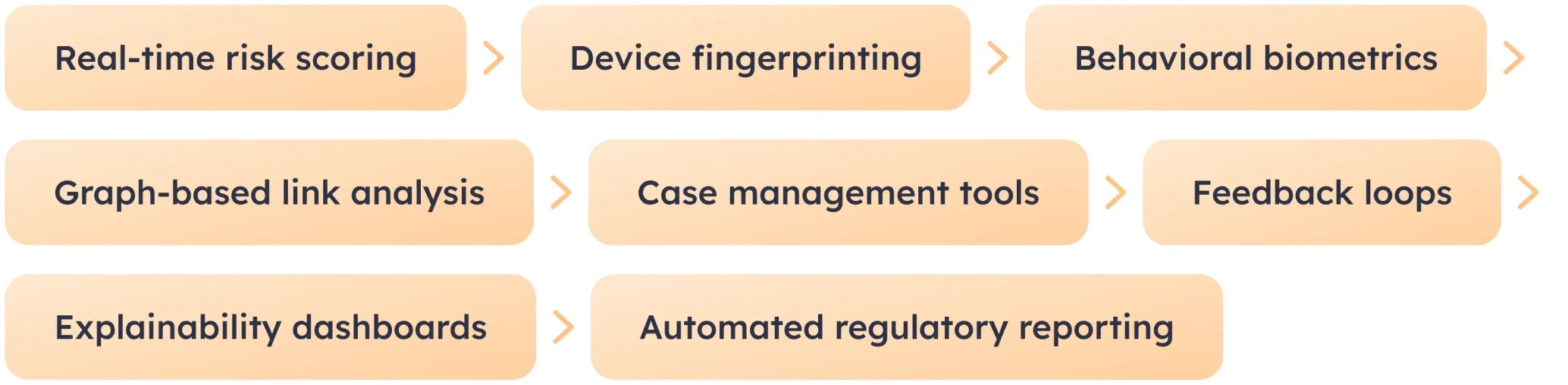
Effective payment fraud detection depends on all eight capabilities working together. Weaknesses in any one area can create opportunities for fraudsters to bypass controls.
Real-time AI transaction monitoring
AI transaction monitoring checks each payment the moment it happens – fast enough that a customer waiting at checkout never notices the pause. To do that, the system instantly pulls together the context it needs, such as the customer's recent activity, the device in use, and how this payment compares to their normal habits.
The goal is simple: stop a fraudulent payment before the money moves, not discover it afterward. Reliable AI transaction monitoring systems also keep a tamper-proof record of every decision, which makes later investigations, customer disputes, and regulatory checks far easier to handle.
Behavioral biometrics and device intelligence
Passwords and one-time codes verify credentials, but they cannot confirm that the person using them is the legitimate account owner. Behavioral biometrics adds this layer of protection by analyzing keystroke patterns, mouse movements, touch interactions, and navigation behavior, then comparing live activity against a customer's established profile.
Combined with device fingerprinting – a unique device signature based on browser, operating system, and hardware characteristics – these signals provide one of the strongest defenses against account takeover. Even when criminals obtain valid credentials, they rarely use the account in the same way as the genuine customer.
ML models used in fraud detection and credit risk
There is no single best algorithm for fraud detection or credit risk. Different model families solve different problems, and successful fraud detection in banking using machine learning depends on choosing the right tool for the task.
Supervised models (XGBoost, LightGBM) – the reliable workhorse for fraud the system has seen before. They are fast and accurate, and usually the first choice for catching known patterns.
Unsupervised models (Isolation Forest, autoencoders) – the early-warning system for brand-new scams. They flag anything that simply looks abnormal, even when no one has seen that trick before.
Graph models, or graph neural networks (GNNs) – the detective for organized crime. They reveal when many seemingly separate customers, devices, and accounts are secretly linked, exposing fraud rings that one-by-one checks miss.
Deep learning models (transformers) – the long-game spotter. They track patterns across a customer's full history, catching fraud that develops slowly, in small steps spread out over time.
This same toolkit also powers credit risk modeling. Since the signals that flag fraud also improve machine learning credit scoring, many banks build one shared data platform that serves both their fraud and credit risk modeling teams. For a broader view of how these technologies fit into modern financial products, see our AI in financial services hub.
Architecture: building real-time fraud detection at scale
A typical architecture for real-time fraud detection is easiest to follow by tracking a single payment. From the moment a customer taps their card or hits pay, the system does four things in a fraction of a second:
1. It gathers context. Before judging the payment, the system pulls together what it already knows – the customer's recent activity, the device they are using, their location, and how all of it compares to their normal habits.
2. It scores the risk. The AI weighs every signal at once and produces a single risk score, from completely normal to almost certainly fraud.
3. It decides. A low score is approved instantly. A borderline score triggers an extra check, such as a one-time code. A high score is blocked on the spot – before any money moves.
4. It learns. Once the bank confirms whether a flagged payment was truly fraud, that result is fed back into the system, so it keeps getting sharper.
Two things make this hard to build. The check has to finish in well under a tenth of a second, so the customer never feels a delay – and it has to do that for thousands of payments every second when traffic peaks. Getting both speed and accuracy at once is the real challenge of AI transaction monitoring. Many teams also use generative AI for fraud alert summarization to convert technical alerts into concise case summaries, allowing analysts to focus on decisions rather than reviewing raw logs.
Build phases, timelines, and costs
Building an in-house fraud detection platform is typically a phased investment rather than a single project. Most organizations follow four stages on the path from concept to production deployment.
Discovery
Timeline
~2 weeks
Cost
$15K-$30K
Outcome
Data audit, fraud taxonomy, success metrics
MVP model + integration
Timeline
8-12 weeks
Cost
$80K-$200K
Outcome
First scoring model deployed on live traffic
Pilot + governance
Timeline
~4 weeks
Cost
$40K-$80K
Outcome
Monitoring, explainability, model risk controls
Scale-out
Timeline
Ongoing
Cost
Variable
Outcome
Increased throughput, retraining, new fraud coverage
Most teams reach production within four to six months, with total investment commonly ranging between $150K and $500K depending on transaction volume, compliance requirements, and integration complexity.
The build-versus-buy decision remains an important consideration. Off-the-shelf platforms can accelerate deployment but often limit customization, while a custom platform provides greater control over data, models, and a long-term roadmap. The delivery model matters as well, which is why many organizations evaluate staff augmentation vs full fintech outsourcing before starting implementation.
This is exactly where the Modsen fintech engineering team typically helps. Leveraging proven fintech case studies as real-world examples of delivered solutions, we support discovery, architecture design, model development, integrations, and production deployment.
For companies integrating fraud engines into broader digital products, our custom software development services and fintech app development guide provide additional implementation perspectives.
FAQ
How to detect fraud in banking with AI?
What is the difference between rule-based and AI fraud detection?
What ML models are best for payment fraud detection?
How much does it cost to build an AI fraud detection system?
Can AI fraud detection work in real time under 100ms?
Conclusion
The direction of the industry is clear: fraud prevention is moving from static, rule-based systems to adaptive, data-driven platforms. AI fraud detection enables financial institutions to identify complex fraud patterns, reduce false positives, and make decisions fast enough to stop suspicious transactions before settlement.
But putting an AI fraud detection system into production successfully takes more than an accurate model. It also depends on the right architecture, high-quality data, solid operational processes, and ongoing model governance. Organizations that invest in these foundations are far better positioned to scale fraud prevention as transaction volumes grow and fraud tactics keep evolving.
If you are evaluating an AI fraud detection initiative, a focused discovery phase is often the most effective first step. Modsen team can help assess your data, define the architecture, estimate timelines, and determine whether a custom solution or an existing platform is the better fit for your business goals.
References
Read more






Get a weekly dose of first-hand tech insights delivered directly to your inbox