
Composable commerce in 2026: architecture patterns and vendors
9 min read
Last updated: Jul 24, 2026
Summary
Composable commerce is an architecture approach where best-of-breed modules – catalog, checkout, search, payments, content – connect via APIs instead of being locked inside a single monolithic platform. The difference matters because you can replace any module independently, without replatforming the entire stack.
Here you'll learn what composable commerce is and how it differs from headless, the four MACH building blocks, the vendor landscape in 2026, a realistic migration roadmap with timelines and risks, and why B2B retailers benefit most. If your team is already evaluating platforms or planning a migration, Modsen e-commerce engineering team can help scope the work before you commit to a direction.
Key takeaways
Composable commerce ia best-of-breed modules connected via APIs. Every capability is a separate, replaceable service. Nothing is hardwired together.
MACH is the technical standard that defines what a composable stack looks like.
Every composable stack is built from five vendor categories: commerce engine, front-end framework, headless CMS, search, and payments.
Migration takes 9–18 months using a strangler-fig approach: replace one domain at a time, never a full cutover. The SEO cutover phase carries the highest risk.
B2B ecommerce benefits most from composable: custom pricing per buyer, quote-to-cash workflows, ecommerce ERP integration, and multi-buyer accounts are genuinely difficult on monolithic platforms.

Aleksandr Yakavets
Head of PMO at Modsen
What is composable commerce? Definition and comparison


Composable commerce is an architectural pattern where every capability – catalog management, search, checkout, payments, content, identity – exists as a separate, loosely-coupled service.
Each service exposes an API (a standardized interface that lets other services request data or trigger actions without knowing how the service works internally). The front-end and other services call those APIs. Nothing is hardwired together, which means you can swap a payment provider or a search engine without touching the rest of the platform.
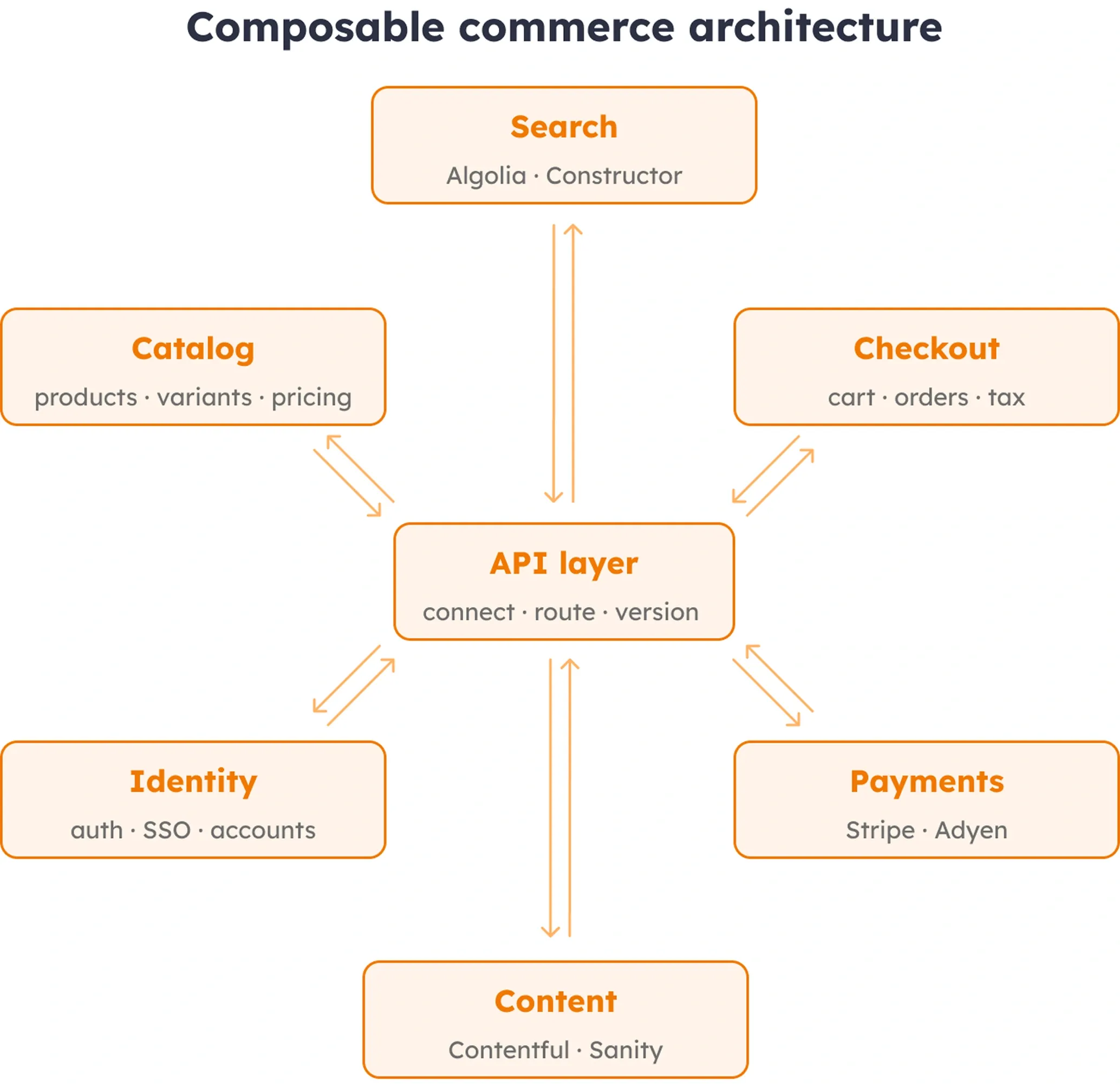
Each module is independently replaceable
That's the structural difference from headless ecommerce, which decouples only the presentation layer from a commerce engine that still bundles everything else together. With headless, you get a flexible front-end (what customers see). With composable, you get flexible everything. Search and AI personalization are typically the first modules retailers replace on a composable stack – see how AI personalization, recommendations and search work for what that looks like in practice.
Composable vs headless vs monolithic: quick comparison
Monolithic
Examples
Shopify, Salesforce CC
What's decoupled
Nothing
Customization
Limited by platform
Time to market
Fast
Total cost of ownership
Low initially
Headless
Examples
Shopify Headless, BigCommerce
What's decoupled
Front-end only
Customization
High (front-end)
Time to market
Medium
Total cost of ownership
Medium
Composable
Examples
Сommercetools, Saleor, Spryker
What's decoupled
Every module independently
Customization
Unlimited
Time to market
Slow initially, fast at scale
Total cost of ownership
High initially, lower long-ter
Monolithic platforms work well at the start. The problems appear when your sales volume grows and your business needs things the platform wasn't built for – custom pricing rules, a faster search, a checkout flow.
Headless ecommerce platforms are the middle step: you replace the front-end while keeping the same commerce engine underneath. More flexibility, less disruption.
Composable platforms go further. You replace individual back-end capabilities one at a time – swap the search for one that handles scale, rebuild the checkout to improve conversion, bring in a CMS your merchandising team can actually operate without developer help.
Why headless e-commerce is foundational for composable
Headless commerce separates the storefront from the commerce engine. The storefront calls the engine via API to get product data, prices, and cart logic but neither knows how the other works internally. You can redesign the storefront without touching the back-end, or replace the back-end without rebuilding the storefront.
Composable takes that further. Instead of one commerce engine bundling everything together, every capability becomes its own independent service: catalog, search, checkout, payments, content – each separate, each replaceable. They communicate only through APIs, so swapping one doesn't affect the others.
A practical example: your search is slow. On a monolith, that's a platform problem – expensive and risky to fix. On a composable stack, you swap the search service, update one API endpoint, and everything else keeps running.
MACH architecture: the 4 building blocks, Alliance
MACH is the technical standard that defines what a composable commerce stack looks like under the hood. The four letters describe the four architectural requirements every component in the stack must meet.
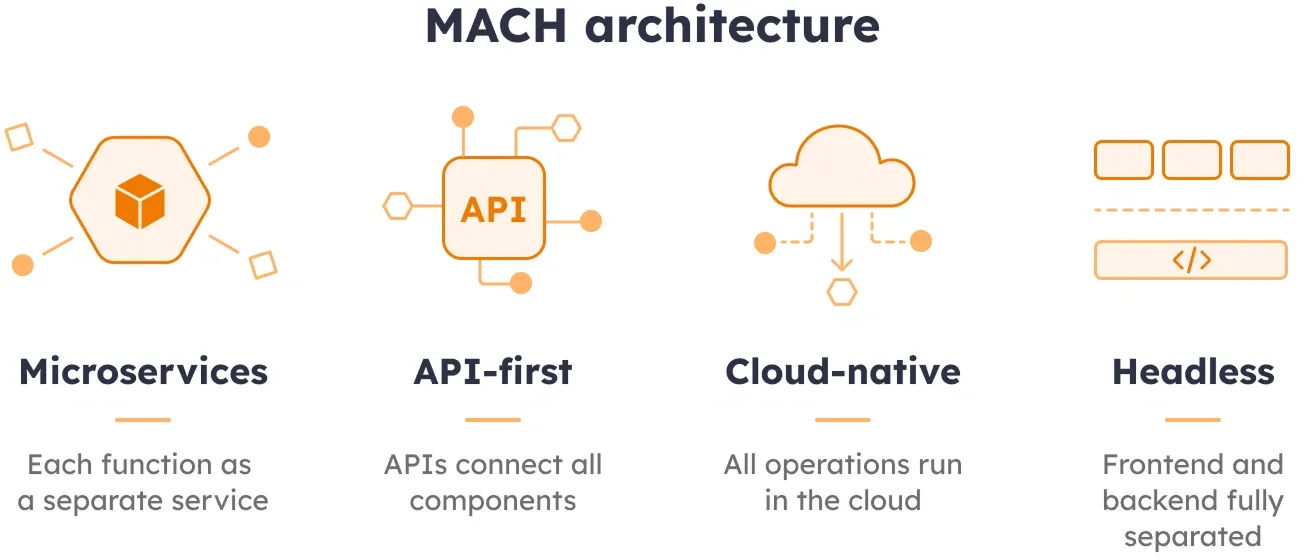
M – Microservices. Each commerce capability is a separate service with its own database and deployment pipeline. The product catalog is a service. The order management system is a service. When catalog search gets slow, you scale that service independently.
A – API-first. Every capability is exposed through an API. No capability is accessible except through an API – no direct database calls, no shared libraries. Ecosystem is composable: any front-end or service can call any other service through a documented, stable interface.
C – Cloud-native. Infrastructure runs on SaaS platforms (AWS, GCP, Azure) that auto-scale without manual intervention. The platform scales when Black Friday traffic spikes; you pay for what you use.
H – Headless. The presentation layer is fully decoupled from the commerce engine. One API serves web, mobile app, kiosk, and voice – the same product data, pricing, and cart logic everywhere.
MACH has an Alliance.
The MACH Alliance is an industry body that certifies vendors whose products meet MACH standards.
Building on a MACH-certified stack has become the standard approach for large retailers. The MACH Alliance's 2025 Global Annual Research surveyed 561 IT decision-makers and found that 87% of organizations have widely implemented MACH technologies. The top three benefits they reported: better customer experience (55%), greater automation (54%), and faster ability to adapt to change (50%).
When does it make sense to go MACH? When your business is big enough that the limitations of a monolithic platform are actively costing you money. You want to add chat, voice, or messenger – each new channel needs its own frontend calling the same commerce APIs, which is exactly what conversational commerce layers are built on.
Planning a composable commerce migration?
Leave your email and Modsen e-commerce engineering team will walk you through what the build actually involves for your stack.
Composable commerce vendors compared in 2026
Every composable commerce stack is assembled from five categories of tools – one for each core capability, each connected to the others via API.
What it does
Commerce engine
Manages product catalog, pricing, orders, and customer accounts. The most critical choice in the stack.
Front-end framework
The storefront layer that calls the commerce engine and other services via API. Serves web, mobile, and other channels from the same codebase.
Headless CMS ecommerce
Manages editorial content (banners, landing pages, campaign copy) separately from the product catalog.
Search
Handles product discovery, filtering, and ranking. A dedicated search service consistently outperforms native platform search on conversion. Headless ecommerce development almost always includes a dedicated search layer.
Payments
Processes transactions, handles refunds, manages multi-currency and local payment methods.
What to look for
Commerce engine
B2B support, GraphQL API, multi-currency, open-source vs proprietary license
Front-end framework
Next.js or Vue compatibility, performance, developer experience
Headless CMS ecommerce
Structured content model, real-time editing, API-first
Search
AI re-ranking, typo tolerance, faceted filtering, latency under 100ms
Payments
Developer API quality, multi-currency support, enterprise acquiring
Migration to composable: roadmap and risks
A composable commerce migration is a phased replacement of one domain at a time.
The approach is to run the old system alongside the new one, migrate one capability, validate, then move to the next. Never a full cutover.
1. Audit
Inventory all existing integrations, identify performance bottlenecks and platform limitations.
Output: an integration map and a prioritized list of domains to migrate first.
2. API boundary definition
Map domains (catalog, orders, customers, content) and define API contracts for each before any build begins.
Output: API specification documents.
3. Strangler-fig migration
Replace one domain at a time. Start with lower-risk internal tools (search, CMS) before touching customer-facing checkout. Each migrated service runs in parallel with the monolith until validated.
4. Data migration
Migrate catalog, customer records, and order history with validation checkpoints at each stage.
Output: clean data in the new system, legacy system archived.
5. Cutover and SEO protection
301 redirects, canonical tags, pre-migration crawl, post-migration traffic monitoring. This is the highest-risk phase of any ecommerce platform migration – staged rollouts with redirects in place before decommissioning old URLs are non-negotiable.
Ecommerce platform migration risks
1. SEO drop
URL structure changes during migration cause temporary ranking drops.
Mitigation: staged cutover, 301 redirects in place before decommissioning old URLs.
2. Integration debt
Composable adds integration points. Each API call is a potential failure mode.
Mitigation: define API contracts before build begins, not after.
3. Vendor lock-in
Some "composable" vendors use proprietary APIs that create the same lock-in as a monolith.
Mitigation: prioritize open standards (GraphQL, REST), avoid proprietary query languages.
Ecommerce automation plays a role in migration: catalog sync, customer data validation, and redirect mapping can be automated to reduce manual error. Teams that skip automation in these steps typically extend timelines by 30–50%.
For examples of how composable migrations play out in practice, see Modsen e-commerce case studies.
Why B2B e-commerce needs composable more than B2C
B2B ecommerce requirements are genuinely too complex for monolithic platforms. Monoliths handle them through workarounds that break on every platform update. Composable commerce handles them as separate, independent services.
The four capabilities that matter most for B2B:
Custom pricing per segment – each buyer sees prices based on their negotiated contract.
Quote-to-cash workflows – quote generation, approval, and order conversion integrated with ecommerce ERP systems like SAP, NetSuite, or Microsoft Dynamics. Ecommerce CRM integration (Salesforce, HubSpot) feeds order history back to the sales team, closing the loop between commerce and the sales pipeline.
Multi-buyer accounts – a purchasing department with multiple buyers, each with different permission levels and spending limits. .
Approval flows – orders above a threshold route to a manager before checkout completes.
For how AI agents will automate parts of the B2B buying process via autonomous quote requests, approval routing, procurement recommendations see how AI agents will reshape online shopping.
FAQ
What is composable commerce in 2026?
How is composable commerce different from headless?
How long does composable migration take?
Which composable commerce vendors are leading in 2026?
Does composable commerce work for B2B?
Conclusion
Composable commerce is an architectural decision that pays off when your business outgrows what a single platform can handle. The flexibility to replace any module independently, add new channels without rebuilding the backend, and support B2B workflows that monolithic platforms simply weren't designed for – that's the return on the investment.
If that's where you are, Modsen works with retailers on migration planning, API boundary definition, and vendor selection. For broader engineering scope, see our custom software development services.
References
Read more




Get a weekly dose of first-hand tech insights delivered directly to your inbox