
AI ecommerce in 2026: personalization, recommendations and search
11 min read
Last updated: Jul 25, 2026
Summary
AI ecommerce runs behind the product pages, search bars and recommendation blocks that convert well in 2026. That’s the default setup now, already running at scale. Three areas carry most of that result: personalization, recommendations and search. Most guides jump straight to feature lists and skip the part that actually matters: what changes in a store, what it costs to add, and where to start. This guide fills that gap.
Key takeaways
AI has moved from an optional add-on to the default layer behind product discovery, search and support in 2026.
Personalized offers can bring in up to three times the ROI of mass promotions.
Semantic search is replacing keyword search for product discovery across mid-size and enterprise catalogs.
A well-built ecommerce recommendation engine can drive up to a third of a store’s purchases.
Conversational and agentic commerce sit one layer above AI ecommerce, using the same personalization and search foundations to power chat- and agent-driven shopping.

Aleksandr Yakavets
Head of PMO at Modsen
What is AI ecommerce? Definition and scope
AI powered ecommerce is machine learning and generative AI running inside search, recommendations, personalization and back-office work, not as an add-on, but as the system a store runs on in 2026.
We’ve watched that shift happen in real time, from two angles. On the one hand, we build AI features for ecommerce clients, project by project, and that teaches you a lot, but only about the clients you have. The fix for that is simple: we also spend time at industry events, Ecommerce Berlin Expo among them, where the rest of the industry compares notes out loud.
Three years ago at that same expo, AI got its own stage for the first time, but most talks were still about the future: VR, Web3, what shopping might look like in 2030. A year later, organizers summed up the shift in one line: AI ecommerce and automation are no longer the future, they’re essential now. This year, the opening keynote pushed it further, go AI-first or risk falling behind, and OTTO brought a Chief AI Officer on stage, a title that barely existed a few years ago.
Three years, and the picture didn’t just change, it flipped. Speculation became a keynote, and the keynote became a mandate. That’s the pace stores need to build for now, and it’s exactly what our сustom ecommerce development company does every day. So before anything else, it’s worth being precise about what “AI” even means here, because not all of it works the same way.
Classical AI, GenAI and agentic commerce: How they differ
Classical AI handles scoring and classification: fraud checks, churn prediction, demand forecasts. Generative AI produces content: product descriptions, chat replies, personalized emails. Agentic commerce goes further and lets a system act on its own, assisting in completing a purchase or adjusting a price within limits a human set in advance.
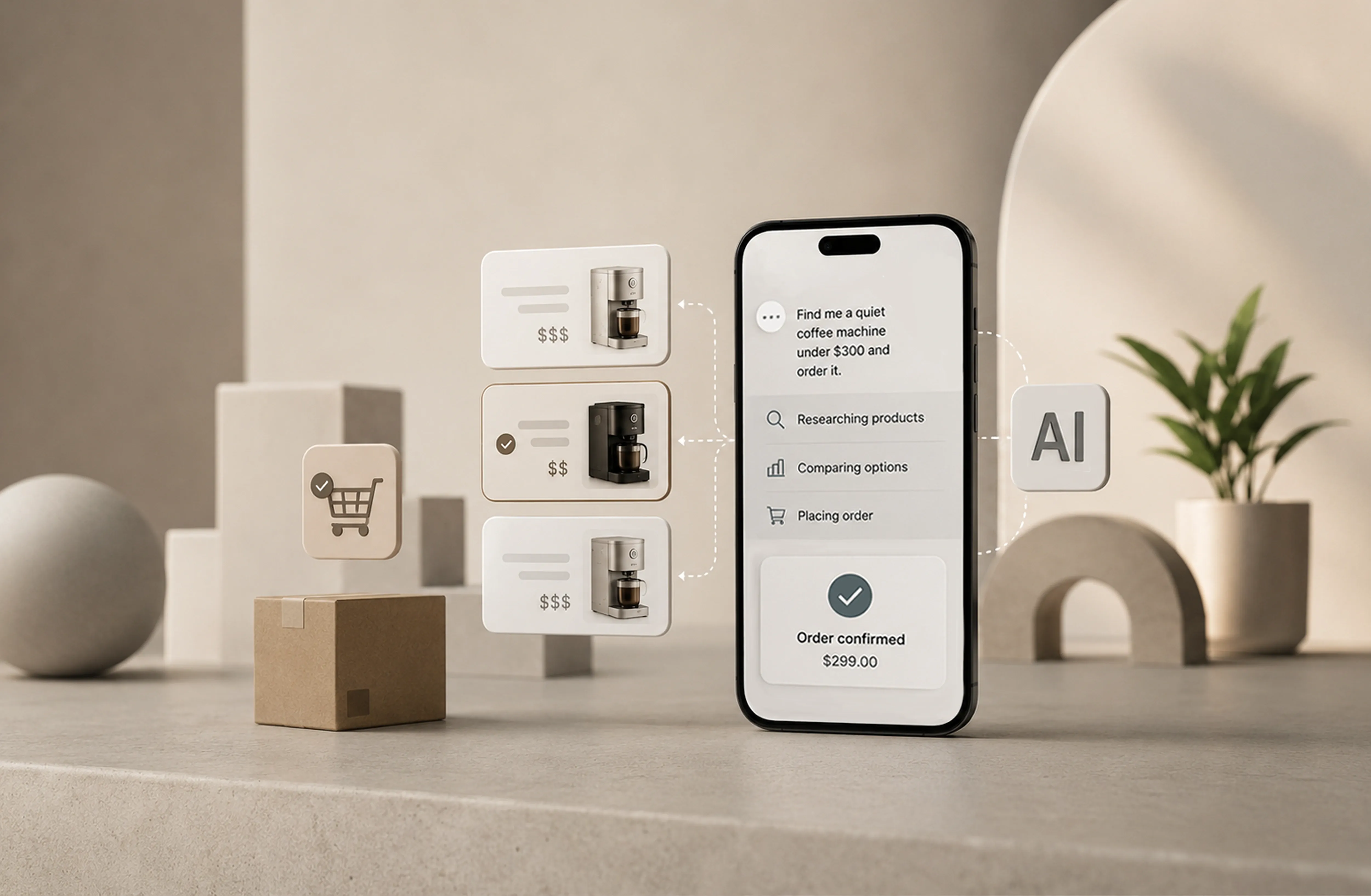
A real store uses all three at once. A recommendation might come from classical scoring, the text next to it from generative AI, and a shopping assistant that checks out on a customer’s behalf from an agent. Much of this shows up first in conversational commerce, where a chat window replaces a search bar, and the line between browsing and buying gets thin. We cover that layer on its own in how chat, voice and messenger drive online sales, and the agent side in how AI agents will reshape online shopping.
But definitions aside, the practical question for most teams is where AI actually earns its budget. Personalization is usually the first place to look.
Where does AI actually earn its budget in your store?
Book a free consultation with Modsen – we’ll help you find the AI investment with the fastest payback.
AI ecommerce personalization: How real-time intent reshapes product discovery
Personalization used to mean showing a name in an email and grouping shoppers by age and location. Not much, you might think, next to what AI ecommerce can do in 2026. But that basic version, a year before ChatGPT even existed, already lifted revenue by 10 to 15 percent, according to McKinsey. Now add real-time intent signals on top: clickstream data, time spent on a product page, and behavior patterns that update as a session goes on. Some platforms also write product descriptions on the fly with an LLM, matching tone and detail to what a specific shopper seems to want. This is AI ecommerce personalization in practice, not a plan for next year.
The numbers only got stronger since then. BCG’s research found that personalized offers bring in three times the ROI of mass promotions. Vendors building this layer include Algolia AI, Bloomreach, Constructor.io and Dynamic Yield, each with a different mix of search, merchandising and email personalization.
Privacy rules shape what’s possible here. GDPR and similar laws require consent for behavior tracking, which pushes teams toward first-party data collected with clear permission, instead of third-party tracking bought from data brokers.
But where does that data actually come from, and which signals inside it matter most?
AI ecommerce personalization data: sources and signals
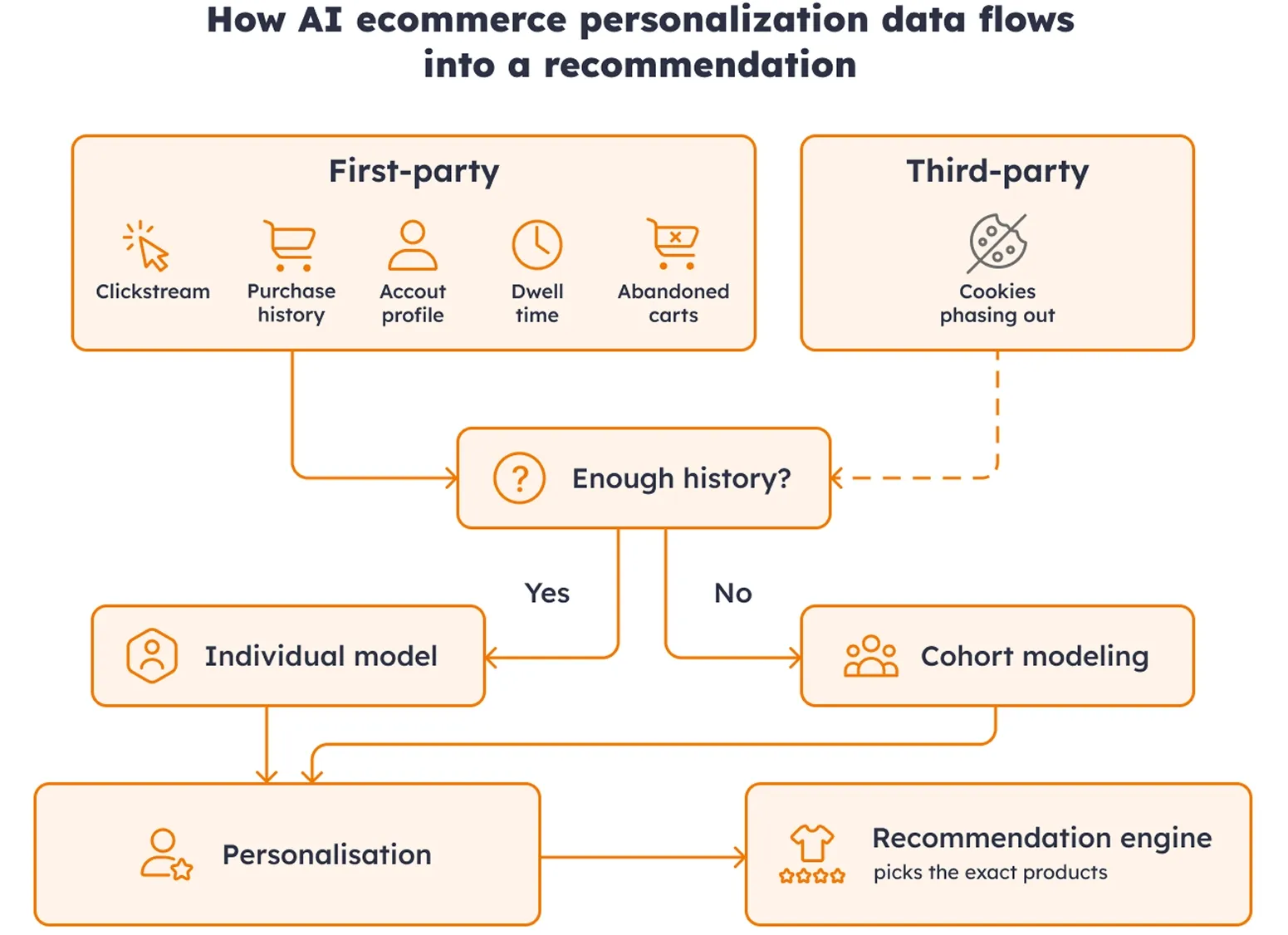
First-party signals carry the most weight: clickstream behavior (what a shopper clicks and in what order), purchase history, account profile data, dwell time on product pages, and abandoned carts. These sources belong to the retailer and don’t depend on external cookies.
Third-party data is a shrinking category. Browsers are phasing out cookies, so personalization teams now lean more on first-party data and on data-sharing deals built on clear consent. Cohort modeling, grouping shoppers by shared behavior instead of tracking each one alone, works as a backup when one shopper’s history is too short to build a model just for them.
Personalization shapes what a shopper sees through the whole visit. An ecommerce recommendation engine is the part that picks the exact products in front of them, and that’s worth a closer look on its own.
Ecommerce recommendation engine architecture and use cases
Recommendation engines are one of the clearest, most measurable parts of AI powered ecommerce, because unlike personalization or search, you can usually point to the exact block on the page that made the sale. It can run on collaborative filtering (what similar shoppers bought), content-based filtering (what’s similar to items a shopper already viewed), or a mix of both. Newer engines also use vector embeddings, a way for an LLM to turn each product into a set of numbers that capture what it’s actually like. That lets the engine match products that are similar in meaning even when they share no keywords or category tags.
The common use cases sit at four points in the shopping journey: “customers also viewed” on the product page, “complete the look” in the cart, recommendation blocks in retargeting emails, and search results re-ranked based on a shopper’s history. An often-repeated McKinsey estimate says recommendations drive around 35 percent of Amazon’s revenue. That number goes back to 2013 and is hard to check today, but it’s still used as a rough benchmark for how much a good recommendation engine can add.
Teams building this piece of an AI ecommerce stack choose between buying a ready-made platform or building on a vector database, paired with their own model. See real recommendation-engine projects and more in Modsen ecommerce case studies.
So that’s recommendations to tell a shopper what to buy next. Search decides whether they find anything worth buying in the first place, and that part of the store just went through its biggest change in years.
AI powered search: semantic, visual and conversational
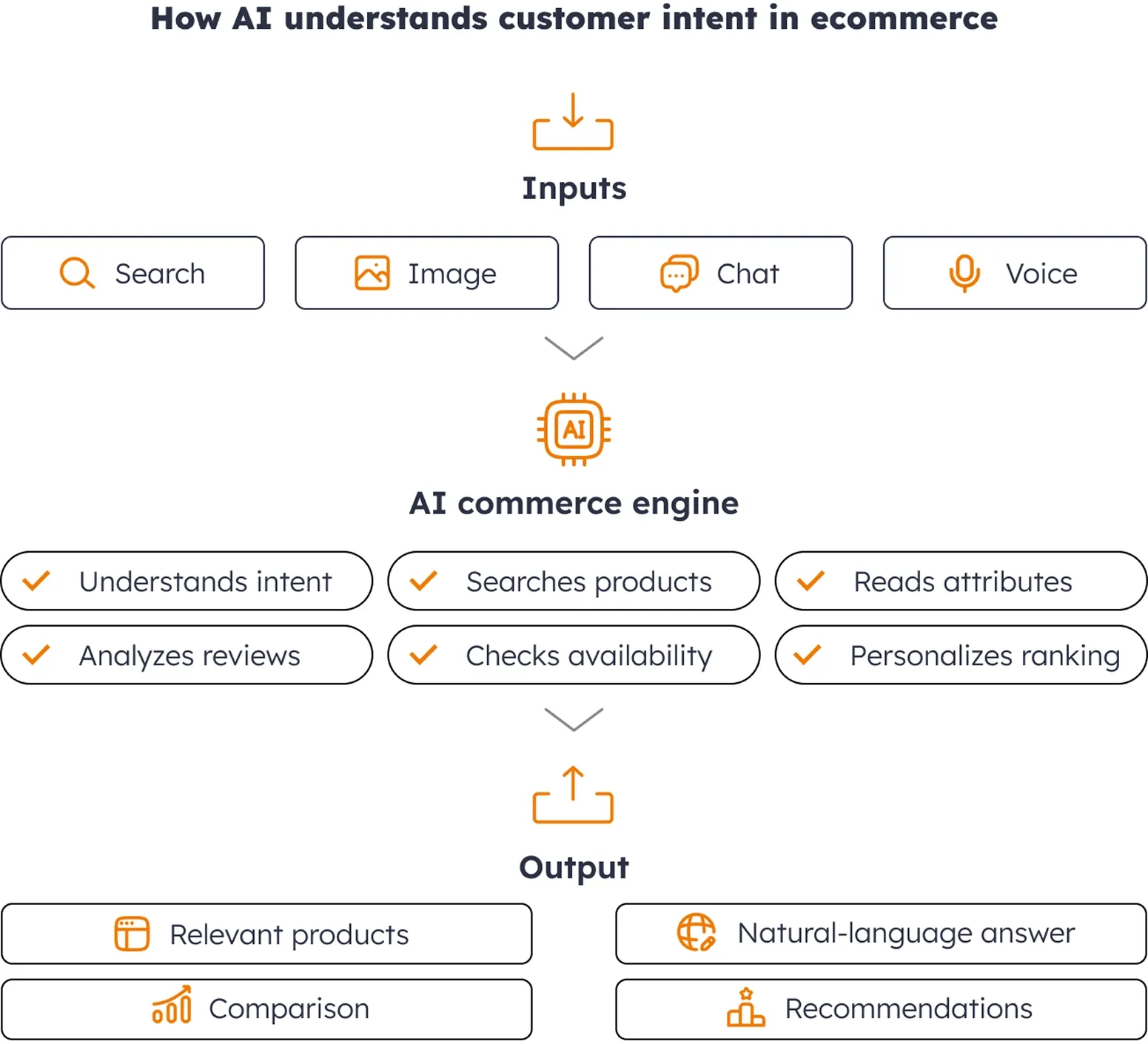
Keyword search matches exact words. Semantic search, built on vector embeddings (a way for the model to store what a product means, not just what it’s called), matches meaning instead. A search for "headphones that block noise on a plane" can return active noise-cancelling headphones even if the listing never uses the words "plane" or "block noise." For catalogs with messy tags or a lot of niche products, this closes a real gap that keyword search never could, and it’s a big part of why AI ecommerce search feels so different from what came before.
Visual search adds another way in: a shopper uploads a photo, and the system finds products that look similar, the same idea behind the camera tools Amazon and Pinterest made popular. Conversational search sits on top of both. A shopper describes what they want in plain words and narrows it down through a back-and-forth chat instead of one search box, which is often the first real taste of AI chatbot ecommerce a customer gets. That layer connects straight to conversational commerce, covered in our guide on how chat, voice and messenger drive online sales.
Tools in this space include Algolia NeuralSearch, Coveo AI and Elasticsearch’s or any other ML-based ranking. None of this works well without clean product data behind it, so schema markup and structured product details matter just as much as the search model itself. AI ecommerce only holds together when all three pieces, search, recommendations and personalization, share the same data underneath.
Search, recommendations and personalization all show up on the side of the store a shopper sees. Even so, none of that matters if the item sells out before it ships, and that’s a battle AI is already fighting in the warehouse, not on the page.
AI automation in ecommerce operations: What happens off the page
Back-office AI covers price optimization, inventory forecasting, fraud detection, and customer support automation that sends simple questions to a bot and hard ones to a person. None of this is visible to a shopper, but it shows up in profit margin and in how often a product is in stock when someone wants to buy it. This is where most of the ecommerce automation budget actually goes in 2026.
Ecommerce CRM integration turns these into one system instead of a set of separate tools. When pricing, inventory and support data all feed the same customer record, personalization and recommendation models get better input, and support agents see the same shopping history the storefront used to make a recommendation. The payoff shows up as fewer stockouts, lower cost per support ticket, and fewer markdowns from bad pricing timing.
Most of our ecommerce clients have already decided to automate these functions. What’s left to figure out is how much of the AI behind them to build in-house versus buy, and that depends heavily on scale.
Architecture choices: build, buy, or composable AI stack
There are three practical paths. Buying a ready-made SaaS AI tool gets a team to market fastest and works well for smaller catalogs and smaller teams. Building on cloud AI ecommerce services like OpenAI’s API, AWS Bedrock, Google Vertex AI, etc. gives more control over how the model behaves, without managing the infrastructure from scratch. A fully composable AI stack, a vector database, an LLM and a custom layer that connects them, gives the most control but needs a team that can keep it running. Most stores that go this far also run on headless ecommerce, an architecture that separates the storefront a shopper sees from the backend that manages products, orders and payments, so each AI piece can be swapped or upgraded without rebuilding the whole site.
Which path fits depends on Gross Merchandise Value (GMV, the total value of everything a store sells) and team size, more than on ambition. Retailers under roughly $50 million in GMV tend to get the best return from SaaS platforms built for personalization and search. Between $50 million and $500 million, a mixed approach, SaaS for the core with a custom layer on top, usually balances speed and control. Above $500 million, the case for a composable stack with your own models gets stronger, since the volume makes the extra engineering work pay off.
These architecture choices are one part of a bigger shift in how online stores get built in 2026, the one we map out fully in ecommerce trends and the 3-forces framework. For teams weighing the build side of this decision, our custom software development services page walks through how that engineering work actually gets scoped. work actually gets scoped.
FAQ
What is AI ecommerce in 2026?
How does AI ecommerce personalization increase revenue?
What is the difference between AI personalization and an ecommerce recommendation engine?
Should I build AI ecommerce integration in-house or use a SaaS solution?
How does conversational commerce relate to AI ecommerce?
Conclusion
Personalization, recommendations and search are three separate systems, but they run on the same data underneath. Get one right without the other two, and the return stays small. Get all three working together, and the effect shows up directly in revenue: more visits turn into a sale, more carts make it to checkout, and fewer shoppers leave because a search came back empty. That's what AI ecommerce actually does in 2026: it connects discovery, decision and checkout into one system. Talk to Modsen ecommerce engineering team about what that could look like for your storefront.
References
Read more





Get a weekly dose of first-hand tech insights delivered directly to your inbox