
Software project discovery phase: What it is and why it matters
9 min read
Last updated: May 02, 2026
Summary
Nearly half of unsuccessful projects are affected by poor requirements management, while projects that define success criteria upfront perform significantly better. Instead of guessing, you can build processes on facts and reduce risk early. That’s the difference between a controlled project and a chaotic one.
This article explains how the software discovery phase helps teams define scope, align stakeholders, assess technical constraints, and prepare a product for execution before development begins. It also breaks down the main steps, deliverables, and timelines that make discovery a practical tool for reducing delivery risk and improving planning quality.
Key takeaways
The discovery phase defines scope, requirements, and technical approach before development.
It helps reduce budget overruns, delays, and product misalignment.
Typical duration is 2-4 weeks depending on complexity.
Discovery improves decision-making and long-term product stability.

Eugene Kalugin
CTO at Modsen
What is the software discovery phase
The software discovery phase is a structured pre-development stage where teams define requirements, clarify scope, align stakeholders, and assess the technical and business constraints.
For early-stage products, that usually means deciding what belongs in the first release and what should wait. That same decision shapes MVP planning – the first version has to stay narrow enough to launch, test, and improve without unnecessary complexity. A more detailed breakdown is available in our guide to building an MVP.
At the project discovery stage, the goal is to turn an initial product idea into a clear implementation plan. By the end of the product discovery process, teams clarify how the product will function, how its components interact, and how defined constraints will shape delivery.
5 Benefits of a Discovery Phase
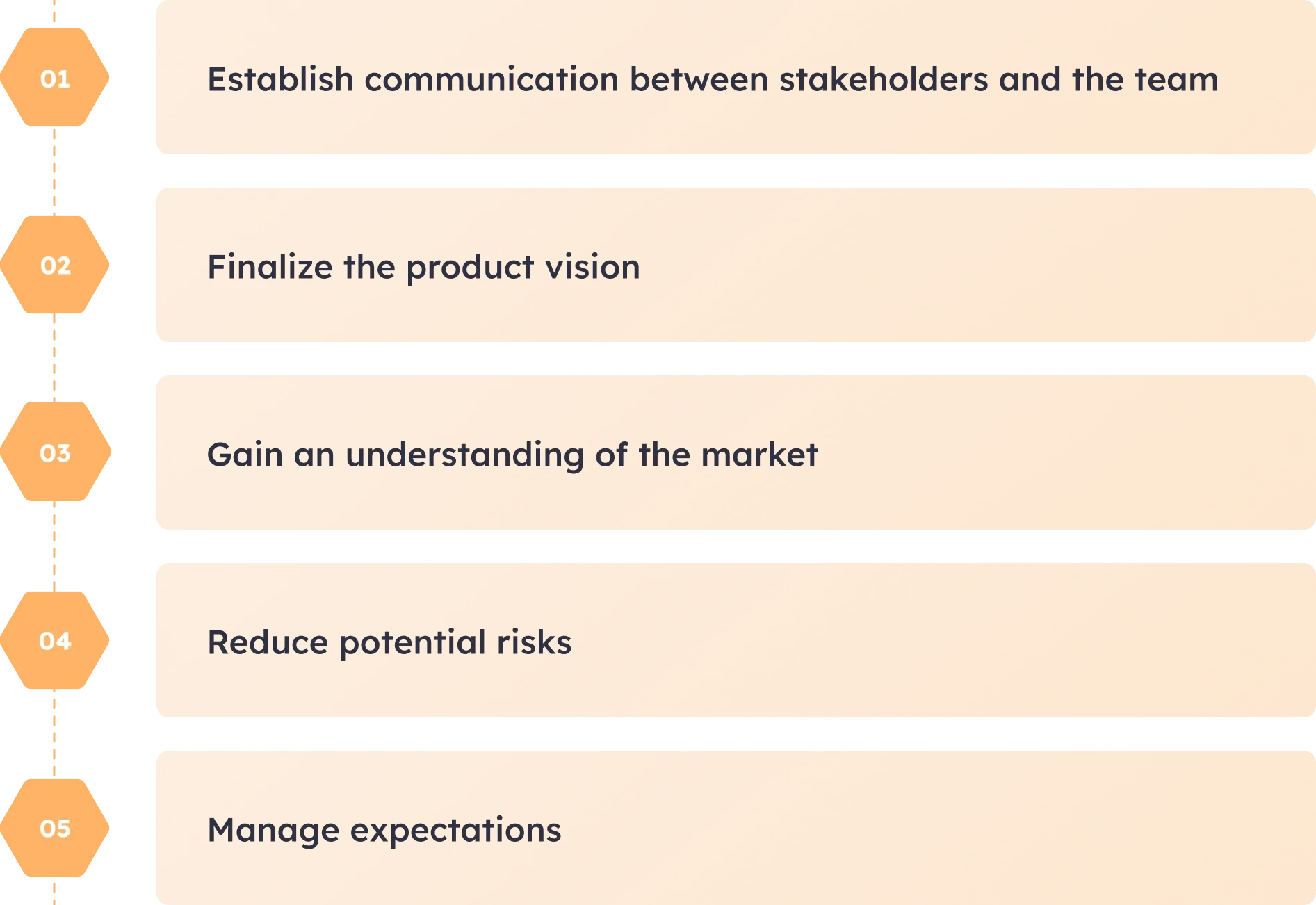
Software discovery phase benefits
Discovery vs. jumping straight into development
Skipping the software discovery phase often looks like a shortcut – teams start coding faster and see immediate progress.
The problem shows up later. Requirements begin to shift because they were never fully defined. Different parts of the system evolve in isolation. Early technical decisions, made too quickly or with incomplete context, start limiting performance, scalability, or integration options instead of supporting them.
At that point, the team is no longer building forward but fixing what has already been done. And the cost difference is significant. Clarifying a requirement during the software discovery phase takes hours. Resolving the same issue during development can take days or even weeks.
This becomes even more visible in startup environments, where limited resources leave little room for rework, and early delivery problems often begin when teams are still figuring out how to build their first product.
When your project needs a discovery sprint
A discovery phase is especially useful when the product idea is still forming, or the delivery environment is too complex to plan reliably without upfront analysis.
This situation is common in projects with multiple stakeholders, unclear priorities, strict compliance requirements, complex integrations, or demanding performance expectations. It also applies when the business needs more accurate estimates before committing a larger budget or building team.
A discovery gives the team space to validate priorities, define scope, and make early decisions before execution begins, absorbing time, budget, and engineering effort.
Key steps in the discovery phase
A strong software discovery phase follows a structured process rather than a one-time requirements session.
By this stage, the goal is to reduce uncertainty in a practical way: clarify what needs to be built, define what matters most, and identify the constraints that will shape delivery. The process typically starts with the requirement gathering phase and then moves through scope definition, feasibility assessment, prioritization, and early validation.
Stakeholder interviews and requirements gathering
The process starts with interviews, where business goals, user needs, operational constraints, and delivery expectations are clarified.
This step often exposes inconsistencies. Different stakeholders may have different views of what the product should do. Aligning them early prevents conflicts later. Business requirements are not just collected but interpreted and validated.
Project scope definition and success criteria
After gathering requirements, teams move to defining project scope. At this point, the team decides what belongs in the product, what belongs in the first release, and what should be left out for now.
This step matters because unclear scope creates a predictable chain of problems: priorities shift too easily, requirements keep expanding, and delivery loses focus.
Technical feasibility and architecture assessment
The next step is a technical feasibility analysis, where the team evaluates whether the product can be built within given constraints. This includes assessing system architecture, performance expectations, and integration complexity. Potential risks are identified before they affect development.
The goal is to surface issues before they affect implementation. Fixing architectural mistakes later is significantly more expensive than addressing them during the software discovery phase.
It also helps teams think beyond application logic alone by addressing release workflows, environments, infrastructure dependencies, and operational readiness upfront. That broader delivery perspective is often missed when planning starts too late, which is one reason it helps to understand the DevOps lifecycle explanation early on.
User story mapping and prioritization
With requirements and scope defined, the next step is user story mapping. This approach organizes features around real user interactions rather than isolated tasks. It helps prioritize what needs to be built first and how different parts of the system connect. As a result, the product evolves in a logical sequence, not as a collection of unrelated features.
Wireframing and early prototyping
At this stage, the product starts taking visual form through wireframing and prototyping. Instead of discussing abstract ideas, teams work with interface layouts and user flows. This helps uncover missing requirements, weak navigation paths, or conflicting expectations before development begins.
Early prototypes make it easier to validate assumptions and adjust decisions before development begins. Changes at this moment are fast and inexpensive compared to changes made after implementation.
Project discovery phase deliverables: What you get at the end
By the end of the software discovery phase, the team has a set of deliverables that guide development. These outputs are meant to support estimation, and give everyone involved a clearer view of what will be built and how the work should move forward.
Technical specification document
The technical specification is the core output of the software discovery phase that translates business requirements into a clear, structured description of how the system should work. This document captures product logic, system behavior, and key technical decisions. It defines how components interact, what constraints apply, and how the product is expected to perform under real conditions.
For the development team, technical specification removes ambiguity. Instead of interpreting requirements, engineers work with a shared understanding of what needs to be built. For stakeholders, it provides transparency. You can see how your idea turns into a working system before development begins.
Project roadmap and estimation
Another key output of discovery is a project roadmap with estimates based on a clearly defined scope. Requirements are clarified, and dependencies between system components are visible now. The sequence of work becomes clear, so timelines reflect actual effort rather than assumptions. Once delivery needs are clearer, it becomes easier to assess capacity, define ownership, and make decisions about choosing the engagement model for the work ahead.
Based on this, software project planning proceeds with an understanding of priorities, constraints, and delivery order. The team can move forward without revisiting core decisions during development.
Get a specification and roadmap before development begins.
Our specialists will help you turn your idea into a clear implementation plan through a structured discovery phase. Book a free personal consultation.
Paul Kirikov
Head of Business Development



How long does the discovery phase take
The duration of the software discovery phase depends on product complexity, the number of stakeholders involved, and the level of uncertainty in requirements.
Typical timelines: 2–4 weeks depending on complexity
Projects with a clear vision and limited scope move faster. Products with multiple integrations, strict compliance requirements, or unclear priorities take longer because more decisions need to be validated upfront.
For many software products, the software discovery phase typically takes around 2 to 4 weeks. This is a realistic range for projects that are reasonably well-defined and do not involve unusually heavy technical or regulatory complexity.
Small, narrowly scoped initiative
Estimated timeline
1-2 weeks
Key factors
Limited scope, fewer stakeholders, faster validation
Product with clear goals and manageable complexity
Estimated timeline
2-4 weeks
Key factors
Defined business case, moderate requirements, straightforward planning
Product with multiple integrations or unclear priorities
Estimated timeline
4-6 weeks
Key factors
More decisions to validate, additional technical assessment
Enterprise system with legacy dependencies or compliance-heavy environment
Estimated timeline
6+ weeks
Key factors
Deeper risk analysis, architecture work, and regulatory review
Typical software discovery phase timelines
What matters most is not compressing discovery into the shortest possible window, but giving the team enough time to define scope, validate assumptions, and make the decisions that will shape delivery.
Why discovery reduces risk and saves budget
The main value of the software discovery phase is timing. It is far cheaper to resolve uncertainty before development begins than after implementation is already in motion.
Clearer scope, validated assumptions, and earlier technical decisions reduce the risk of rework, delivery delays, and weak estimation.
This is where business analysis for software development has direct commercial value. It helps teams make better trade-offs, set more realistic expectations, and avoid committing budget against unresolved questions.
For early-stage companies, that matters even more, since limited budgets leave less room for rework and planning mistakes. Many of these risks mirror the startup tech challenges and solutions teams face early on when scope and technical decisions are shaped too late.
Instead of correcting the product under delivery pressure, the team moves forward with a clearer plan and fewer avoidable mistakes.
FAQ
What is the discovery phase in software development?
How long does a discovery phase take?
What deliverables come from the discovery phase?
How much does a software discovery phase cost?
Can you skip the discovery phase?
Conclusion
A software discovery phase helps businesses move into development with clearer scope, validated assumptions, and fewer expensive unknowns. Instead of making critical delivery decisions under pressure, teams get a more reliable basis for planning, estimation, and execution.
At Modsen, the product discovery process is used as a working stage of product and delivery planning, where business analysis, technical assessment, architecture thinking, and scope control come together before coding starts.
If you are preparing to build a product and need clearer scope, more realistic estimates, and fewer delivery risks, get in touch with the Modsen team before full-scale development begins – and start with clarity, not assumptions.
References
1.
2.
Cagan, M. (2018). Inspired: How to Create Tech Products Customers Love (2nd ed.). O'Reilly Media.
3.
Rosala, M. (2020). Discovery: Definition. Nielsen Norman Group.
4.
Rosala, M. (2024). 7 Tips for Successful Discoveries. Nielsen Norman Group.
5.
Rosala, M. (2024). Discovery: Study Guide. Nielsen Norman Group.
Read more






Get a weekly dose of first-hand tech insights delivered directly to your inbox