UI/UX design services for B2B companies: how to choose the right partner
8 min read
Last updated: Jun 22, 2026
Summary
B2B products lose deals at the demo stage. The issue isn’t the feature set; the UX makes evaluators doubt the product. A buying team seeing a cluttered dashboard, confusing navigation, or inconsistent flows during a live demo will mentally attribute those problems to the engineering team, the product roadmap, and ultimately the vendor's reliability. The UX becomes proxy evidence for product quality.
This guide covers what separates UI/UX design services for B2B companies from general UX work and how to choose the right partner for your product. For a broader overview of what modern UX work looks like across industries, see our complete UI UX design services guide.
Key takeaways
UI/UX design services for B2B companies serve three distinct user types simultaneously: buyer, end user, and admin, where B2C typically optimizes for one.
Core deliverables include discovery audit, multi-role personas, IA and flows, hi-fi UI, design system, and onboarding redesign.
Seven criteria reliably separate credible B2B UX partners from generalists.
Typical timelines: 1–2 weeks for an audit, 8–16 weeks for a full redesign.
Four engagement models are team extension, fixed price, dedicated team, consulting.

Igor Buturlia
Head of Design Studio
Why a B2B UX design agency demands a different approach than B2C
B2B products involve more stakeholders than B2C by design and that changes everything about how UX decisions get made.
A user experience agency without B2B experience will design for one type of user and ignore the rest. The result is a product that works for whoever was in the brief – and creates friction for everyone else.
The cost of getting this wrong is also different. A consumer app losing a user costs a few dollars in LTV. A B2B product that falls apart during an enterprise demo can cost a six-figure deal and months of pipeline.


When assessing UI/UX design services for B2B companies, it is better to ask do they understand multi-role products, procurement-driven buying cycles, and enterprise workflow complexity.
Multi-role user personas in B2B
A consumer product has one user with one goal. A B2B product serves an entire organization but three roles drive most of the friction. The fundamental structural difference in enterprise UX design is that the person who approves the purchase is rarely the person who uses the product every day.
Take a mid-market SaaS tool: a VP of Operations approves the purchase, a team of analysts uses it every day, and an IT manager handles access and integrations without ever touching the core product. All three interact with the same software, and all three have a different definition of "works well."
In a typical B2B SaaS deal:
Economic buyer (VP, CFO)
Primary concern
ROI, compliance, risk
UX touchpoint
Demo, pitch deck, pricing page
Power user (analyst, ops lead)
Primary concern
Speed, keyboard shortcuts, minimal friction
UX touchpoint
Daily workflows, dashboards, exports
IT admin
Primary concern
Security, integrations, access control
UX touchpoint
Settings, SSO config, audit logs
A UX team that maps only one of these personas will produce a product that creates friction for the others. UI/UX design services for B2B companies should include multi-role persona research as an early deliverable.
Long sales cycle and UX touchpoints
A B2B deal typically takes 6-18 months to close as purchases involve multiple decision-makers. Each needs to sign off before a contract moves forward, which is why the average deal takes so much to close.
At each stage, the product has to do some of the selling.
Demo
The interface has to tell a clear story in short to people who've never seen the product. That means every flow, every label, every screen transition has been a design decision – reviewed, debated, and signed off by multiple stakeholders.
Free trial
Behind it are dozens of UX decisions: what to show first, what to hide, how to guide without overwhelming. Each one goes through rounds of feedback from product, sales, and customer success before it ships.
Contract signed
This is where UX decisions face the hardest scrutiny: actual users, actual workflows, actual deadlines. Every friction point gets escalated, every missing feature gets flagged, and every confusing flow becomes a support ticket.
At a specialist level, UI/UX design services for B2B companies encompass the full buying and adoption lifecycle.
Core deliverables in UI/UX design services for B2B companies
Not all UX work is the same, and a B2B UX design agency should be able to explain precisely what they deliver and why each piece exists. Forrester's research UX ROI for B2B tech vendors confirms that UX remains largely tactical rather than strategic at most companies.
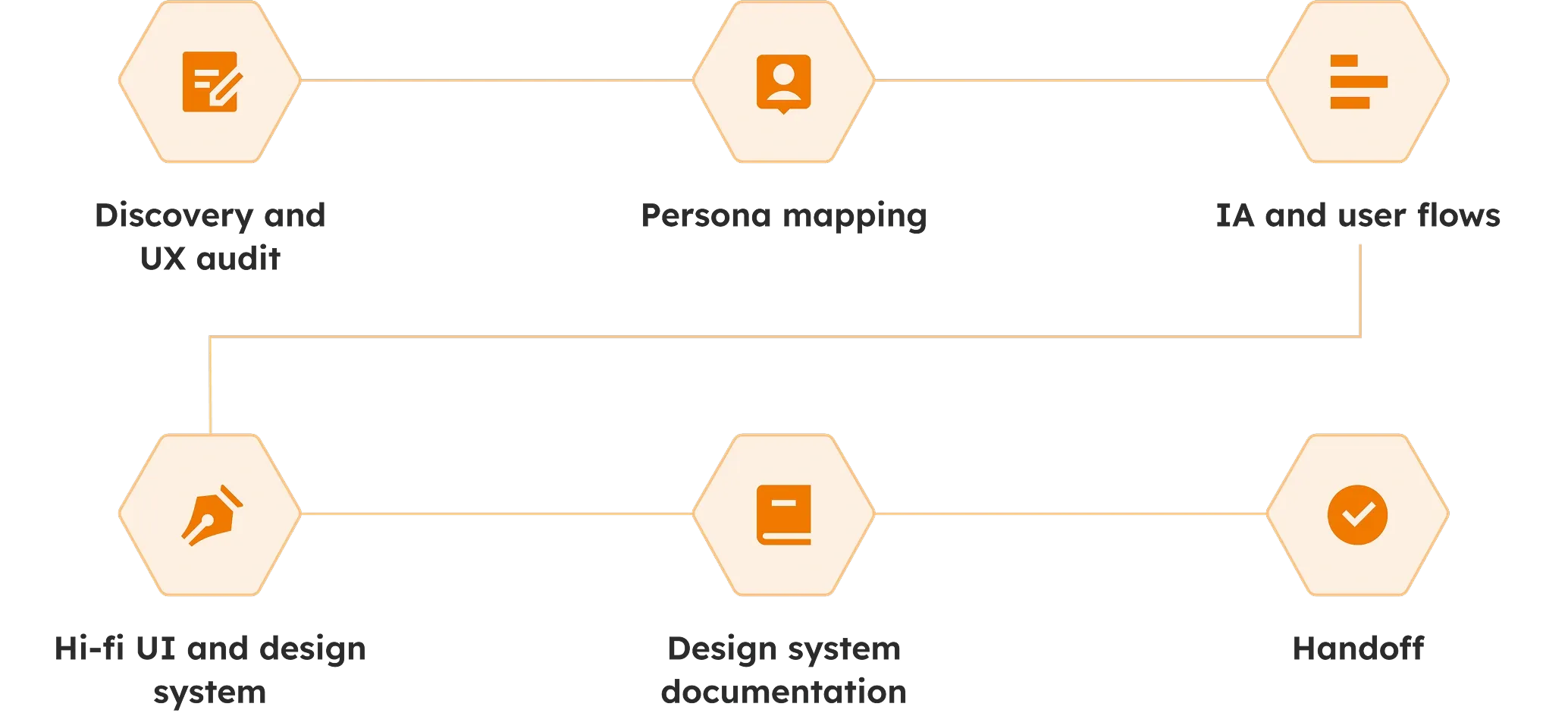
Here are the five deliverables that matter in B2B, with what each should actually contain:
1. Discovery and UX audit
A structured review of the existing product, identifying friction points, inconsistencies, and missing flows. In B2B this should include stakeholder interviews across all three user types.
Output: prioritized audit report with severity ratings.
2. Multi-role persona mapping
Detailed documentation of each distinct user type, their workflows, decision criteria, technical environment, and definition of task success – the foundation of any UI/UX design services for b2b companies engagement.
Output: 3–5 persona documents with workflow maps.
3. Information architecture (IA) and user flows
Structural decisions about navigation, hierarchy, and how users move through the product. In enterprise products this includes permission-based navigation states (what admin sees vs. what a viewer sees).
Output: IA diagrams, user flow maps, annotated screen inventory.
4. Hi-fi UI and design system
Pixel-accurate interface designs built on a reusable component library. In B2B, the design system matters more because the product surface is larger and the engineering team needs consistency without constant designer involvement.
Output: UI UX services that translate directly into developer handoff: Figma component library, design tokens, annotated UI specs.
5. Design system documentation
Documentation explains what each component is for, when to use it, and how to implement it in code. Without it, developers make their own decisions – and the product slowly diverges from the design.
Output: component usage guidelines, naming conventions, implementation notes for developers.
Any UI design agency for B2B should be able to walk you through exactly what each of these deliverables produces and why. See how this plays out in practice in Modsen B2B case studies.
Get a free design consultation
We will answer all your questions and provide valuable insights about the future of your project.
Igor Buturlia
Head of Design Studio



Enterprise vs mid-market: different scope
Enterprise UX design and mid-market product work require different sequencing and different levels of investment.
Enterprise (200+ seat deployments, multi-product platforms):
| Mid-market (single product, 20–200 users):
|
UI/UX design services for B2B companies that pitch a fixed mid-market scope for an enterprise problem will run out of budget before the work is done.
Engagement models for B2B UI/UX design
The wrong engagement model of UI/UX design services for B2B companies creates misaligned incentives and friction even with a skilled team.
Team extension
What it is
The UI design company works inside your process, adding capacity without taking over.
Best for
You have a design lead but need more hands.
Duration
Ongoing
Fixed price
What it is
Defined scope, agreed cost, fixed deadline.
Best for
One-time project with a clear brief.
Duration
4–16 weeks
Dedicated pod
What it is
A small team assigned exclusively to your product.
Best for
Scaling a design function without hiring in-house.
Duration
6–12 months
UI UX consulting services
What it is
A short diagnostic: the agency reviews your product and tells you what to fix and why.
Best for
Before committing to a full redesign.
Duration
1–4 weeks
Not sure whether your situation calls for a full engagement or a scoped audit first? See our breakdown of when to start with UI UX consulting before committing to a longer statement of work.
How to vet a B2B UX partner: 7 criteria that matter
Most businesses evaluate UI/UX design services for B2B companies on portfolio aesthetics and price. Those are reasonable starting points, but neither predicts whether the engagement will produce a product that performs better. Here are the criteria that actually matter.
1. Portfolio in B2B
Look for case studies involving multi-role products, dashboards, enterprise workflows, or data-heavy interfaces. A strong portfolio in B2B will show navigation systems and data tables alongside visual polish.
Reading through best UX design agency criteria research – consistently places vertical relevance as the top differentiator in B2B selection decisions.
2. Case studies with business metrics
A credible case study shows what changed after the redesign: demo conversion rate, onboarding completion, support ticket volume, or time-on-task reduction. If a team can't point to outcomes, they either don't track them or the work didn't move metrics.
3. Senior-led user experience design agency
Ask directly: who will be the day-to-day lead on your project? Is that person available to meet before contract signing? What's their involvement in client work vs. business development?
4. Process transparency
You should understand exactly how the engagement runs. How often are reviews? Who approves what? What happens when scope changes? Vague process documentation is a risk signal for agencies that adjust their methodology to whatever the client seems to expect, rather than running a disciplined process.
5. NDA and IP transfer
Confirm that all deliverables (Figma files, research data, design tokens, component libraries) transfer to you at engagement end. Some UI UX design firms retain IP by default. Confirm NDA coverage for any product information shared during discovery.
6. Communication cadence
Async-first or sync-heavy? Neither is inherently better, but mismatches cause friction. If your team is distributed across time zones and the agency expects live daily standups, that's a compatibility problem. Clarify expected response times, meeting frequency, and escalation paths before day one.
7. Post-launch support scope
What happens after handoff? Confirm whether the agency offers a support period for developer questions, and whether iteration cycles after launch are in scope. For a full framework on due diligence before signing, see our guide on how to vet a UI design company.
Average costs and timelines for B2B UX projects in 2026
Transparent pricing is rare in agency services, so most B2B buyers go into procurement without useful benchmarks. Here's what the market looks like in 2026, based on Clutch.co industry data and verified project scopes:
Timelines by engagement type:
Engagement | Typical timeline |
|---|---|
Discovery and UX audit | 1–2 weeks |
Single-product redesign | 8–16 weeks |
Design system build | 6–12 weeks |
Full product overhaul (multi-surface) | 16–24 weeks |
Pricing by model:
Model | Range |
|---|---|
Hourly | Varies by geography and seniority ($25–$250/hr) |
Fixed price | Scope dependent ($10K–$500K) |
Team extension | Scope and team size dependent ($5K–$80K/month) |
FAQ
What do UI/UX design services for B2B companies actually include?
How are B2B UI UX design services different from B2C?
How long does a B2B design project take?
What's the ROI of investing in B2B UX design?
Should B2B startups outsource UI/UX design or hire in-house?
Where to go from here
Most B2B companies pick a UX partner based on how the portfolio looks and how the first call goes. That's not enough. A team that's done great work for a consumer fintech app will struggle with a multi-role enterprise dashboard. Use the criteria in this guide as a filter before the pitch deck even comes out. Ask who will actually run the project. Ask what the discovery phase produces. Ask what happens after handoff.
The right UI/UX design services for B2B companies are evaluated on substance, not presentation and the vetting criteria and pricing benchmarks above give you the tools to do exactly that.
If you'd like a scoped estimate based on your specific product, the Modsen UI/UX design team works with B2B companies across SaaS, fintech, and enterprise software.
References
Read more






Get a weekly dose of first-hand tech insights delivered directly to your inbox