
E-COMMERCE SOFTWARE DEVELOPMENT FOR EUROPEAN BUSINESSES
European e-commerce software development is the process of building and modernising online commerce platforms for country-specific tax, payment, privacy, accessibility, and localisation requirements. Modsen builds multilingual, VAT-ready, accessibility-ready commerce platforms and SaaS products with privacy-by-design and AI- and agent-ready architectures for retailers, brands, marketplaces, and B2B sellers.

Why European e-commerce organizations choose Modsen
500+
tech specialists
7+
years in e-commerce development
30+
e-commerce projects
SaaS
products built & supported
Regular
E-commerce Berlin Expo participant
AI-
augmented delivery model
What we can help you implement
Modsen works with European e-commerce companies as an engineering partner – from adding specialists to an existing team to building and advising on the platform itself.
Scale your in-house team
Add e-commerce engineers with 7+ years of experience, without months of hiring.
Grow your e-commerce platform
Multi-tenant architecture, billing and infrastructure that keep up with your user base.
E-commerce consulting & product strategy
From payment infrastructure to compliance-heavy platforms.
Bring AI agents into your delivery
Engineers who set up agents for e-commerce testing, code review and release workflows.
European e-commerce software success stories: case studies
Not every project can be named or shown publicly. Some partners prefer confidentiality, while others are happy for us to share their stories. Explore the cases we can share here, and let's discuss additional projects on a call.
Value
9 weeks to first customer pilot
3 workflows validated
80% of the MVP codebase carried into the full product

Market-ready demand-forecast SaaS MVP for retail
Custom software development
Challenge
A European retail tech startup needed to validate a demand-forecast SaaS product. Serving multiple retailers from one platform meant isolating each customer's data: a GDPR requirement for any multi-tenant product.
Solution
Modsen built a focused MVP on a multi-tenant architecture with isolated retailer data, POS integrations, and an AI-augmented delivery model to keep scope tight.
Value
9 weeks to first customer pilot
3 workflows validated
80% of the MVP codebase carried into the full product
Value
5 engineers at peak
2-week request-to-start
100% retention, features shipped through peak season

Extra React and Node.js engineers for a retail development project
Staff augmentation
Challenge
A high-traffic EU retailer had no spare in-house capacity for new features. New features had to ship on a live storefront during peak season, with zero room for checkout downtime.
Solution
Modsen added senior React/Node engineers into existing sprints, candidates vetted through the client's process and Modsen CTO sign-off.
Value
5 engineers at peak
2-week request-to-start
100% retention, features shipped through peak season



Discuss your European e-commerce project
Every market brings its own tax rules, payment habits, and compliance deadlines. Tell us which project you're launching or scaling into, and we'll map out what your storefront, checkout, and back office need to support them.
E-commerce development solutions built around European businesses
Custom platform development
Headless & composable commerce
B2B e-commerce development
E-commerce mobile app development
Legacy migration & re-platforming
ERP, CRM & POS integrations
E-commerce QA & performance testing
IT infrastructure for e-commerce
European e-commerce compliance software: built for accessibility and product data
Europe doesn't have one e-commerce rulebook. It has several, landing at different times, for different reasons.
Omnibus Directive
Discounts must show the relevant prior price used to calculate the reduction

May 28, 2022
Digital Services Act
Applies to online intermediaries – relevance for a standalone store depends on your business model
Feb 17, 2024
GPSR
Responsible economic operator in the EU and safety data on the product page
Dec 13, 2024
European Accessibility Act
E-commerce services fall under accessibility requirements
Jun 28, 2025
EU AI Act
Transparency rules for chatbots: disclosure that the customer is talking to an AI
Aug 2, 2026
All of these Modsen solves together at the architecture stage, reflected in how the data model is structured, how the UX is designed, and how every integration is built from the ground up.
Top custom software development partner







European VAT, e-invoicing, and payment orchestration
European commerce requires more than a standard checkout. Tax rules, invoicing mandates, payment authentication, and local payment habits vary across markets. We connect them into one flexible operations layer, with e-commerce VAT OSS integration, e-commerce e-invoicing integration, and local payment methods e-commerce for Europe built into the architecture.
Destination VAT & OSS/IOSS
|
Country e-invoicing adapters and ViDA- |
PSD2/SCA/3DS2
|
Local payment methods
|
Zero-downtime replatforming and MACH modernisation
Moving platforms in Europe means moving several storefronts at once: different languages, currencies, VAT regimes, and consent settings, all live at the same time. Modsen replatforms without stopping sales, keeps SEO and data intact through the move, and brings MACH commerce development to Europe so releases can go out country by country instead of all at once.
Composable commerce development for Europe
MACH combines API-first services and composable components, often including SaaS platforms. This lets businesses scale or replace individual parts without rebuilding the entire store.
Independent releases per country
API-first integrations with local payment and tax/invoicing services
One shared core behind a separate storefront per market
SaaS subscription setup and vendor integration handled alongside the build
Intershop, OXID, and legacy platform migration services
Ageing platforms (Intershop, OXID, Magento 1, custom PHP or Java builds) don't scale well across multiple country storefronts.
Migration to Shopware, commercetools, Spryker, or Shopify Plus, country by country
Old and new storefronts run in parallel
Gradual releases with a rollback plan
Cutover scheduled outside peak season
Data, SEO, consent, and redirect migration
A platform migration risks losing more than code: catalogue content, order history, consent records, rankings, and price history can all disappear if the move isn't handled carefully.
Localised content and customer history carried over
GDPR consent records kept as proof
301 redirect map per language version, hreflang, structured data
Price history intact for the Omnibus 30-day rule
Rankings monitored for 4–8 weeks post-launch
AI-powered and agentic e-commerce for European markets
AI can lift conversion, average order value, and multilingual support but AI e-commerce development for Europe works differently from, e.g., a US build. The EU AI Act introduces transparency requirements for certain AI systems, while GDPR continues to shape how personal data is collected, used, and shared. Modsen builds AI e-commerce solutions with defined data boundaries, human escalation, and compliance requirements considered from the architecture stage.
Transparent AI assistants and human escalation
Modsen builds multilingual AI assistants for order status, returns under the 14-day withdrawal period, and voice-led shopping, grounded in your product catalogue. Assistants disclose the AI use, log conversations, escalate to a human on request or low confidence, and carry guardrails on claims about price, stock, and safety data.
Privacy-aware recommendations and search
AI recommendations in GDPR-regulated e-commerce run on consent-based data, not open profiling: limited segmentation, a documented legal basis per model, and personalisation the customer can switch off. Modsen works with tools like Algolia, Bloomreach, and Nosto, or custom models where data volume justifies it.
AI-powered visual search, built on consented image data
Customers upload a photo and get matching products through computer vision matched against your catalogue, built for fashion, home decor, electronics, and marketplace categories. Because the image can count as personal data, Modsen processes it under a defined retention policy rather than storing it by default.
Fraud detection with a human right of review
Modsen builds real-time fraud scoring, behavioural anomaly detection, and device fingerprinting, with models retraining as patterns shift. Automated fraud decisions fall under GDPR's Article 22, so every flagged order carries a built-in path to human review, lowering chargebacks without inflating false positives.
Agentic commerce and agent-ready product APIs
Agentic commerce means purchases, or B2B procurement, that an AI agent completes on your behalf. Modsen prepares stores with structured product data (Schema.org Product/Offer), an API-first catalogue and checkout, limited agent permissions, and a handoff to SCA/3DS2 at payment. Emerging protocols like ACP and AP2 are treated as still developing.
Technologies & platforms we work with
Our e-commerce work for Europe draws on the cloud providers, languages, and platforms your operating model needs from country-specific tax and payment integrations to the ERP and PIM systems already running your business.
E-commerce platforms
 Shopware
 Commercetools
 Spryker
 Shopify Plus
 Adobe Commerce
 Sylius
 PrestaShop
 SAP Commerce
Java
 Java 8/11/17/21
 J2EE
 Spring Framework
- Kotlin
 Ktor 3
 Quarkus 3
 Vert.x 4
JS
 React
 Angular
 Vue.js
 Next.js
 Node.js
 NestJS
 Express
- React Native
QA/AQA
 BDD
 CI/CD
 Selenium
 Selenide
 Playwright
- Selendroid
 Appium
AI/ML
 Python
 TensorFlow
 Keras
 PyTorch
 MatLab
- Google Cloud Platform
.NET
 C#
 Visual Basic
 F#
 Linq
 .NET Core
 Entity Framework
 Hibernate
 ASP .NET MVC Core
 WPF
- MAUI
Mobile
 Objective-C
- Swift
 SwiftUI
- Java
- Kotlin
 Jetpack Compose
 Flutter
 KMM
Business Analysis
- Requirements elicitation
- Requirements traceability
- Change management
- Diagramming
- Stakeholder management
- Prototyping
- Benchmarking
- Data analysis, SQL
System Analysis
- Requirements management
- Decomposition & Alignment
- Impact analysis
- Modeling
- Technical documentation
- Traceability
- System & Integration analysis
DevOps
- Cloud Platforms
- CI/CD
- Container Orchestration
- Infrastructure as Code (IaC)
- Configuration Management
- Monitoring & Observability
- Log Management
Why choose Modsen as an e-commerce development company in Europe?
As a European e-commerce development company, we start where regulation and software meet, keep platform, payments, tax, and ERP work inside one team, and roll out country by country on infrastructure built for it.
European regulatory requirements translated into software
Platform, payments, tax, and ERP expertise in one team
Country rollouts with privacy-safe cloud operations
AI-augmented delivery for faster European e-commerce releases
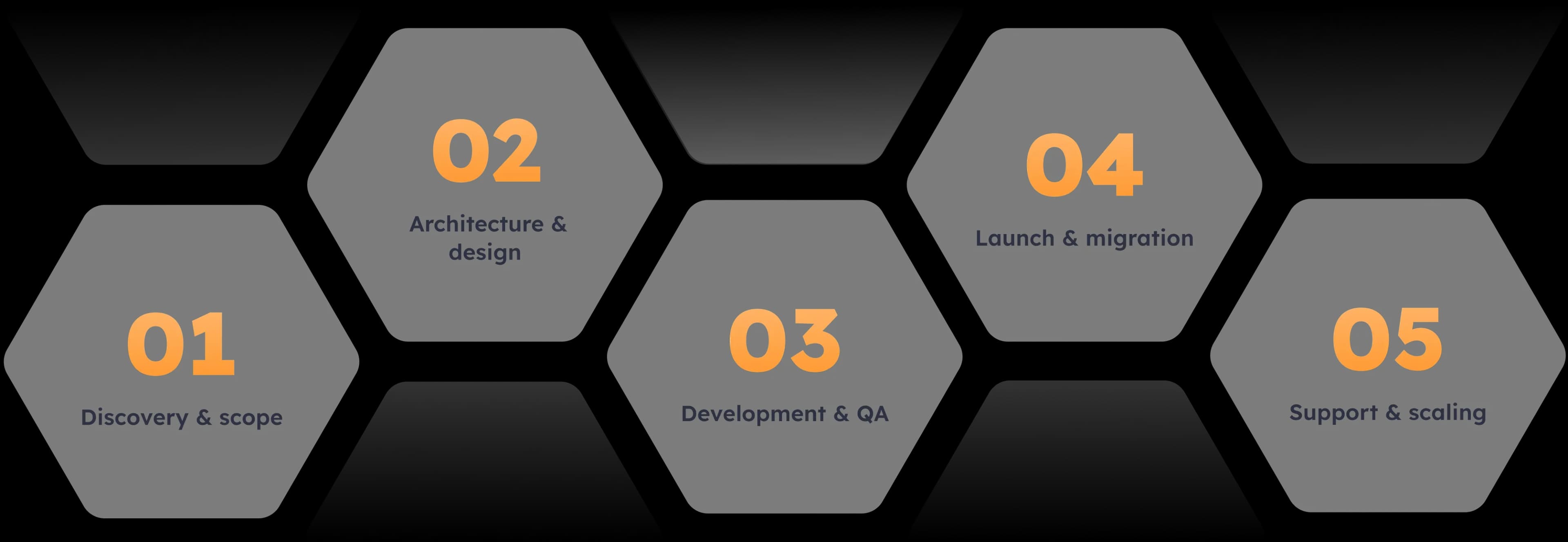
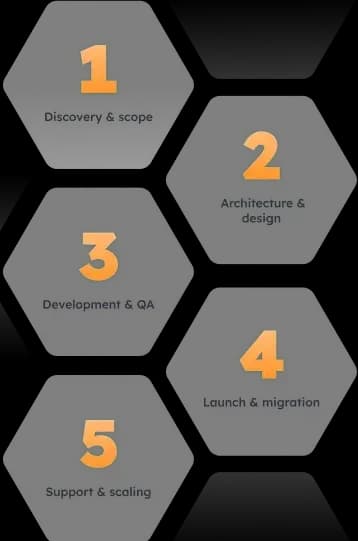
Our e-commerce development process
We follow a structured lifecycle with AI-supported delivery integrated where it improves work without compromising architecture decisions. AI handles routine research, documentation, and test scaffolding under engineer supervision.
What our European clients say about working with Modsen

“They delivered a scalable solution that reduced our HR workload by 50%.”
Head of IT
Manufacturing Company, Eastern Europe
Clutch · Verified


“We see Modsen as a trustworthy partner providing high-quality banking mobile app services.”
Natalia Osipchik, Founder
UMIND
TopDevelopers · Verified
“They moved at the pace our investors expected, not the pace an outsourced team usually has.”
Sophia, CPO
TechBehemoths · Verified
More reviews on request
Leave your email and Modsen will send a list of other partners happy to talk about their experience.
Industries we serve across e-commerce
European e-commerce software development FAQ
What makes e-commerce software development in Europe different?
How do you build GDPR and cookie consent into an e-commerce platform?
What does the European Accessibility Act require from e-commerce websites?
How do OSS and IOSS work in e-commerce software?
Can you integrate European e-invoicing systems?
How do PSD2 SCA and 3DS2 affect checkout conversion?
Which local payment methods should a European checkout support?
Which commerce platform fits a European rollout?
Can you replatform a store without losing SEO or customer data?
How do you prepare e-commerce for AI agents and GDPR-aware personalisation?