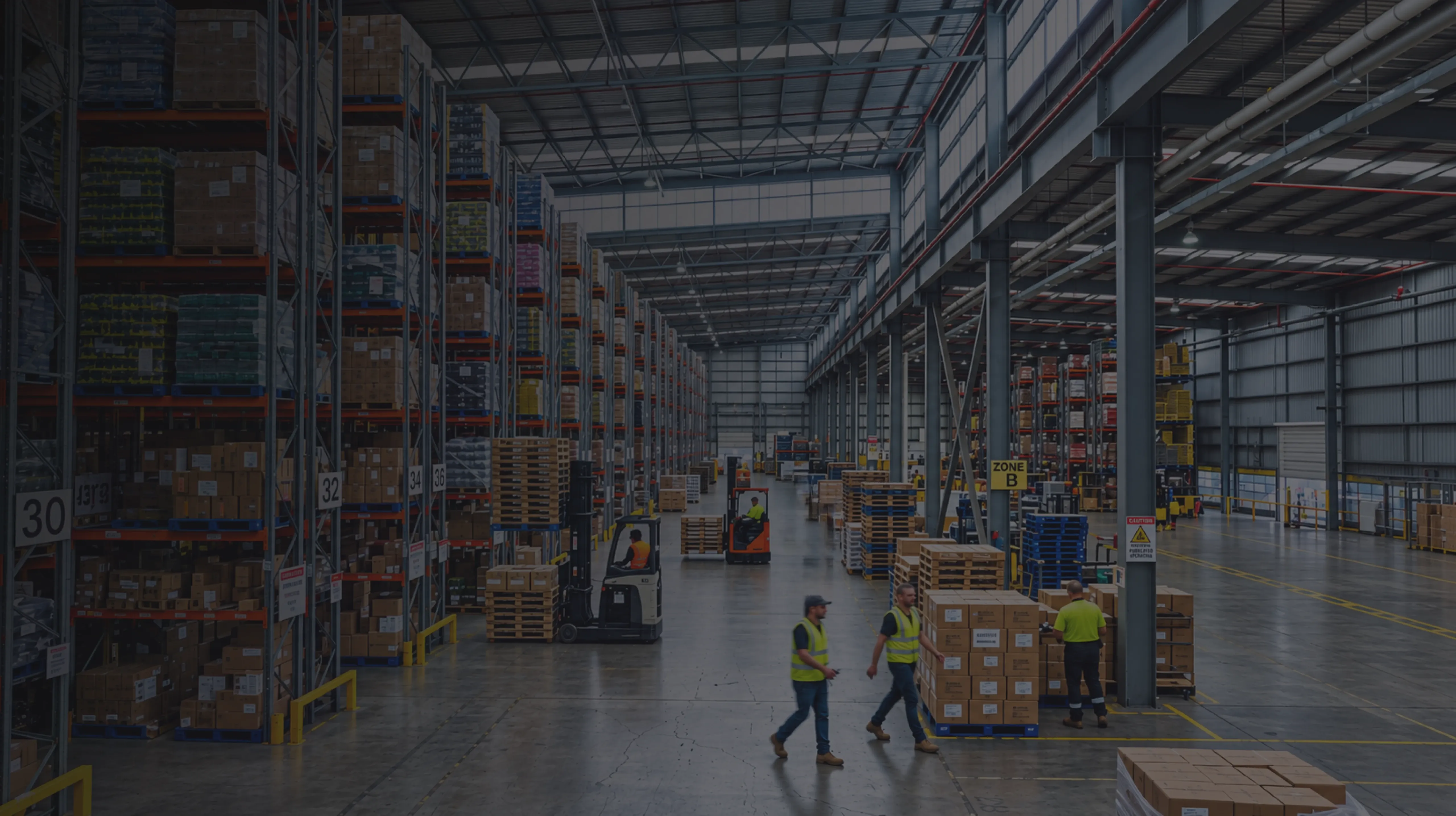
LOGISTICS SOFTWARE DEVELOPMENT FOR EUROPEAN BUSINESSES
European logistics software development is the process of building and modernising transport, warehouse and fleet systems for multi-country operations: electronic freight documents, customs and tachograph data, national e-invoicing and emissions reporting, integrated with local carriers and authorities. Modsen is building these systems for SaaS, carriers, 3PL providers and shippers operating across several countries.

European logistics software development expertise in numbers
20+
logistics partners served
10+
years of logistics engineering expertise
500+
in-house tech specialists
Full
local regulatory compliance
Cross-border
logistics workflows supported
AI-
augmented delivery model
What we can help you implement
From your first product idea to a growing logistics platform, we help turn operational needs into working software with the right team, architecture, and technology for European markets.
Build a new logistics product or SaaS platform
Discovery maps your operations, architecture supports your markets, and the MVP launches with essential integrations.
Scale your logistics engineering team
Add engineers with 5+ years of experience to your existing team, processes, and backlog.
Logistics consulting & product strategy
Audit your architecture, costs, and European compliance gaps. Get a prioritized scaling plan with estimates.
Bring AI agents into your product delivery
AI agents support code generation, testing, and documentation under engineer review.
Top logistics custom software development partner





European logistics software success stories: case studies
Public cases here, confidential ones on request. Some partners are happy to be named; others aren't, and that discretion is part of how we work. More case studies are available to discuss in a call.
Value
100% goods preservation
~40% less spoilage and rejected deliveries
2x quicker decision-making
Temperature-controlled IoT platform for perishable freight
Custom software development
Challenge
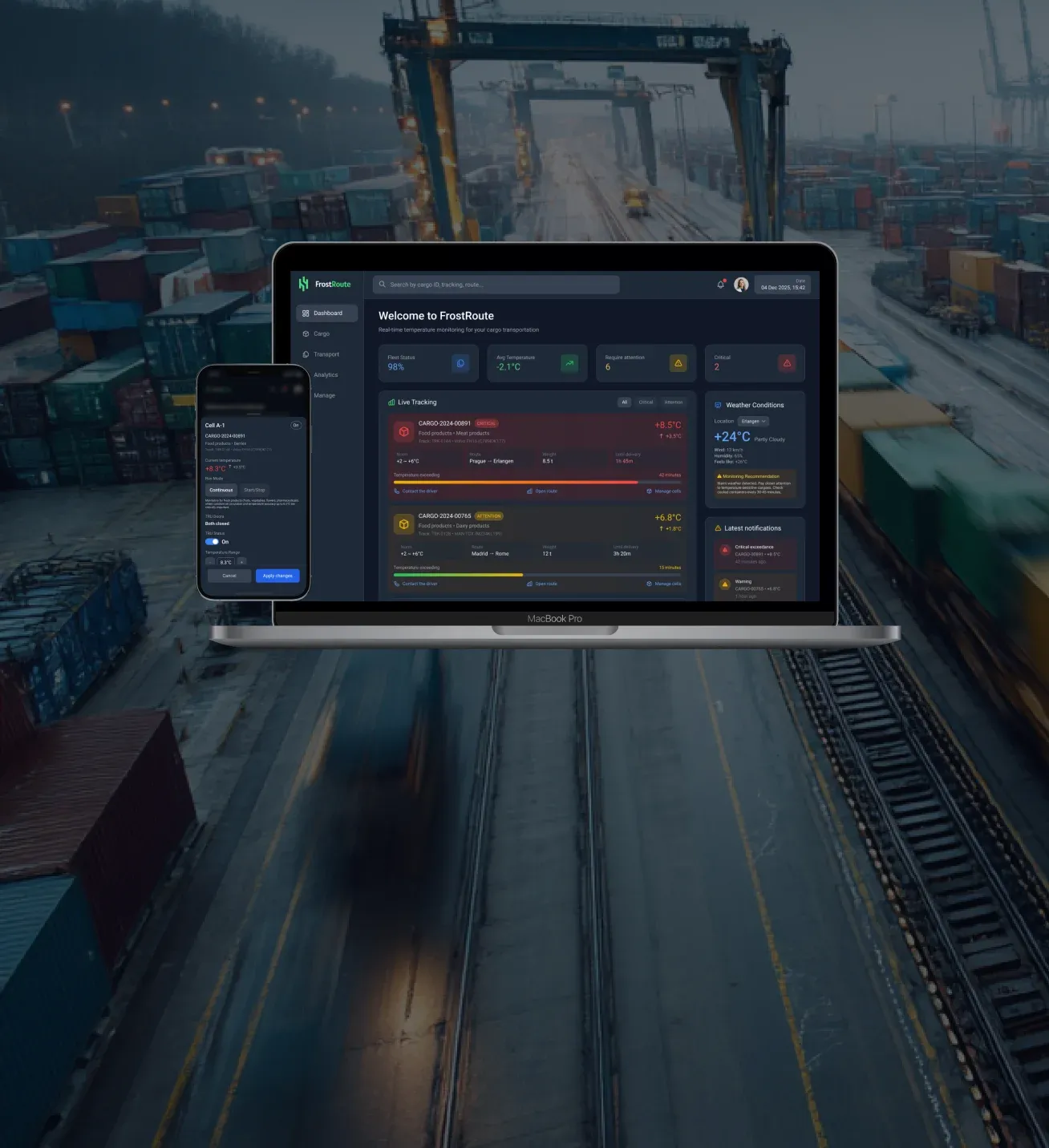
A food logistics company moving berries had no continuous temperature control and no real-time view of cargo conditions. Adjustments were manual and late.
Solution
Modsen built an IoT platform that monitors container temperature and adjusts it against external weather, integrated with the existing logistics infrastructure.
Value
100% goods preservation
~40% less spoilage and rejected deliveries
2x quicker decision-making
Value
100% retention rate since September 2023
~1 week from request to start
Engagement ongoing since 2023

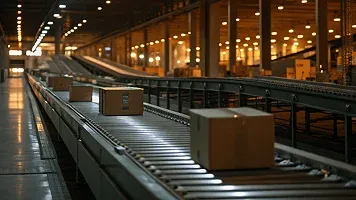
.NET engineering for Escher Group's postal platform
IT staff augmentation
Challenge
Escher Group, supplier to 40+ national postal operators, needed .NET engineers for a proprietary platform where every change requires core-team sign-off across several country versions.
Solution
Two Modsen engineers embedded into Escher Group Scrum workflows – country-specific features, WPF and .NET MAUI interfaces, message brokers and Windows Services Agents.
Value
100% retention rate since September 2023
~1 week from request to start
Engagement ongoing since 2023

Logistics software development solutions tailored to your needs
Transportation management system (TMS)
Fleet management software
Logistics SaaS platform development
Freight forwarding & route optimisation
Warehouse management system (WMS)
Inventory management software
Supply chain management (SCM)
Shipment tracking & last-mile delivery
Transportation management system (TMS)
Logistics SaaS platform development
Warehouse management system (WMS)
Supply chain management (SCM)
Fleet management software
Freight forwarding & route optimisation
Inventory management software
Shipment tracking & last-mile delivery



Discuss your European logistics project
Let’s discuss your goals, challenges, and the best way to move forward from initial idea to a scalable solution.
European logistics compliance built into the software
EU & Europe regulations can affect everything from data fields and business rules to integrations and workflows. We account for these requirements in the software architecture from the start, so compliance is built into how the system operates.
Mobility Package
Smart tachograph 2 on new HDV, driver hours and cabotage counting

Aug 21, 2023
NIS2
Transport enters critical sectors: logging, incident handling, supplier controls
Oct 17, 2024
EU AI Act
Risk classification, transparency and human oversight for AI features
Aug 2, 2026
eFTI
Authorities must accept electronic freight information
Jul 9, 2027
Cyber Resilience Act
Security obligations for products with digital elements, including telematics devices
Sep 11, 2026;
Mobility Package: smart tachograph 2, driver hours and cabotage
EU Mobility Package compliance software starts with tachograph data management: smart tachograph 2 integration for vehicles covered and the retrofit deadlines that followed. Cabotage compliance software counts three operations per seven days and the four-day cooling-off period. Violations appear before the check.
GDPR, NIS2 and Cyber Resilience Act readiness
GDPR-compliant fleet tracking software means a legal basis for driver location data, retention limits, a DPIA and access roles agreed with the works council. NIS2 readiness adds logging, incident handling, and supplier controls; the CRA adds reporting obligations. Telematics then passes your customer audits.
EU AI Act governance for logistics AI
AI logistics software development in Europe carries governance obligations: risk classification of AI features, transparency for users, human oversight, and logging of decisions and model versions. For dispatch and warehouse tools, that means documented models.
eFTI and e-CMR for electronic transport documents
eFTI software integration means structuring consignment data the way authorities will read it under Regulation (EU) 2020/1056. e-CMR software development covers the electronic consignment note under the 2008 protocol, with signatures and document versions. Drivers stop carrying paper, and roadside checks close on data.
Customs and border integrations for European trade
With customs software integration across Europe, one shipment can stay in a single workflow even when it crosses different customs domains. We connect systems through dedicated adapters for declarations, statuses, and deadlines, so operators do not have to manage each system separately.
ICS2 (EU safety)
What Modsen builds
ENS submission at house level, statuses, referrals and "do not load" handling. ICS2 integration services cover road and rail under Release 3
In force
Road and rail since 1 April 2025
NCTS/AES (EU transit and export)
What Modsen builds
NCTS integration software for Phase 5 transit declarations, AES exports with national migration schedules, readiness for Phase 6
In force
Phase 5 since 2 December 2024; Phase 6 from 2026
GVMS/CDS (UK)
What Modsen builds
Goods Movement References and UK declarations as a separate domain over the same shipment object
In force
Current
Passar (Switzerland)
What Modsen builds
Swiss import and export flows; Norway handled as EEA, outside the customs union
In force
Passar 2.0 imports from 2026
EORI/AEO/CBAM/EUDR
What Modsen builds
Validation and storage inside the shipment record, so reporting data is collected in transit
In force
CBAM definitive period from 1 January 2026; EUDR from 30 December 2026
For cross-border logistics software in Europe, each customs system needs its own integration. Modsen handles the technical side, while your customs broker handles the customs work.
Tolls, low-emission zones and transport emissions reporting
European transport planning has to account for more than distance. EETS toll management software brings toll rules and charges into route and cost planning, while transport emissions reporting software EU helps turn vehicle and shipment data into measurable CO2 figures.
EETS toll management across European toll domains
Toll is a planning input. We connect your toll providers to the transport platform so charges calculate per trip, per domain and per vehicle class, and reconcile against what the provider actually bills.
We handle:
Toll rules and charges across different domains
CO2 and vehicle classes where they affect toll rates
EETS provider integrations
Toll costs as part of route profitability
Low-emission zone routing and vehicle eligibility rules
A route can be technically possible and still be unavailable to a particular vehicle. Our low emission zone routing software checks eligibility against the rules that actually apply.
We work with:
Euro and CO2 classes
Vehicle weight, fuel type, and registration country
French Crit'Air/ZFE and German Umweltzonen
Restrictions and effective dates
Charging stops and available AFIR infrastructure
ISO 14083-aligned CO2 calculation per shipment
Our ISO 14083 emissions calculation software calculates transport emissions at shipment and journey-leg level using operational data.
We handle:
Shipment, leg and vehicle data
Versioned emission factors & shipment allocation
WTW/TTW calculations
Audit trails and reporting exports
Data can feed transport emissions reporting software for EU and ESRS workflows.
Integrations with European carriers, telematics and e‑invoicing
European logistics platforms rarely work with one standard or one provider. Modsen builds the integration layer that connects different European systems to your existing architecture, handling data mapping, transformation, validation, authentication, webhooks, errors, and country-specific requirements.


AI logistics software for European operations
AI can help logistics teams optimise routes, process documents, and forecast demand. Our AI logistics software development for Europe accounts for tolls, LEZs, driver hours, data residency, GDPR, and AI Act requirements.
Route and dispatch optimisation with toll, LEZ and driver-hours constraints
AI-assisted routing can consider:
- Toll costs and low emission zone routing software
- Vehicle and driver eligibility
- Driving hours and rest periods
- Fuel and operating costs
ResultResult: better routes with fewer unnecessary costs and compliance risks.
Document AI for customs, eFTI and e-CMR data capture
We turn logistics documents into structured data for customs and transport workflows:
- CMRs, invoices, and packing lists
- eFTI and ENS/ICS2 data
- Validation and human review
- Model versioning and audit logs
ResultResult: less manual entry and fewer declaration errors.
Demand forecasting and warehouse assistants trained on EU data
As part of warehouse management software development in Europe, we add AI for:
- Demand and inventory forecasting
- Replenishment recommendations
- NLP warehouse assistants
- EU-based hosting and processing
ResultResult: better stock decisions across countries while keeping data within the required environment.
Technologies & platforms we work with
Java
 Java 8/11/17/21
 J2EE
 Spring Framework
- Kotlin
 Ktor 3
 Quarkus 3
 Vert.x 4
JS
 React
 Angular
 Vue.js
 Next.js
 Node.js
 NestJS
 Express
- React Native
QA/AQA
 BDD
 CI/CD
 Selenium
 Selenide
 Playwright
- Selendroid
 Appium
AI/ML
 Python
 TensorFlow
 Keras
 PyTorch
 MatLab
- Google Cloud Platform
.NET
 C#
 Visual Basic
 F#
 Linq
 .NET Core
 Entity Framework
 Hibernate
 ASP .NET MVC Core
 WPF
- MAUI
Mobile
 Objective-C
- Swift
 SwiftUI
- Java
- Kotlin
 Jetpack Compose
 Flutter
 KMM
Business Analysis
- Requirements elicitation
- Requirements traceability
- Change management
- Diagramming
- Stakeholder management
- Prototyping
- Benchmarking
- Data analysis, SQL
DevOps
- Cloud Platforms
- CI/CD
- Container Orchestration
- Infrastructure as Code (IaC)
- Configuration Management
- Monitoring & Observability
- Log Management
Why choose Modsen as a logistics software development company in Europe?
Modsen combines logistics domain expertise with software engineering capabilities to help European logistics businesses build, modernize, and scale digital systems. We account for industry-specific processes and regulatory requirements from the early stages of development.
Engineers who know logisticsOur teams have worked on fleet management, warehouse operations, postal platforms, transportation, and other logistics solutions. This domain knowledge helps us understand operational requirements and translate them into practical software solutions. | Compliance considered from the startEU logistics compliance software needs to account for requirements related to eFTI, tachograph data, customs, e-invoicing, and other regulatory areas. We consider these requirements during discovery and architecture planning rather than treating compliance as a final-stage task. | Dedicated logistics teamA dedicated team can cover the key technical areas of a logistics solution, from back-end and integrations to telematics, data, and user-facing applications. This keeps related components aligned throughout development and simplifies communication. |
Built for European data requirementsWe design solutions with European data protection, security, hosting, and retention requirements in mind. Where needed, these requirements can be incorporated into the architecture, infrastructure, and data management approach. | Ready to scale across marketsLogistics businesses operating in multiple European countries often need to support different carriers, formats, tax rules, and operational processes. We design systems with modular integrations and configurable components to make expansion to new markets easier. | We already work in these marketsOur logistics engineering experience covers projects and business requirements across European markets. We use this experience to help clients navigate the technical and operational differences that come with regional expansion. |
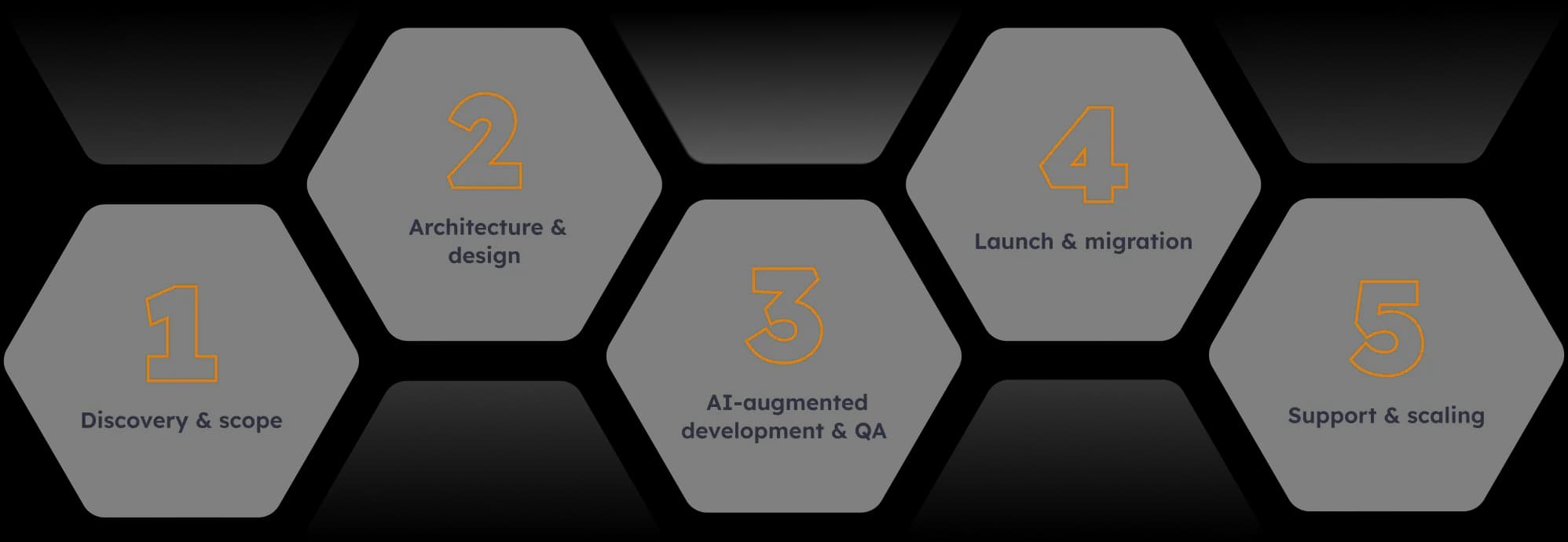
Our logistics software development process
A structured lifecycle from discovery to support, with AI applied where it saves engineer time – research, documentation, test scaffolding. Every output is reviewed before it enters the codebase.
Modsen logistics software development by industry
3PL & 4PL providers
E-commerce & retail
SaaS platforms
Freight forwarding & carriers
Manufacturing & supply chain
What our European clients say about working with Modsen
“They delivered a scalable solution that reduced our HR workload by 50%.”
Head of IT
Manufacturing Company, Eastern Europe
Clutch · Verified


“We see Modsen as a trustworthy partner providing high-quality banking mobile app services.”
Natalia Osipchik, Founder
UMIND
TopDevelopers · Verified

“They moved at the pace our investors expected, not the pace an outsourced team usually has.”
Sophia, CPO
TechBehemoths · Verified
More reviews on request
Leave your email and Modsen will send a list of other partners happy to talk about their experience.
Logistics software development in Europe: FAQ
What makes logistics software development in Europe different?
Does eFTI replace e-CMR and customs declarations?
How should software handle smart tachograph 2, driver hours and cabotage rules?
How do e-invoicing requirements differ across European countries?
How can logistics software calculate CO2 emissions under ISO 14083 and CountEmissionsEU?
What GDPR controls are needed for fleet tracking and telematics?
Can one platform support EU, UK and Swiss customs and toll workflows?