Artificial intelligence in logistics 2026: cutting costs by 20–30%
14 min read
Last updated: Aug 03, 2026
Summary
Artificial intelligence in logistics uses machine learning, predictive analytics, and computer vision to automate decisions that previously required human intervention.
Today, AI is already embedded across transportation, inventory management, and warehousing, reducing costs by up to 30% across different stages of the supply chain, while improving speed and accuracy of processes.
In this guide, we break down core application areas of AI in logistics, observe main use cases with real cost impact, and provide you with practical steps to implement it in your logistics operations.
Key takeaways
The biggest cost‑saving use cases of AI and logistics are route optimization, freight rate management, demand forecasting, warehouse automation, and predictive maintenance.
AI is already capable of reducing transportation time by ~15%, cutting fuel consumption by up to 30%, lowering excess inventory by up to 20%, and increasing warehouse picking productivity by around 30%.
Artificial intelligence is gradually moving beyond process optimization into strategic transformation with autonomous trucking initiatives and end‑to‑end supply chain visibility.
Generative AI expands logistics capabilities through document automation, customer support, contract analysis, and employee training.
Successful AI in logistics adoption starts with data readiness, making clean data, a high‑ROI use case, and pilot‑first implementation critical to long‑term success.

Dmitry Grishanovich
Head of .NET Department at Modsen
What is artificial intelligence in logistics? Core areas of application


Artificial intelligence in logistics is the use of machine learning, computer vision, natural language processing, and predictive analytics to automate operations and enhance decision‑making. It replaces manual planning with data‑driven execution and real‑time insights.
In practice, logistics and artificial intelligence work together to reduce errors, speed up processes, and improve cost control across the entire supply chain. Typical areas of application include:
Transportation. AI optimizes routes, predicts ETAs, and adjusts plans based on traffic and demand.
Warehousing. Computer vision and robotics automate picking, sorting and inventory tracking.
Supply chain management. Predictive models increase demand forecasting accuracy and detect risks early.
Customer experience. AI powers tracking chatbots, proactive alerts, and real‑time updates.
Most of these solutions are delivered through custom logistics software development services tailored to specific workflows and data environments.
AI vs traditional logistics automation
To understand how exactly AI transforms logistics, it’s essential to compare it with traditional automation approaches.
Conventional logistics automation is rule‑based. It follows predefined “if‑then” logic and executes tasks according to fixed scenarios set in advance. Such systems handle repetitive tasks efficiently but can’t adapt if conditions change or unexpected events occur.
Artificial intelligence in logistics works differently. It learns from data and adapts over time. AI models analyze historical patterns, real‑time inputs, and external factors to improve decisions continuously. Instead of following static rules, they optimize outcomes in dynamic conditions.
The table below summarizes the differences:
Traditional automation
Decision logic
Fixed rules (“if‑then”)
Flexibility
Low
Adaptation
Manual updates
Data usage
Limited, structured
Best for
Stable, predictable workflows
AI‑driven logistics
Decision logic
Learns from data
Flexibility
High
Adaptation
Real‑time adjustment
Data usage
Large‑scale, real‑time
Best for
Dynamic, complex operations
Take route planning as an example. Traditional routing systems assign the shortest path based on fixed parameters (preset rules), while AI systems adjust routes in real time using traffic, weather, and demand data to minimize delays and costs.
This adaptivity translates into key benefits of AI in logistics: higher accuracy, better forecasting, and more efficient operations under changing conditions.
AI applications in logistics: 5 use cases with real cost impact
AI in logistics and supply chain delivers the most value when applied to specific operational tasks. Here are five use cases that drive significant savings:
Description
Route optimization
Real‑time analysis of traffic, weather and delivery constraints
Freight rate optimization
Comparison of carrier rates based on demand, capacity and performance
Demand forecasting
Demand prediction using historical data, seasonality and market signals
Warehouse automation
Automated picking, sorting and inventory tracking using computer vision and robotics
Predictive maintenance
Continuous monitoring of equipment using sensor data and usage patterns
Impact
Route optimization
Lower fuel consumption, shorter delivery times and reduced transport costs
Freight rate optimization
More cost‑efficient carrier selection and lower shipping costs
Demand forecasting
Better inventory balance with fewer stockouts and overstocks
Warehouse automation
Higher throughput, improved accuracy and lower labor dependency
Predictive maintenance
Fewer breakdowns and lower maintenance costs
Rather than isolated tools, these AI in logistics examples work across the entire workflow, increasing efficiency and cutting costs at multiple stages. In the following sections, we take a closer look at each use case and its impact in practice.
AI for route optimization and freight rate management
Route optimization is one of the most mature applications of artificial intelligence in logistics.
It relies on algorithms – sets of rules and mathematical calculations – that process large volumes of data to build the most efficient delivery routes. These algorithms combine historical route data with real‑time inputs such as traffic conditions, weather, and vehicle capacity constraints. As an outcome, routes are continuously recalculated based on actual operating conditions, not static assumptions.
Concerning measurable improvements, research shows that AI‑enabled route optimization can reduce transportation time by around 15% on average. In parallel, it helps significantly cut fuel consumption – up to 15–30% in certain scenarios.
A well‑known example here is UPS’s ORION system, which analyzes millions of possible route combinations to minimize distance traveled. It results in fewer miles driven and less fuel usage at scale, leading to substantial cost savings across the delivery network.
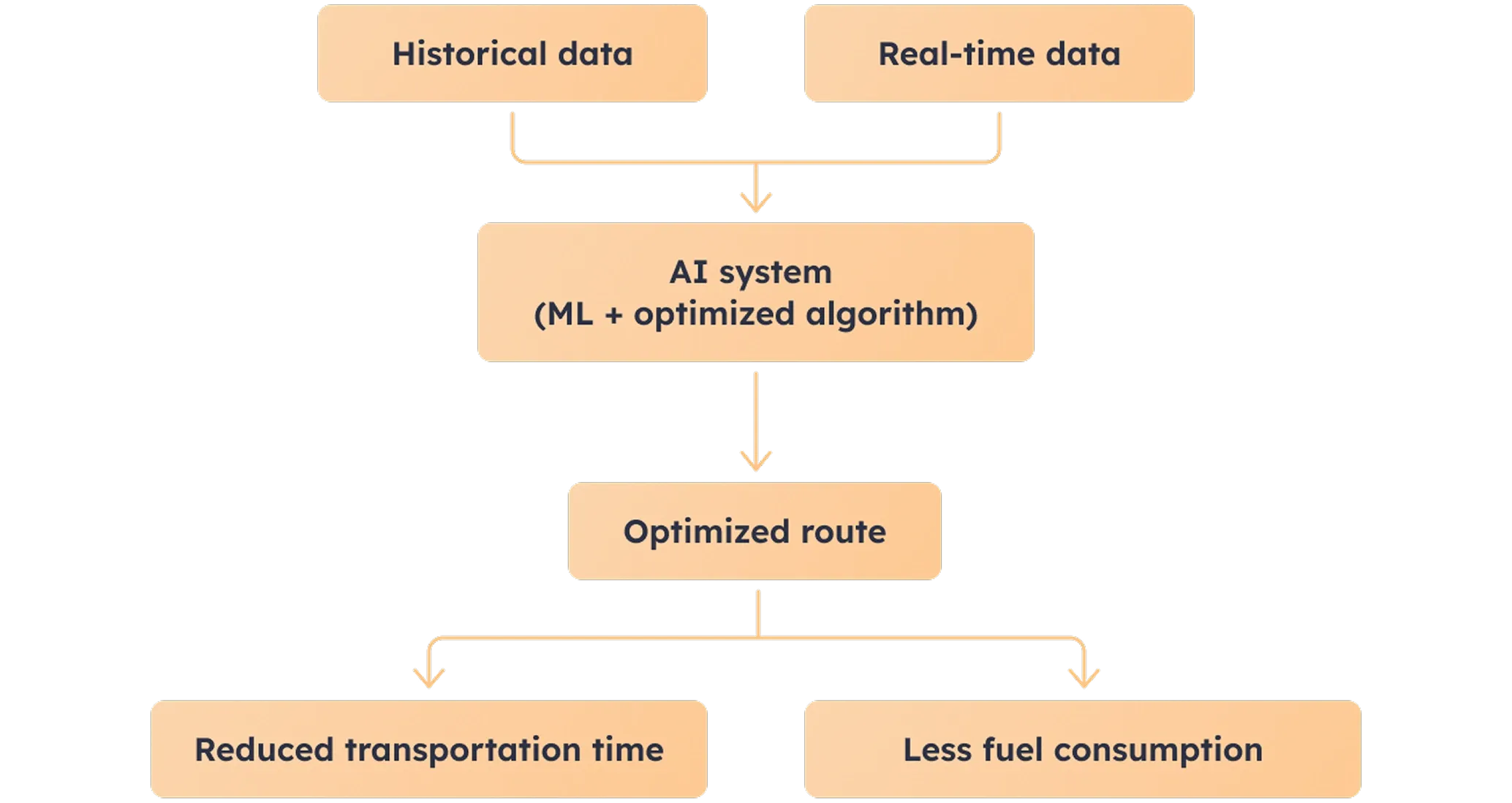
AI route optimization
Another key application of AI in logistics is freight rate optimization and carrier selection.
AI models process a lot of data from multiple sources (historical pricing data, seasonal trends, fuel indices, port congestion, capacity availability, etc.) to evaluate both current and expected shipping costs.
Instead of relying on fixed contracts or static routing guides, AI continuously compares rates across multiple carriers and predicts how they may change. This way, companies can select the most cost‑efficient carrier for each shipment at a specific moment in time.
Overall, such a dynamic approach helps avoid overpaying during peak demand, respond to market fluctuations, and improve cost control at the shipment level. At the same time, it ensures better alignment between price, service quality, and delivery requirements.
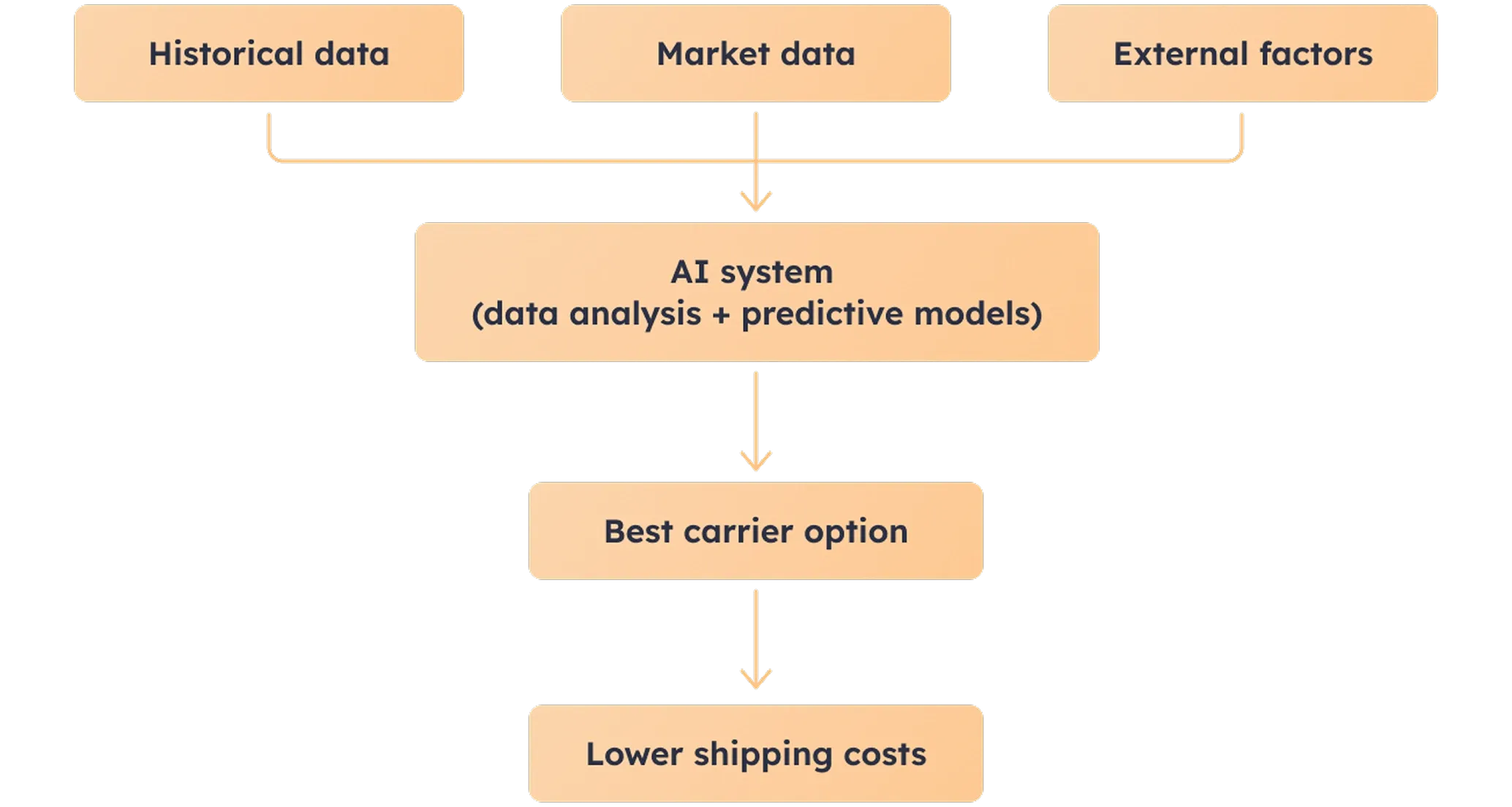
AI‑driven carrier selection
AI‑assisted demand forecasting and warehouse automation
Artificial intelligence in logistics is widely used to enhance demand forecasting and inventory planning.
AI systems analyze numerous data sources, including historical sales by stock‑keeping units, seasonality, promotional activity, and external signals such as weather or market trends. Based on this data, they generate granular forecasts for each product across distribution locations.
This allows companies to better align supply with actual demand and avoid common planning errors. As a result, businesses can reduce excess inventory by up to 20% while maintaining service levels.
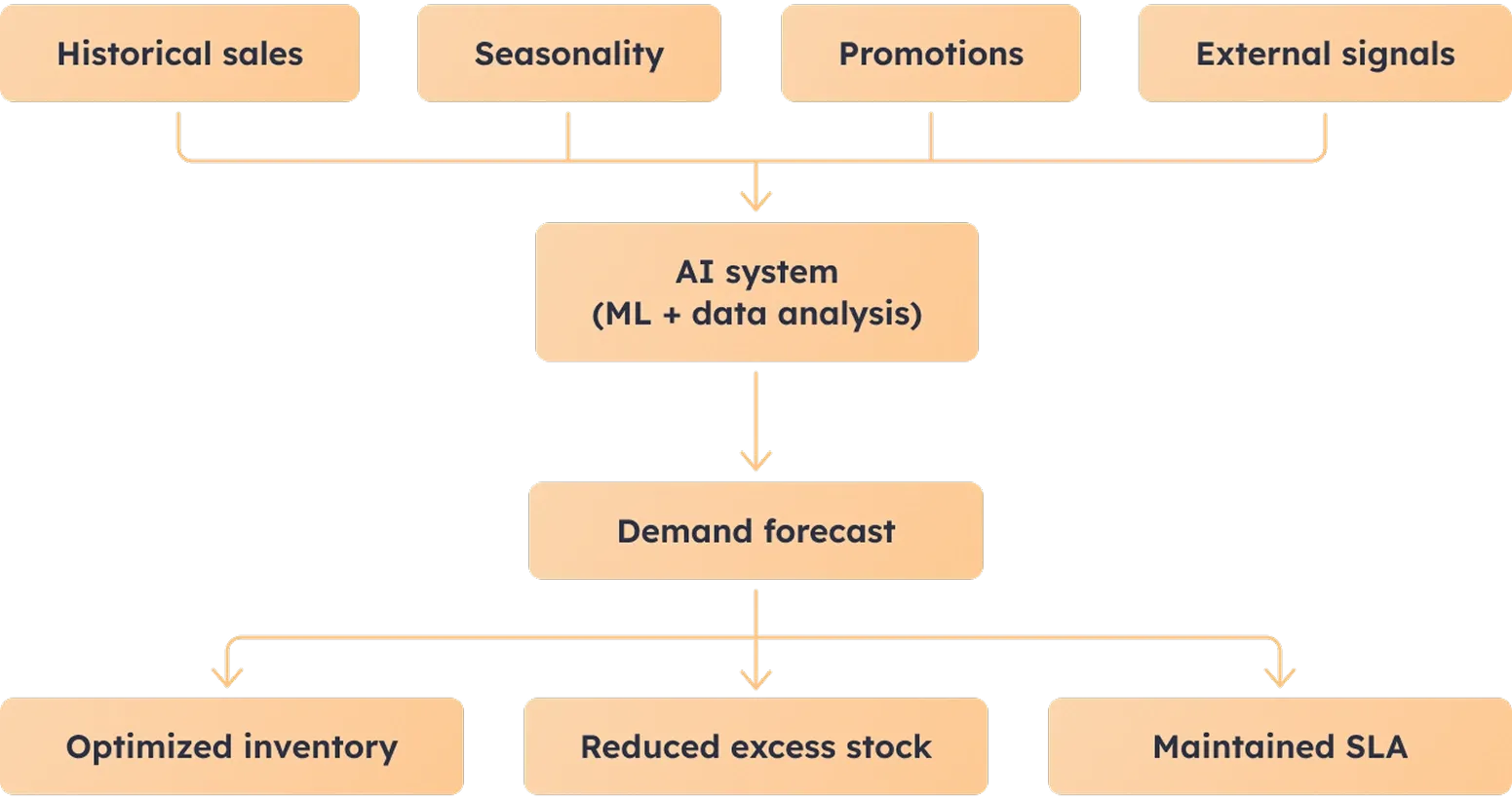
AI‑powered demand forecasting
Warehouse automation is another area heavily transformed by artificial intelligence.
AI‑powered systems combine computer vision and machine learning models to control robotic picking operations. These robots navigate warehouse layouts, locate items, and support picking and packing processes with minimal human involvement.
By optimizing movement and task allocation, they significantly increase operational efficiency – in particular, order processing speed. For example, DHL reports that item‑picking robots increased units picked per hour by around 30% in one warehouse.
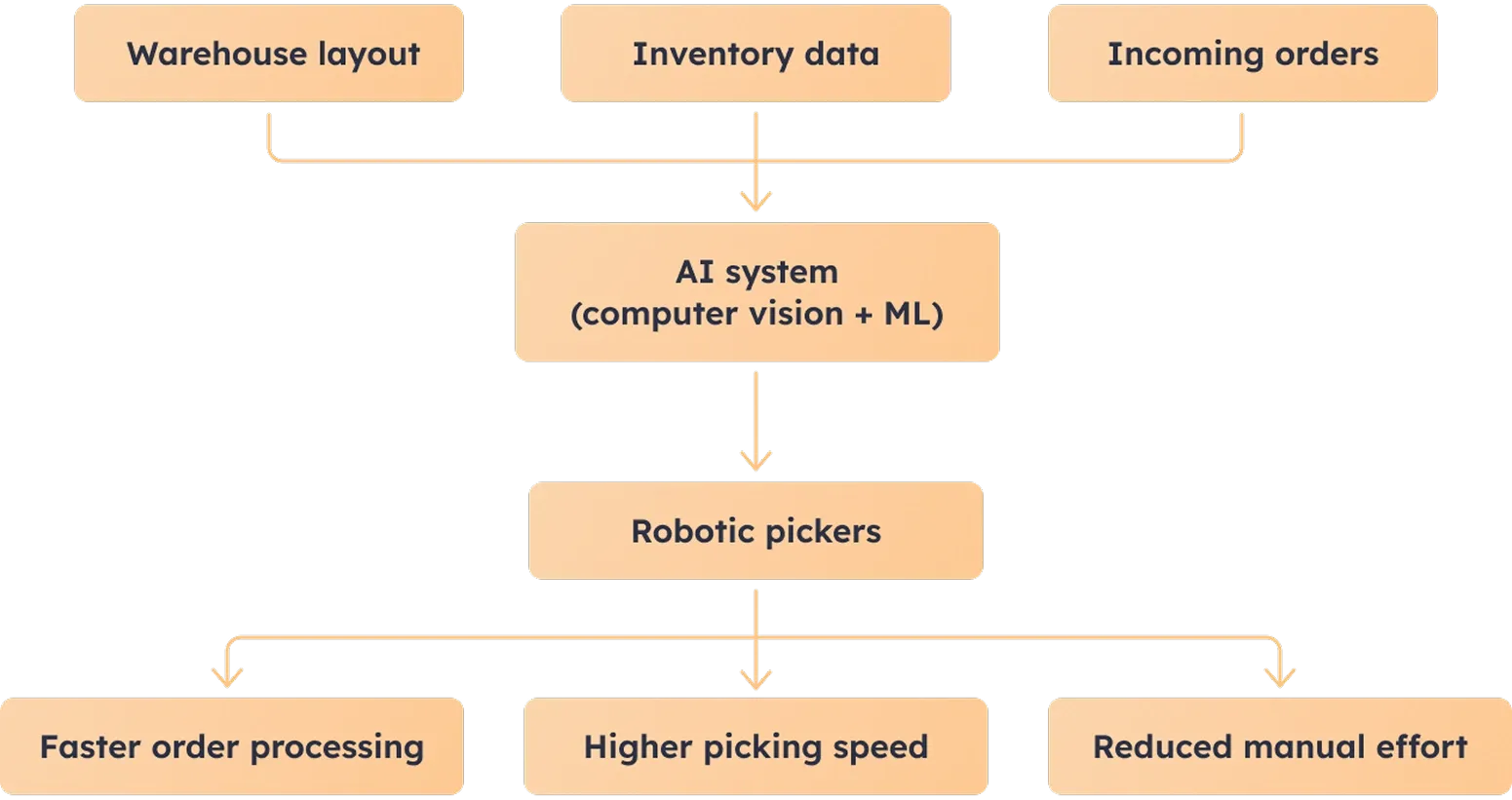
AI warehouse automation
AI in predictive maintenance
Artificial intelligence in logistics also enables predictive maintenance to prevent costly disruptions. The main focus here is on detecting issues before they lead to failures.
It works as follows: IoT sensors collect data from key vehicle components (the engine, transmission, braking and cooling systems), while AI analyzes this data in real time to identify abnormal patterns and early signs of malfunction.
When a risk is detected, the system alerts maintenance teams in advance, allowing companies to move from reactive repairs to planned maintenance.
The impact is direct – fleet downtime is reduced, maintenance costs decrease, and emergency repairs become less frequent. In addition, preventing failures on critical routes helps avoid SLA penalties and unexpected operational losses.
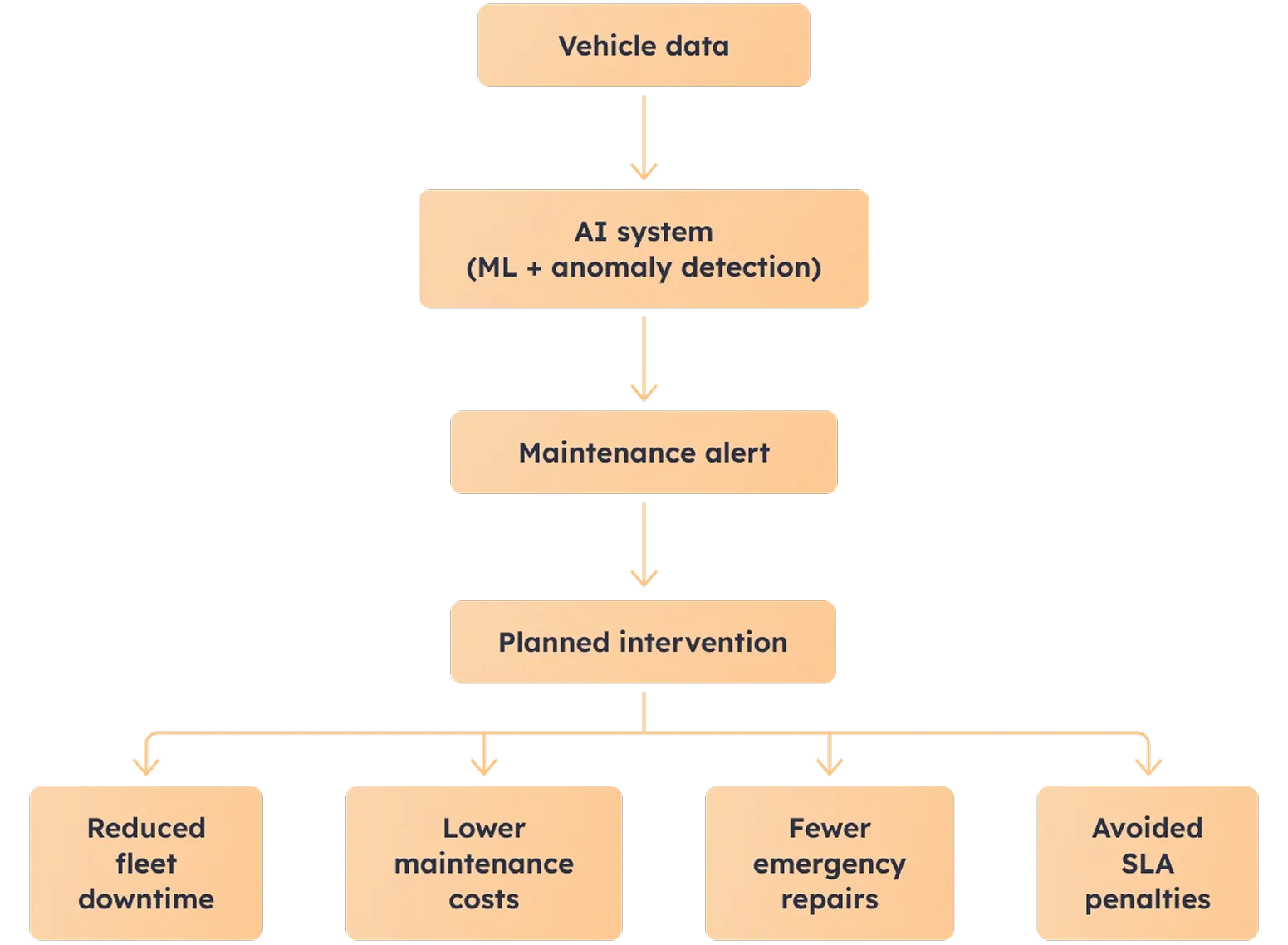
AI‑assisted predictive maintenance
Looking to identify the highest‑impact AI use cases for your logistics operations?
Book a free consultation with Modsen experts to assess your current processes, discover where AI can deliver the greatest business impact, and build a practical adoption roadmap.
Dmitry Grishanovich
Head of .NET Department at Modsen



AI in transportation and supply chain: a broader view
While the use cases above concentrate on optimization of existing processes, artificial intelligence in logistics isn’t about operational improvements only.
Today, AI in logistics and transportation is increasingly used beyond route optimization and freight rate management, with autonomous trucking as one of the most visible examples. Companies like Waymo and Aurora are already deploying self‑driving freight vehicles in pilot programs on real routes, using AI to navigate roads, make driving decisions, and operate without human drivers.
Across the broader supply chain, AI usage isn’t limited to early risk detection and proactive decision‑making. It provides multi‑tier visibility by connecting data across suppliers, warehouses, and transportation flows – something that allows businesses to improve coordination between all stakeholders and maintain more stable operations across the entire supply network.
This shows that AI is evolving from optimizing individual processes to transforming transportation and supply chain systems at a strategic level. For a deeper overview of the topic, explore our guide on transportation logistics software.
Generative AI in logistics: documentation, support, and new applications
Unlike traditional AI, which focuses on prediction and optimization, GenAI is designed to create and process content, supporting a growing range of administrative and operational tasks in logistics.
Key applications include:
Document automation – bills of lading, customs documentation, and shipment records generation based on existing data
Customer support – order status updates, routine inquiries handling, and delivery exception management through AI‑powered chatbots
Carrier contract analysis – agreement summarization, core terms extraction, and potential risk identification
Training and onboarding – generation of learning materials and role‑specific guidance for employees
However, the technology still has its limitations. Generative AI may produce inaccurate information and raise data privacy concerns when sensitive business data is involved. Human oversight remains essential.
Looking to adopt these capabilities? Start by evaluating available AI services and solutions.
How to implement AI in your logistics operations
As we’ve seen, AI makes a significant difference both in everyday logistics operations and strategic execution. So, how do you introduce it into your business?
Successful AI adoption starts with data, not technology. Data readiness remains one of the biggest challenges of artificial intelligence for logistics as even the most advanced AI systems depend on reliable inputs. This means companies should assess data quality, availability, and consistency before implementing any solution.
A practical AI adoption roadmap typically consists of four steps:
Data audit to identify gaps, inconsistencies, and data quality issues
Identification of the highest‑ROI use case based on business goals and operational priorities
Selection of the right implementation approach (either a vendor SaaS solution with built‑in AI capabilities or a custom‑built system developed with an internal team or external IT staff augmentation support)
Pilot project execution to measure results and gradually scale successful initiatives across the organization
Most importantly, avoid trying to transform everything at once. A focused use case, supported by clean data and measurable objectives, is usually the fastest path to tangible business value.
If your AI strategy involves custom logistics solutions, take a deeper look at 3PL software development to get additional insights into planning, development, and implementation considerations.
FAQ
What is AI in logistics and supply chain?
What are the main benefits of AI in logistics?
What are real examples of AI in logistics?
How much does AI logistics implementation cost?
What is generative AI in logistics?
Conclusion
Artificial intelligence for logistics is no longer limited to experimental projects. Today, it delivers measurable value across route optimization, demand forecasting, warehouse automation, predictive maintenance, and generative AI applications even for small businesses.
At the same time, AI is moving beyond process optimization. From autonomous transportation to end‑to‑end supply chain visibility, it’s increasingly transforming logistics operations at a strategic level.
The business case is clear, but successful adoption requires more than technology alone. Clean, reliable data and a well‑defined implementation strategy remain the foundation of long‑term ROI.
If you are exploring AI opportunities in logistics, talk to Modsen team. We are always ready to help you identify high‑impact use cases, define the right implementation approach, and turn your AI initiatives into measurable business results.
References
Read more




Get a weekly dose of first-hand tech insights delivered directly to your inbox