
3PL fulfillment software development services: scope, costs and timeline
9 min read
Last updated: Jul 28, 2026
Summary
U.S. third-party logistics (3PL) market net revenue rose 5.1% to $138.2 billion in 2025, recovering from the 2022–2023 freight recession. That means more volume and more per-client complexity, which is what breaks generic software first. Past a certain scale, 3PL fulfillment software development services stop being optional; the open questions become which modules sit at the core, what a build costs, and how to staff it without betting everything on a single hire. These are the questions custom logistics software development services exist to answer. Across the wider field of transportation industry solutions, the multi-client provider is the clearest case for going custom.
Key takeaways
Custom 3PL software becomes valuable at scale, especially for providers with 50+ clients, unique workflows, or complex SLA requirements.
Six core modules are OMS, WMS, carrier integrations, client portal, analytics, and billing engine.
Client portals create a competitive advantage improving transparency, reducing support requests, and increasing customer retention.
Integrations are critical: reliable connections with carriers, ERP systems, and e-commerce platforms enable real-time data flow and automation.
AI is a second-stage investment, after building a stable core platform, AI can optimize forecasting, routing, carrier selection, and anomaly detection.

Eugene Kalugin
CTO at Modsen
What is 3PL fulfillment software and when to build custom?
A third-party logistics provider manages fulfillment on behalf of other companies.


3PL fulfillment software is the platform that runs the full cycle for many clients at once: order intake, warehouse operations, carrier selection, last-mile tracking, client reporting, and billing. It is a multi-client operations platform, not a warehouse management tool sized for a single site.
The decision to build 3PL software starts when packaged software can’t model the way you already operate. Custom 3PL fulfillment software development services make sense when:
You serve more than 50 clients with different SLAs, rate cards, and reporting requirements that no template accommodates cleanly.
Your workflows are unusual: cold chain (temperature-controlled logistics), hazmat (hazardous materials), or high-value goods.
A branded client portal is part of how you win and keep accounts.
You want to own the intellectual property (IP) outright instead of renting access to someone else's product and absorbing every price increase and feature delay they decide on.
If only one or two of those apply, the answer isn't obvious and that's exactly what IT consulting for logistics is for: mapping your real requirements before anyone writes code, so you don't build custom where a packaged tool would have done.
3PL vs 4PL vs in-house logistics: which needs custom software?
The three operating models carry very different software needs, and custom transportation software is worth the most to the providers that juggle the most variety.
3PL (Third-Party Logistics)
Outsourced logistics for multiple clients, covering warehousing, fulfillment, and shipping on others' behalf
Custom software need: high
4PL (Fourth-Party Logistics)
Manages a client's entire supply chain, including oversight of the 3PL providers underneath it
Custom software need: very high, because multi-layer visibility and coordination almost never fit a packaged product
In-house logistics
A company that runs its own operations
Custom software need: lower
The pattern is consistent: the more distinct clients and requirements a provider serves at once, the harder packaged software pushes back, and the stronger the case for a platform you own and control end to end.
Scope of 3PL fulfillment software: core modules
The scope of 3PL fulfillment software development services comes down to six working parts. Each is described here by what it does for the operation, not by its acronym. Sound logistics app development starts from what each part actually does for the business. That is also why teams that have never run a warehouse for many clients at once tend to underestimate the work.
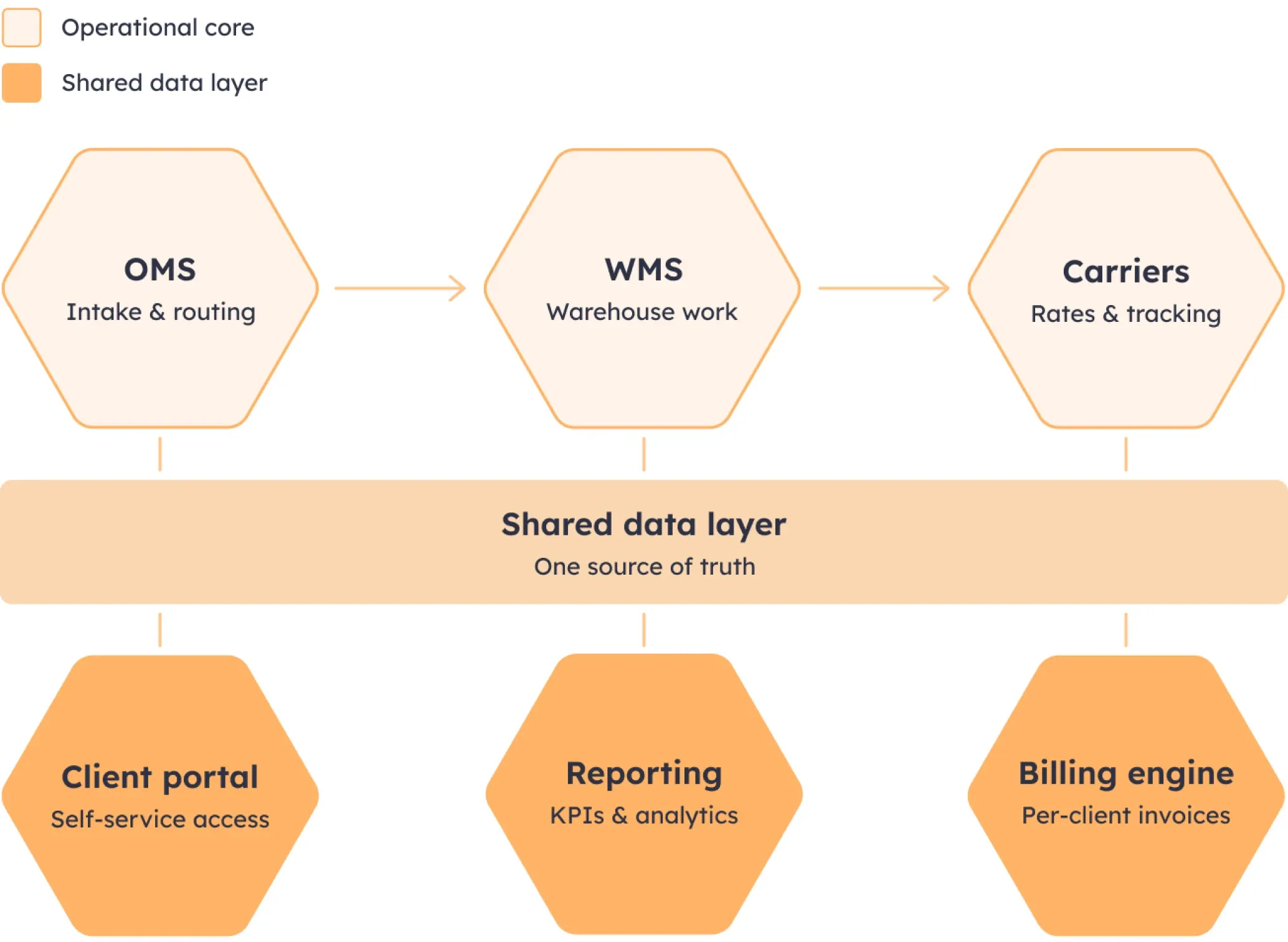
1. OMS (Order Management System)
Takes in orders from every client and channel, routes each to the right warehouse or carrier, and handles exceptions: damaged goods, bad addresses, out-of-stock items.
2. WMS (Warehouse Management System)
Receiving, put-away, picking, packing, and dispatch. It manages multiple clients' inventory inside shared warehouse space and supports client-specific pick rules and packaging requirements.
3. Carrier integration layer
Application programming interface (API) connections to FedEx, UPS, DHL, USPS, less-than-truckload (LTL) carriers, and freight brokers, with real-time rate shopping, label generation, and tracking event ingestion. This layer is what makes multi-carrier operations manageable at volume.
4. Client portal
A branded interface giving each client real-time inventory visibility, order status, shipment tracking, custom reports, and billing statements. Clients who can see their own data tend not to churn.
5. Reporting and analytics
Dashboards for on-time delivery, pick accuracy, cost per order, and SLA adherence per client, in operational and executive views, plus client-facing reports for billing and performance review.
6. Billing engine
Rate card management for per-pick fees, storage, handling surcharges, and accessorial charges, with automated per-client invoicing. This is where 3PL revenue leaks most often without a proper system, and it is the part of logistic software development services that most directly protect margin.
Full 3PL fulfillment software development services also cover the shared data model that lets these six modules read from one source of truth.
Client portal for 3PL: why it's a competitive differentiator
Most 3PL providers compete on two things: price and warehouse location. Both are easy for a rival to undercut. But a branded client portal lets you compete on how easy you are to work with, which is one of the first outcomes 3PL fulfillment software development services are scoped to deliver.
When a client can log in and see their own stock, track their orders, and pull their own reports without phoning anyone, two things happen at once: your operations team gets fewer status-request calls, and the client gets a level of service a cheaper competitor can't match quickly. A client who runs their day through your portal doesn't leave on price alone.
The portal only works as a retention tool if it carries the client's own brand, not yours or a vendor's. White-labeling delivers exactly that: each client gets a portal under their name, with the polish enterprise customers expect. It is one of the details our custom software development services are built to get right.
Integrations for 3PL software: carriers, ERP and e-commerce
A 3PL platform from any serious transportation software company cannot operate in isolation. Warehouses, carriers, ERP systems, marketplaces, and online stores constantly exchange data. Without seamless integrations, logistics providers face manual data entry, shipment delays, inventory inaccuracies, and limited visibility across the supply chain.
Custom 3PL fulfillment software services should serve as a central hub that synchronizes inventory, orders, shipments, and financial data in real time.
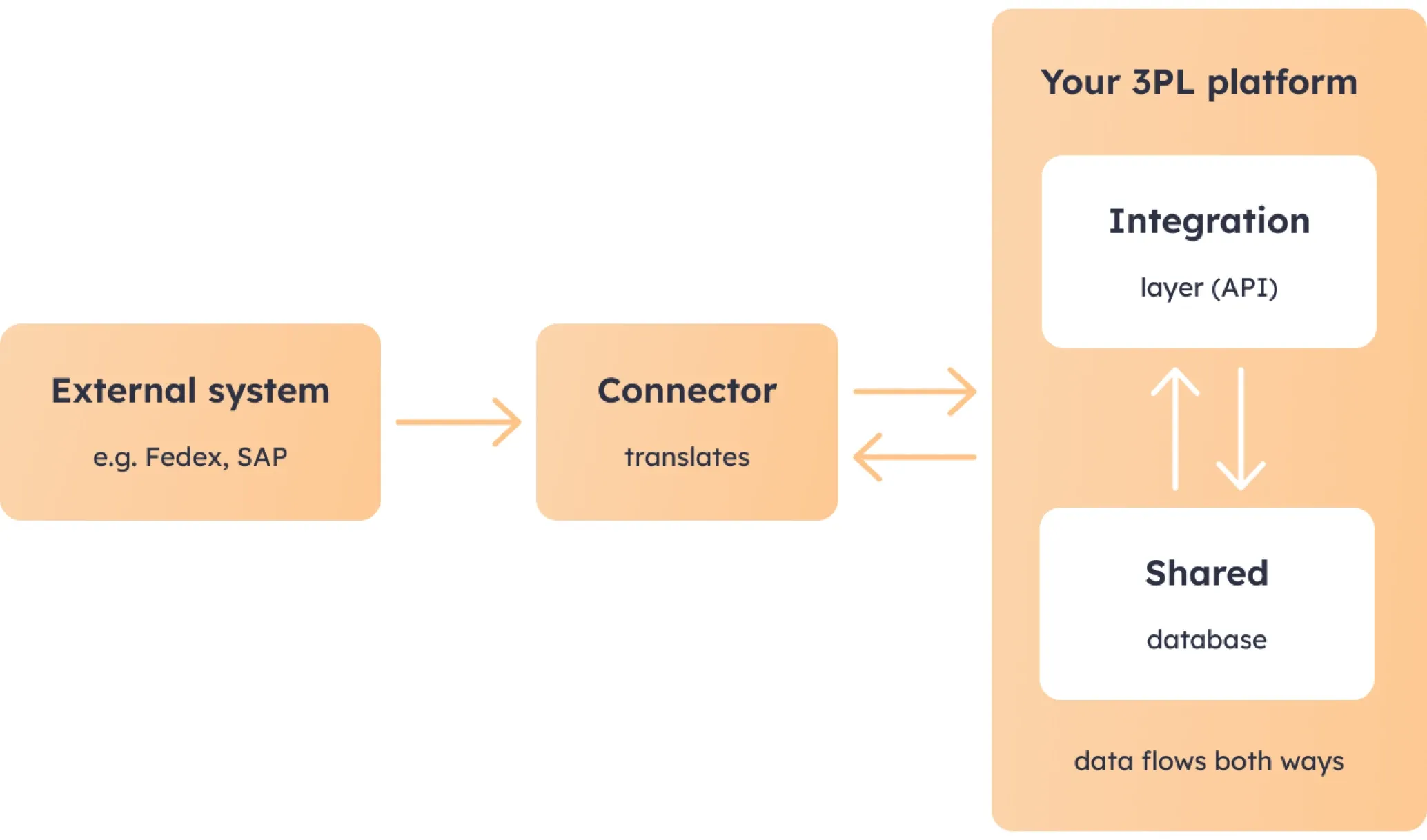
An outside system connects through a translating connector and the platform's API into a single shared database
Carrier integrations for automated shipping operations
Shipping carrier integrations allow logistics providers to automate the entire fulfillment process, from label generation to delivery tracking. Common carrier integrations include FedEx, UPS, DHL, USPS, DPD, and GLS.
With carrier connectivity, businesses can:
automatically create shipping labels
calculate shipping rates in real time
schedule pickups
track shipments across multiple carriers
provide customers with delivery updates
For growing fulfillment operations, carrier integrations help reduce manual workload and improve delivery accuracy.
ERP integrations for end-to-end business visibility
ERP systems contain critical business information such as inventory levels, procurement data, accounting records, and order management workflows.
Integration enables real-time synchronization between warehouse operations and business processes. Common ERP connections: SAP, Oracle NetSuite, Microsoft Dynamics 365, Odoo, Acumatica.
ERP connectivity helps companies:
maintain accurate inventory records
eliminate duplicate data entry
improve demand forecasting
streamline financial reporting
gain complete operational visibility
E-commerce integrations for omnichannel fulfillment
As online sales channels expand, fulfillment providers must support multiple e-commerce platforms and marketplaces simultaneously. A modern 3PL platform can connect to: Shopify, WooCommerce, Magento (Adobe Commerce), BigCommerce, Amazon, eBay, Walmart Marketplace.
These integrations enable automatic order import, inventory synchronization, shipment updates, and returns processing.
As a result, businesses can manage omnichannel fulfillment from a single platform while maintaining consistent inventory data across all sales channels.
API-first architecture for scalable integrations
Every logistics ecosystem is unique. While standard connectors cover common platforms, many organizations require custom integrations with proprietary systems, suppliers, transportation management systems (TMS), or customer portals.
An API-first approach makes it possible to connect virtually any third-party solution and ensure secure real-time data exchange.
At Modsen, we provide custom 3PL fulfillment software services with flexible integration capabilities, helping logistics providers create a connected digital ecosystem that scales with business growth. For providers scaling their carrier and fleet side at the same time, our guide to transportation logistics software for growing fleets covers the fleet-facing half of the stack.
Cost and timeline for 3PL software development
What’s included
Discovery and architecture
Requirements mapping, integration design, technical spec, team structure
MVP
Core modules: OMS, WMS, 2–3 carrier integrations, basic client portal
Full platform
All modules, billing engine, full carrier network, advanced analytics
AI/ML additions (phase 2)
Demand forecasting, dynamic routing, anomaly detection
Cost range*
Discovery and architecture
$15K–$30K
MVP
$80K–$200K
Full platform
$300K–$800K+
AI/ML additions (phase 2)
$50K–$150K additional
Four things move the cost: the number of clients, the number of carrier integrations, compliance requirements (cold chain, hazmat, HIPAA), and team location – Eastern European engineering teams cost substantially less than U.S. teams. The right logistics app development company quotes against those drivers rather than a flat package price, and tells you which ones are pushing your number up.
Phase | Duration |
|---|---|
Discovery and architecture | 4–6 weeks |
MVP | 4–6 months |
Full platform | 12–18 months |
Capacity is the other half. Experienced transportation software developers shorten the MVP mainly by avoiding rework. The most common way providers control both risk and cost: keep architecture in-house and add senior engineers instead of handing the whole build to an outside shop.
Want a scoped estimate for your 3PL platform?
Leave your email and we will prepare an answer based on your specific requirements within 48 hours.
Build vs buy vs augment: making the right decision
Custom solution
Time to deploy
6–18 months
Upfront cost
High
Long-term TCO
Lower (no licensing)
Workflow fit
Unlimited
IP ownership
You
Team control
Full
Buy (SaaS)
Time to deploy
1–3 months
Upfront cost
Low
Long-term TCO
Higher (recurring fees)
Workflow fit
Standard processes only
IP ownership
Vendor
Team control
None
Team augmentation
Time to deploy
4–12 months
Upfront cost
Medium
Long-term TCO
Medium
Workflow fit
High
IP ownership
You
Team control
High
A fully outsourced build hands the project to an experienced partner who has shipped logistics platforms before, freeing your people to run operations. Augmentation keeps your architects in control while senior external engineers add the capacity to build fast. Both give full IP ownership and a platform built around your workflows.
SaaS, by contrast, locks you into someone else's roadmap and fees; a permanent in-house team is slow to hire and over-staffed once the build shifts to maintenance.
For 3PL fulfillment software development services delivered this way, a dedicated team model for logistics development keeps total cost of ownership (TCO) predictable while leaving the roadmap in your hands.
AI and advanced features for 3PL fulfillment platforms in 2026
AI is a phase 2 investment, and one of the more demanding logistics IT solutions to add: a platform needs a working core and real data history before any model can earn its place.
Phase 2 modules worth scoping:
Demand forecasting predicts inbound order volume by client and SKU to cut overstock and stockouts. It needs 6–12 months of historical data to train usefully.
Dynamic route optimization adjusts carrier and route selection in real time against cost, speed, and carrier performance. McKinsey research puts AI-driven logistics cost reductions in the 5–20% range when AI is embedded across operations.
Anomaly detection flags deviations from expected patterns: unusual order volumes, clusters of carrier delays, inventory discrepancies.
Automated carrier selection picks the optimal carrier per shipment by weight, destination, SLA, and current rates, replacing manual rate shopping.
Generative AI for document processing extracts structured data from unstructured shipping documents such as bills of lading (BOLs), customs declarations, and invoices, reducing manual entry.
These capabilities are where transportation industry solutions are heading, but the order matters: data and core platform first, models second. We break down how AI cuts logistics costs and the ROI math behind each of these modules in a separate guide.
FAQ
What do 3PL fulfillment software development services include?
How much does it cost to build custom logistics software?
How long does 3PL software development take?
Which logistics app development company should I choose?
What is the difference between building and buying 3PL software?
Can you add AI to existing 3PL software?
Conclusion
Custom 3PL fulfillment software development services become valuable when operational complexity outgrows the limits of standard platforms. A well-designed solution brings together warehouse operations, carrier integrations, client visibility, billing, and analytics into a single ecosystem that can scale with your business. Whether you're building a new platform or modernizing an existing one, the Modsen logistics engineering team can help define the right scope, delivery model, and roadmap for long-term growth.
References
Read more





Get a weekly dose of first-hand tech insights delivered directly to your inbox