Transportation logistics software: use cases, integrations & pricing
10 min read
Last updated: Aug 04, 2026
Summary
Freight keeps the economy moving, yet the software that plans and tracks it rarely gets the attention the trucks do. Transportation logistics software is a TMS (Transportation Management System) and the adjacent platforms that plan routes, manage carriers, and track shipments in real time.
The category is growing quickly: Grand View Research projects the global transportation management system (TMS) market will rise from $21.8 billion in 2026 to $68.4 billion by 2033.
This guide covers what transportation and logistics software does, the use cases that matter, how it connects to the rest of your stack, and what it costs. If a tailored build is already on your radar, our custom logistics software development services page covers that route.
Key takeaways
Transportation logistics software, most often a TMS, automates route planning, carrier selection, and shipment tracking, replacing manual dispatch and spreadsheets.
Three questions determine whether the platform fits your operations: your shipment volume, fleet type, and how many other systems the tool has to connect to.
Integrations with ERP platforms such as SAP and Oracle, plus live carrier APIs, are now standard expectations rather than premium add‑ons.
SaaS runs about $50 to $500 per user per month; enterprise and custom builds run $100,000 to $500,000, but as a system built around your operation, that spend earns its keep at scale.
A custom transportation & logistics software build starts to pay off once a fleet passes roughly 50 vehicles or hits workflows no off‑the‑shelf product supports.

Paul Kirikov
Head of Business Development Department at Modsen
What is transportation logistics software?
Transportation logistics software is the digital layer that runs freight operations from planning through to payment. Most of it is a TMS – the platform a team uses to plan routes and track shipments in real time. Such a system can replace the spreadsheets, phone calls, and email threads that quietly eat hours every day.
Core functions of transportation logistics software usually include route planning, carrier selection, freight rate management, shipment tracking, freight bill auditing, and reporting. Freight bill auditing means checking each carrier invoice against the rate you agreed to, so you stop paying for errors that add up over a year. Reporting turns raw shipment data into the numbers a manager needs: cost per load, on-time rate, and where delays cluster.
Two setups are common:
A standalone TMS focuses only on transportation and connects to everything else you run.
A TMS built as a module inside an ERP (Enterprise Resource Planning) suite shares one database with finance and inventory, which suits companies already standardized on one vendor.
The choice shapes how much transportation and logistics software you maintain and how cleanly freight data lines up with accounting.
TMS vs freight management platform: what's the difference?
The two get mixed up often. A TMS manages the full lifecycle: planning, execution, and settlement. A freight management platform such as Flexport or Freightos works more like a marketplace with a visibility layer – it helps you book and watch shipments but does less planning.
If your main job is finding capacity and tracking loads, a freight platform may be enough. If you need to plan routes, enforce rules, and audit costs end to end, that is TMS territory.
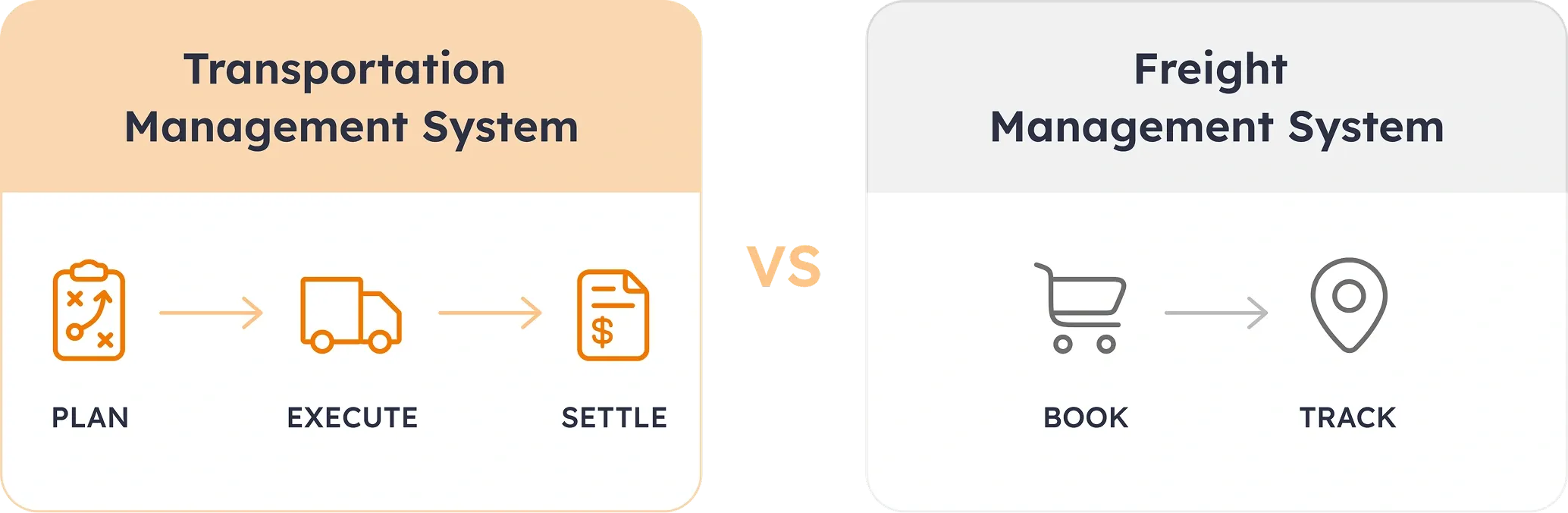
TMS vs FMS in the freight workflow
Shipping logistics software use cases: trucking, freight brokerage, and last-mile delivery
The same category label covers very different jobs, which is why buyers comparing logistic softwares often find that two products both marketed for "transportation" barely overlap in features. Choosing transportation logistics software therefore starts with naming your use case honestly.
For fleet operators, logistic software centers on dispatch, driver management, hours‑of-service compliance, and fuel optimization: keeping trucks legal and moving.
For freight brokers, it is matching loads to capacity, managing a carrier network, and quoting rates fast enough to win the business.
For last-mile delivery, the focus shifts to dynamic routing, proof of delivery, and customer notifications.
One tool rarely does all three well, so the practical question is which workflow you run most.
Trucking features: ELD, HOS, and fleet tracking
Trucking logistics software has to account for both day-to-day fleet operations and regulatory compliance.
Compliance comes first. An ELD (Electronic Logging Device) automatically records driving time to enforce Hours of Service (HOS), the federal cap on driving hours, and has been mandatory for most interstate carriers since the FMCSA compliance date of December 2017. Good software logs HOS by itself and flags a violation before it becomes a fine.
The second job is uptime: live GPS shows where every truck sits, and predictive maintenance alerts catch a fault before it becomes a roadside breakdown.
Logistic software integrations: ERP, e‑commerce, and carrier APIs
A transportation platform is only as useful as the systems it talks to, and this is where shipping logistics software either earns its keep or falls short.
Three connection points matter most:
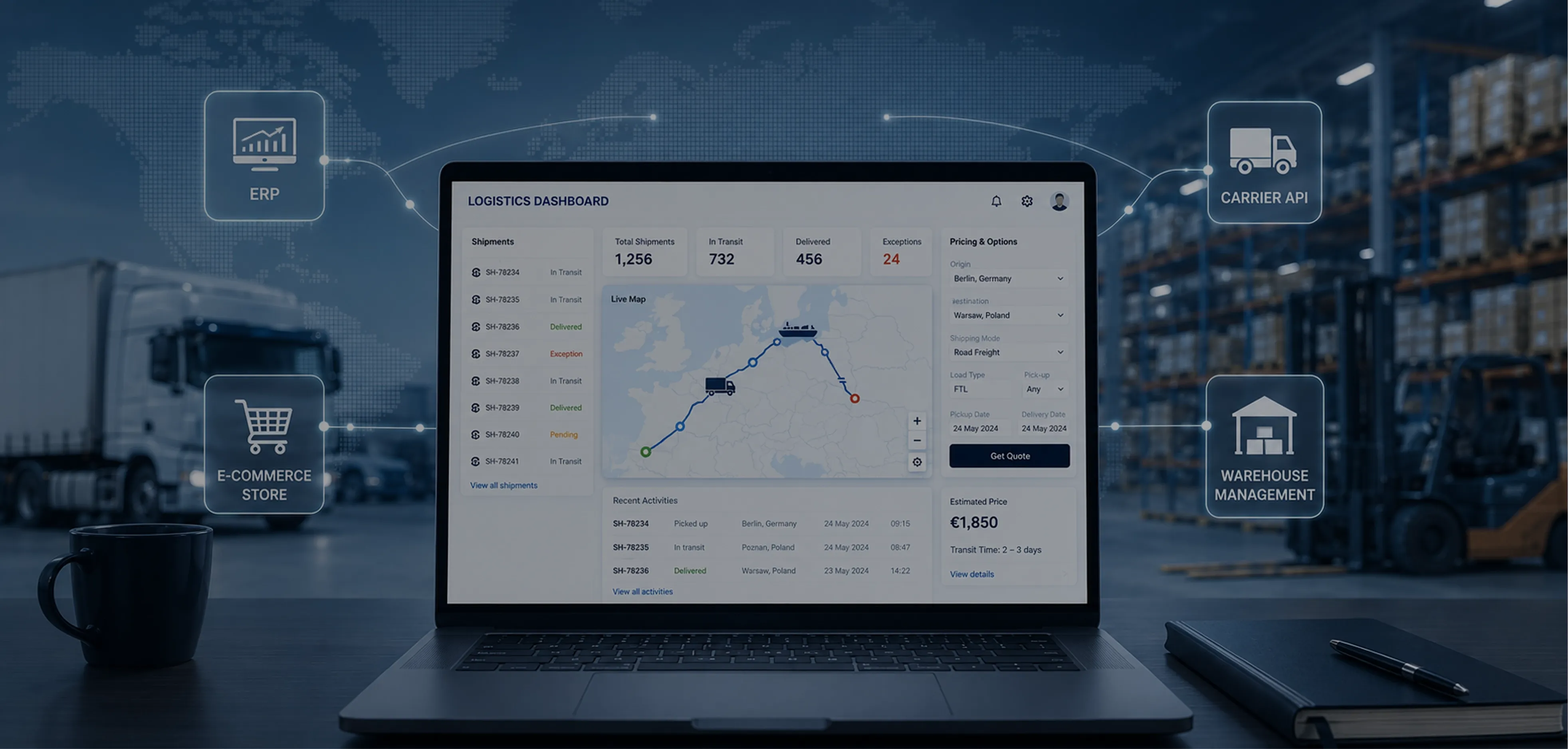
ERP integrations tie freight into finance and inventory through platforms such as SAP TM, Oracle SCM, and Microsoft Dynamics 365.
E‑commerce integrations pull orders straight from Shopify, WooCommerce, and Magento, which is why online sellers need shipping and logistics software that syncs without manual re‑entry.
Carrier APIs connect the platform with parcel and freight carriers for rate quotes, booking shipments, and delivery tracking.
The hard part is rarely the connection itself. It is data mapping, keeping records in sync in real time, and coaxing older systems into a modern format. Those integration challenges are the hidden cost of transportation logistics software, worth scoping upfront.
For businesses that need custom integration across ERP, e‑commerce and carrier systems, Modsen offers our custom software development services to help connect logistics tools, automate data exchange, and reduce manual work.
API-first TMS vs legacy EDI: what to choose in 2026
Modern transportation software increasingly uses an API-first architecture, where systems are built to exchange data with one another automatically from the start, rather than relying on custom connectors added later. This makes it easier to connect with other systems, exchange data in real time, and maintain integrations as the business changes.
EDI (Electronic Data Interchange) is the older standard for exchanging business documents such as purchase orders, invoices, and shipment notices between companies in a fixed electronic format. It is less flexible than APIs, but it has not gone away: large retailers such as Walmart and Amazon still require many suppliers to exchange documents over EDI.
For most companies, the practical answer in 2026 is not choosing one over the other. It is a hybrid setup: an EDI gateway for partners that still require it, with an API layer for everything else.
Logistics software pricing in 2026: SaaS tiers, enterprise, and custom builds
Pricing for transportation logistics software depends on the model: per user, per shipment, monthly SaaS plan, or negotiated enterprise contract. Entry-level SaaS tools often fall around $50-$500 per month, while mid-market setups with more users, shipment volume, integrations, and support usually move into the $1,000-$5,000 per month range.
Enterprise TMS pricing is usually quoted case by case. For planning, annual contracts often sit around $50,000-$500,000, depending on freight volume, modules, regions, integrations, and service levels. Custom development is a separate category: a logistics platform built around your own workflows usually starts around $100,000 and can reach $500,000+ when the scope includes route optimization, carrier integrations, real-time tracking, analytics, mobile apps, and ERP or WMS integrations.
Typical cost
Entry-level SaaS
$50–$500/month
Mid-market SaaS
$1,000–$5,000/month
Enterprise TMS
$50,000–$500,000/year
Custom logistics software
$100,000–$500,000+
Best for
Entry-level SaaS
Small teams with standard shipping workflows
Mid-market SaaS
Growing fleets and higher shipment volume
Enterprise TMS
Large operations across regions or business units
Custom logistics software
Non-standard workflows or strategic logistics products
Main cost driver
Entry-level SaaS
Users and basic features
Mid-market SaaS
Integrations, support, shipment volume
Enterprise TMS
Modules, regions, service levels
Custom logistics software
Scope, integrations, real-time features
The number on the pricing page is not the full cost. Total cost of ownership (TCO) includes implementation, training, support, data migration, integrations, customization, and maintenance.


For standard shipping operations, SaaS is usually faster to launch and easier to budget. Custom software makes sense for larger or fast‑growing logistics businesses that plan to scale. Even before your workflows become highly complex, the investment can pay off through flexibility, fewer workarounds, and lower long‑term operating costs.
If you want to understand where the savings actually come from, our how AI cuts logistics costs guide breaks it down.
Unsure what your logistics software should cost?
Get a clear estimate based on your fleet, shipment volume, and integrations.
How to choose the right platform for your business
Buyers evaluating transportation industry solutions usually weigh five things.
Volume. How many shipments do you move each month now, and how many will you move in two years?
Use case. Trucking, freight brokerage, and last‑mile delivery point to different tools.
Integrations. List the systems the platform must connect to before you compare features.
Budget and TCO. Include implementation, training, support, and integrations, not just the license.
Scalability. The tool should grow with your operation instead of capping it.
A small carrier can often start with a focused SaaS plan and be productive in weeks. A larger operation needs governance, exception handling, and confidence that the platform will not buckle at peak volume.
Off-the-shelf tools cover standard workflows well; custom transportation software earns its place when your routing rules, pricing logic, or integrations fall outside what vendors support, or when owning the product matters strategically.
The honest answer is that the best transportation logistics software is the one that fits your volume and complexity today while leaving room to grow.
If you already know the direction and just need senior engineers to deliver it, IT team augmentation for logistics projects adds proven people fast. For a larger build, our guide to 3PL software development – scope and timeline covers what to expect.
FAQ
What is transportation logistics software?
What is the difference between a TMS and shipping logistics software?
How much does transportation logistics software cost?
What trucking logistics software is best in 2026?
How does transportation software integrate with ERP?
When should I build custom transportation software?
Conclusion
Transportation logistics software in 2026 spans a lot of ground: full TMS platforms, lighter freight marketplaces, and specialized trucking tools, each fitting a different operation. Integrations with ERP systems and carrier APIs are now the baseline, and pricing runs from affordable SaaS to enterprise and custom software. The market is expanding fast, which means the tools and the transportation industry solutions around them keep improving.
Whether you begin with a subscription tool or invest in a tailored platform, the aim is the same: transportation and logistics software that fits how you actually work and scales as you grow. For a wider view of the category, our logistics management software buyer's guide 2026 is a good next step, and smaller operators can start with our guide to the best logistics software for small business.
Talk to Modsen team about selecting or building transportation logistics software tailored to your fleet and workflow.
References
Read more






Get a weekly dose of first-hand tech insights delivered directly to your inbox