
IT consulting services for small business: The 2026 guide to scaling smart
8 min read
Last updated: May 27, 2026
Summary
IT consulting services for small business give growing companies access to technical expertise they couldn't justify hiring full-time. This guide covers the main service categories – cybersecurity, cloud, IT strategy, and software advisory – along with realistic pricing ranges, a clear breakdown of how consulting differs from managed services, and a checklist for evaluating potential partners.
Key takeaways
IT consulting for SMBs typically runs $75-250/
hour or $3000-50000 for a defined project. The four core service areas are cybersecurity, cloud migration, IT strategy, and software development advisory.
Consulting is project-based and advisory; managed IT services are operational and ongoing – most SMBs need both at different stages.
A good consulting partner scopes work in phases, delivers concrete outcomes, and leaves the client in control after the engagement.
Before signing, ask for SMB-specific case studies, clarify who will actually do the work, and get clear on what knowledge transfer looks like.

Paul Kirikov
Head of Business Development Department at Modsen
What are IT consulting services for small businesses
Nearly half of small businesses spend on IT without any underlying strategy. They buy tools their teams don't adopt, patch the same problems repeatedly, and rely on generalists who can't keep up with infrastructure complexity or a threat environment that changes quarterly. IT consulting services for small business exist to close that gap: external expertise that assesses what you actually need, builds a plan your budget can support, and helps you execute without standing up a full in-house department.
Five years ago, small business technology consulting was mostly about network setup and hardware procurement. That's no longer the case. IT consulting now covers cloud architecture, compliance readiness, data governance, and software development advisory, because that's where SMB technology spending has shifted. Cloud, security, and custom applications are the core of most engagements today, and the consultants worth hiring have kept pace with that shift.
The underlying logic is simple: you're renting expertise rather than hiring it. Bring in the right people for the problem at hand, scope the engagement to a deliverable, move on. For most companies under 200 people, IT consulting services for small business are more cost-effective than maintaining a full in-house IT team, while being more honest about what those teams can realistically cover.
How small business IT consulting differs from enterprise consulting
Enterprise IT projects run on different assumptions. There are dedicated procurement teams, multi-year roadmaps, layers of stakeholders, and budgets large enough to absorb delays without crisis. SMB consulting engagements operate under different constraints – decisions happen fast, resources are tight, and the person signing the contract is often the same person managing the rollout.
Experienced SMB-focused consultants build their approach around this. They scope work in phases, work within existing tools where possible instead of recommending full replacements and communicate in plain language because there usually isn't a dedicated technical team on the client side to translate recommendations into action.
The difference between a good enterprise consultant and a good SMB consultant isn't seniority. It's understanding that in a smaller business, speed of decision-making and limited internal bandwidth shape every aspect of how the work has to be done – which is exactly why well-designed IT consulting services for small business prioritize fast delivery over exhaustive documentation.
When does a small business need an IT consultant
Most companies turn to IT consulting services for small business after something breaks. The better question is what signals should prompt that conversation earlier.
Recurring system failures. If your team loses productive time to the same technical issues more than once per quarter, that's a structural problem, not a staffing one. While an internal generalist often focuses on symptom mitigation, a consultant can identify the root cause.
Growth that outpaces your setup. Adding 15 people to an infrastructure built for 5 creates security gaps, performance bottlenecks, and a support burden that falls on whoever is most technically capable, usually someone whose actual job is something else.
Compliance requirements. HIPAA, SOC 2, PCI DSS – each carries specific technical requirements that most small businesses aren't equipped to address without outside guidance.
A planned migration. Moving to the cloud, switching ERP platforms, integrating a new application with legacy systems: these are projects where a planning mistake compounds over time. A single mistake on a migration can cost more to fix than the consultant's entire fee.
Recognize your business in one of these scenarios?
Modsen senior IT consultants help assess your infrastructure, identify risks, and deliver actionable roadmaps.
Core IT consulting services for SMBs
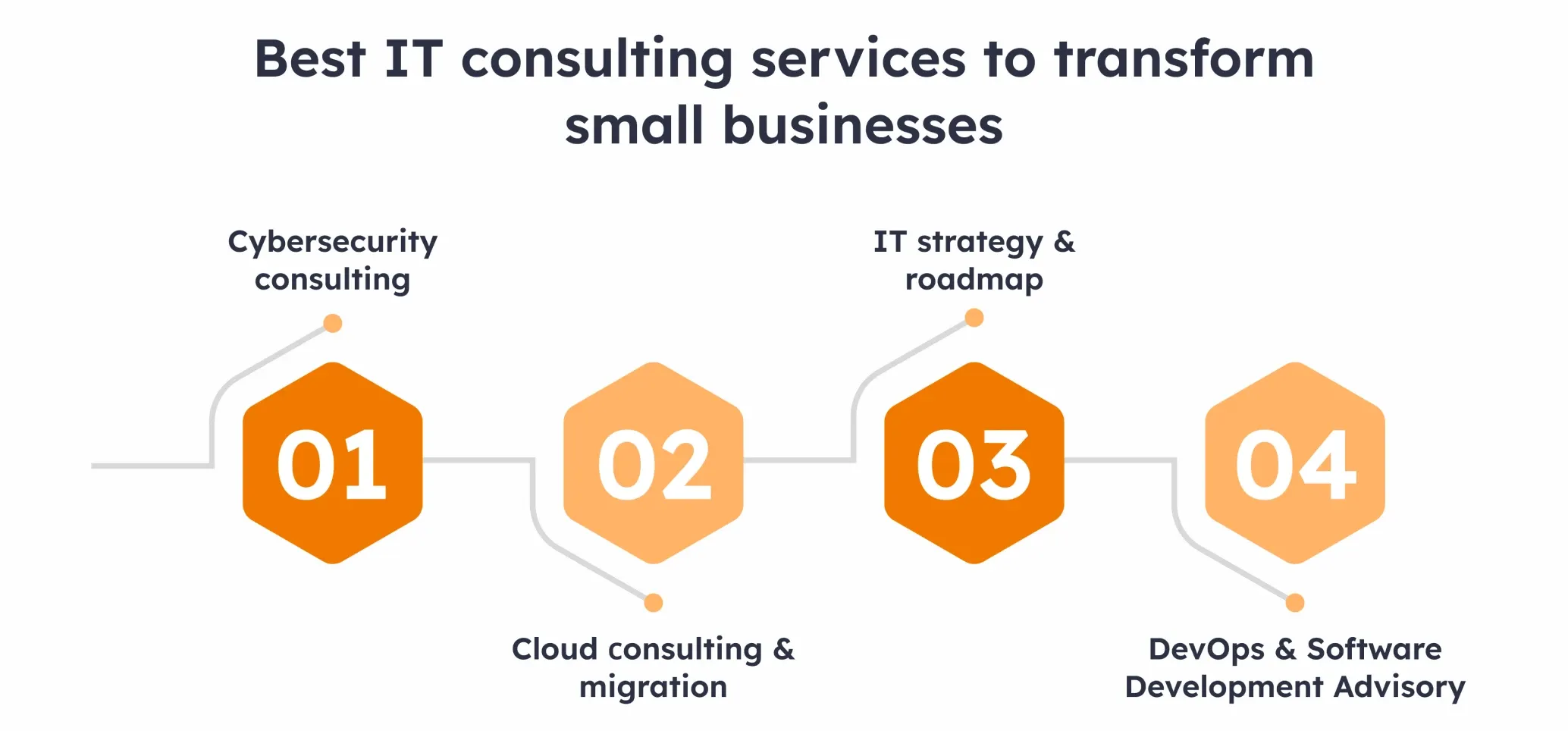
The scope of IT consulting services for small business varies by provider and engagement type, but the following areas account for the majority of SMB demand. For a broader view of how these services support business growth, see how consulting services fuel business growth.
IT consulting services for SMBs
Cybersecurity consulting for small business
Most small businesses operate without a formal security policy. According to Verizon's 2025 Data Breach Investigations Report, ransomware was present in 88% of confirmed breaches involving small businesses, compared to 39% at larger organizations.
Cybersecurity for small business covers far more than installing endpoint protection. A proper engagement includes risk assessment, access management, network architecture review, incident response planning, and employee security awareness.
A cybersecurity consultant typically starts with an audit: what data the company holds, how it's stored and transmitted, who has access to it, and where the gaps are relative to the company's actual risk profile. The output is a prioritized remediation list, not a generic checklist pulled from a template.
For companies in regulated industries, this work also feeds directly into compliance preparation. A SOC 2 readiness assessment, for example, requires specific controls around access, availability, and confidentiality that need to be designed and documented before an auditor arrives.
IBM's 2025 Cost of a Data Breach Report puts the global average breach cost at $4.44 million, factoring in downtime, legal costs, and regulatory fines. For companies evaluating IT consulting services for small business, cybersecurity is often where the ROI calculation is easiest to make. Small business IT support that includes proactive security advisory pays for itself quickly when measured against breach costs.
Cloud consulting and migration for SMBs
Cloud migration saves money in some cases and costs more in others. The outcome depends almost entirely on how the migration is planned. Cloud consulting services cover the architecture decision (which provider, which deployment model, which workloads to move), the migration execution, and post-migration cost optimization.
The most common mistakes when moving without guidance:
over-provisioning resources and paying for capacity that never gets used;
migrating workloads that would run cheaper on-premises;
skipping security configuration because the platform defaults look acceptable.
Each of these is predictable and preventable with a proper workload assessment before anything moves.
A structured migration engagement starts with an inventory of what you're running, a cost model for different scenarios, and a phased plan with defined checkpoints. The timeline depends on the complexity of your environment. A 10-person company with standard SaaS tools can migrate in weeks, while a 100-person company with custom applications and legacy systems will take longer and require more careful sequencing. IT consulting services for small business engagements in cloud migration consistently deliver better cost outcomes largely because resource sizing and security configuration are addressed before anything is deployed.
IT strategy and roadmap development
This is where IT strategy consulting is most visible: a structured assessment of where your technology stack is today, where it needs to be in 12–24 months, and what the path between those two points looks like in terms of priorities, timelines, and budget.
As a deliverable, you get a usable roadmap that identifies initiatives which create the most leverage, explains why those come before others, and gives you enough cost clarity to make actual budget decisions. That's what separates a consulting engagement from a report that sits in a drawer afterward.
For most small businesses, the real value here is prioritization. There are always more technological improvements to make than the budget to make them. When IT consulting services for small business include roadmap development, the deliverable is a ranked list of decisions: what to do first, what to defer, and why. An external advisor who understands your industry, current stack, and growth trajectory provides that clarity faster than any internal process could.
DevOps and software development advisory
When a small business needs a custom application, whether internal tooling, a customer-facing product, or an integration between two systems, the advisory layer in IT consulting services for small business addresses architecture decisions before a line of code is written. That includes selecting the right tech stack for the expected scale, defining the API structure, deciding whether to build in-house or engage an external team, and setting up the development process correctly from day one.
Most SMB decision-makers underestimate how much this matters. A software project started on the wrong architectural assumptions costs significantly more to correct than it would have cost to design properly at the start.
If you're evaluating software outsourcing as part of your development model, getting the advisory layer right is the prerequisite, not something to revisit once development has already started.
How much do IT consulting services cost for small businesses
IT consulting cost for small business varies more than most buyers expect, and the variation tracks specific factors: scope, seniority, engagement type, and delivery model. Understanding the pricing structures before evaluating IT consulting services for small business proposals helps you clearly see what you’re paying for and compare vendors more effectively.
Hourly vs Project-based vs Retainer pricing
Hourly ($75-250/hour). Common for advisory work, audits, and short-duration engagements. Rates above $200/hour at the SMB level are usually justified by specialized certifications, highly regulated industries, or a narrow technical specialization with limited supply.
Project-based ($3000-50000). A defined scope with a fixed price. The right choice for migrations, security audits, roadmap development, and software architecture work where the deliverable is clear and bounded. The scope needs to be specified in detail or change orders will expand the bill beyond the original estimate.
Retainer ($2000-10000/month). A committed block of hours per month, typically used for ongoing strategic support or fractional CTO arrangements. This model makes sense when you need consistent access to senior expertise without the overhead of a full-time hire. The pricing reflects seniority and the level of availability guaranteed.
Most SMBs start with a project engagement, evaluate the output, and move to a retainer with the same provider once the relationship is established. That sequence reduces the risk of committing long-term to a partner whose working style you haven't yet tested, and it's how most effective IT consulting services for small business relationships actually develop in practice.
Not sure what your IT project should actually cost?
Modsen provides transparent project scoping and fixed-price consulting engagements tailored to SMB budgets and timelines.
Cost factors: scope, seniority, and engagement type
A few variables move the final number more than others:
Scope clarity. The more clearly the project is defined, the more accurate the estimate will be. Vague requirements often lead to additional work, revised timelines, and higher costs. Before requesting a proposal, outline the expected deliverables, responsibilities, and success criteria.
Engagement type. Short, well-defined projects are often easier to estimate, while long-term or flexible engagements may require monthly retainers or time-based billing.
Team seniority. Pricing depends not only on the vendor, but also on who will actually perform the work. A project led by a senior consultant will usually cost more than one delivered by a junior specialist with senior-level oversight. Ask which team members will be involved and what role each person will play.
Industry requirements. Complex industries often require more specialized expertise. For example, companies providing healthcare IT consulting for regulated industries operate under additional compliance constraints that justify higher rates, and that expertise is worth paying for if your business operates in those environments.
Benefits of IT consulting for small businesses
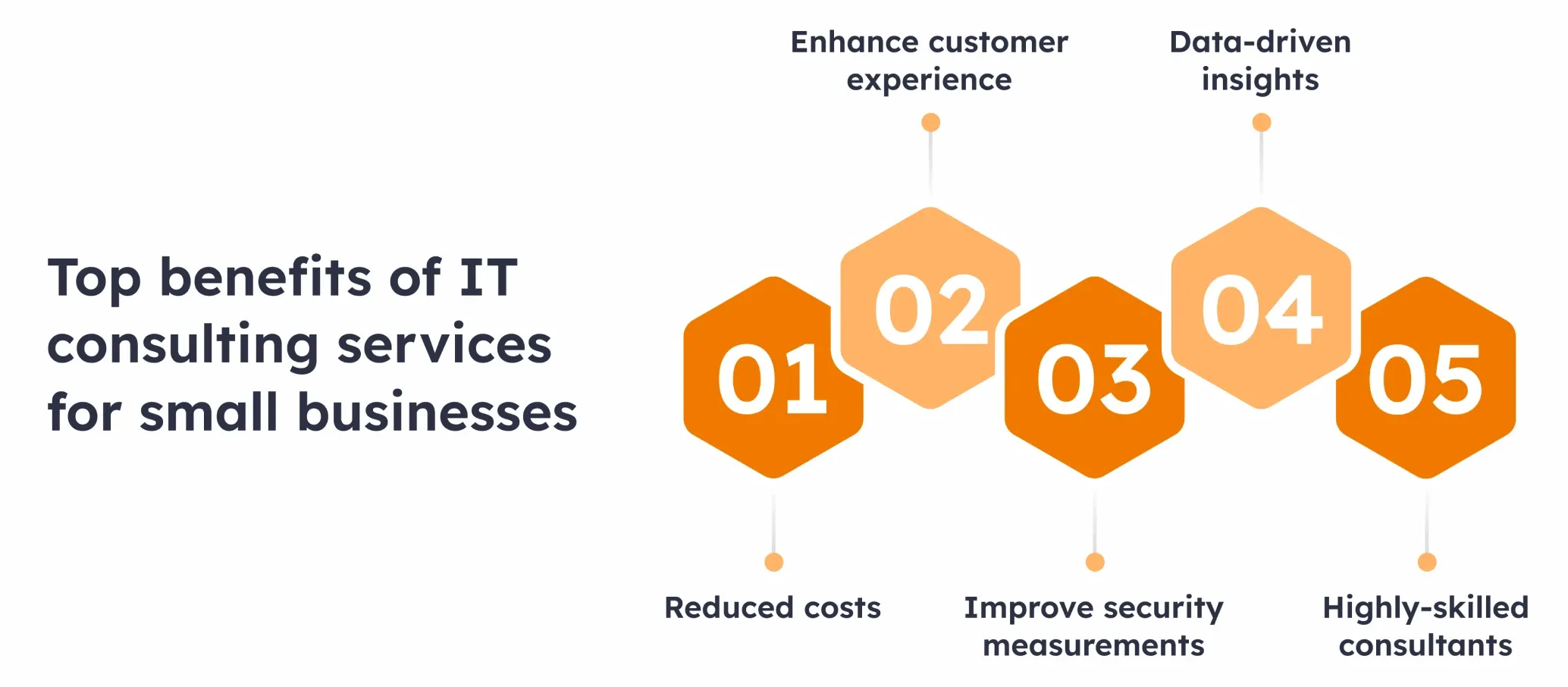
What makes IT consulting services for small business worth the investment is access to expertise that would be too expensive to hire full-time and a structured way to move from unclear priorities to practical execution.
Benefits of IT consulting for SMBs
Faster digital transformation without in-house teams
Digital transformation for small business stalls most often at the same two points: not knowing where to start and not having the people to execute once a direction is chosen. A good provider of IT consulting services for small business addresses both. They bring a structured approach to the initial assessment and can either lead the execution directly or guide an existing team through it with a clear plan.
The companies that move fastest through technology transitions aren't necessarily the ones with the largest IT budgets. They're the ones that spend time planning before spending money on execution, and that usually means bringing in an outside perspective early, not after a failed first attempt. For a structured view of what that process looks like end-to-end, a practical roadmap for digital transformation covers the key phases in detail.
Reduced risk through expert audits and roadmaps
Risk reduction is the ROI story that resonates most with SMB decision-makers, and the numbers support it. A cloud architecture review before a migration can identify cost and performance problems that would have compounded over the years. Analyzing software architecture before development starts can prevent a complete redesign months later.
A consulting engagement does not eliminate risk – it helps price that properly and moves key decisions to the point where they are still inexpensive to make. That is one of the main reasons IT consulting services for small business can generate measurable ROI within the first year for companies that track it.
IT consulting vs Managed services: Which model is right
Managed IT services for small business and IT consulting are frequently conflated, but they serve different purposes and operate on different billing structures. Comparing consulting models with managed service contracts in detail is worth doing before you sign anything, because what you're buying is substantively different.
Consulting is advisory and project-based, managed services – are operational and ongoing. A consultant designs the system, runs the audit, or builds the roadmap, and then the engagement ends. A managed service provider takes over the day-to-day operation of defined systems under a recurring contract.
Focus
IT consulting
Strategy, architecture, projects
Managed IT services
Daily operations, monitoring, support
Duration
IT consulting
Defined scope (weeks to months)
Managed IT services
Ongoing contract (months to years)
Billing
IT consulting
Hourly, project, or short retainer
Managed IT services
Monthly flat fee
Best for
IT consulting
Migrations, audits, new initiatives
Managed IT services
IT support desk, maintenance, uptime
Outcome ownership
IT consulting
Client, with guidance
Managed IT services
Provider
IT consulting and managed services comparison
Most small businesses need both at different stages. A consultant helps design the right system; a managed services provider keeps it running.
IT consulting services for small business are how you build the right foundation – managed services are how you maintain it. Treating the two as substitutes leads to either overpaying for ongoing services or under-investing in the strategic work that determines whether those services are built on a sound foundation.
How to choose an IT consulting partner for your SMB
Selecting the right provider of IT consulting services for small business requires more due diligence than most SMBs apply to the process. The wrong choice wastes budget and produces work that needs to be undone. Knowing how to choose an IT consulting firm means asking specific questions about how the work actually gets done, not just reviewing a list of technologies on a credentials page.
7 questions to ask before hiring
1. Do you have case studies from our size companies? Enterprise consulting experience doesn't automatically translate to work for SMBs. Ask for specific examples: project type, company size, what the deliverable was, and what the outcome looked like months later.
2. Who will actually do the work? Many firms sell based on senior consultants and deliver through junior staff. Get clear on this before signing, and get it documented in the engagement terms.
3. What does your handoff process look like? High-quality IT consulting services for small business end with the client in control, not dependent on continued engagement. Ask specifically what documentation, training, and knowledge transfer is included in the scope.
4. What certifications does your team hold? Relevant certifications (AWS, Azure, GCP, CISSP, CompTIA, CISA) signal structured knowledge, not just accumulated experience. For regulated industries, certifications are often a minimum requirement.
5. How do you handle scope changes? Change orders are inevitable on most engagements. How a firm handles scope expansion tells you more about the working relationship than the original proposal does.
6. What's your communication model across time zones? If your consulting team is eight hours ahead, find out exactly how daily coordination works before assuming it does.
7. Can you provide references from similar engagements? References from comparable projects give you a clearer picture of how the consulting team performs after the contract is signed.
Red flags in IT consulting proposals
No discovery phase before the proposal. A detailed scope delivered without any discovery call means the engagement was templated, not assessed. Credible IT consulting services for small business should begin with discovery.
Deliverables are defined by time, not outcomes. "20 hours of advisory" is not a deliverable and does not tell you what you will actually receive. Look for concrete outputs, such as an infrastructure audit, a security assessment, a roadmap, or a prioritized remediation plan.
No clear escalation path. Every proposal should explain who owns the engagement, who handles urgent issues, and how problems are escalated. If that process is unclear before the project starts, it will be even harder to navigate when something goes wrong.
Promises without assumptions. Claims like “we will reduce IT costs by 40%” are meaningless without a baseline, scope, timeframe, and clear assumptions. Any quantified promise should explain what it depends on.
Unclear methodology. A consulting firm should be able to explain how it works before you sign: how it assesses the environment, documents findings, communicates progress, and hands over results. Confidentiality may apply to client data or proprietary tools, but not to the basic consulting process.
FAQ
What are IT consulting services for small business?
How much do IT consulting services cost for a small business?
When should a small business hire an IT consultant?
What is the difference between IT consulting and managed IT services?
Can small businesses afford IT consulting?
How do I choose the right IT consulting firm for my small business?
Conclusion
IT consulting services for small business work best when they're treated as a planning tool rather than an emergency response. The companies that get the most value from external consulting are the ones that identify where outside expertise closes a gap they can't close internally, then run a scoped engagement before that gap becomes a crisis.
Most SMBs that approach it this way find a partner worth continuing to work with and find that IT consulting for SMBs naturally evolves into a longer-term relationship as the business grows.
If your business is at a stage where technology decisions are becoming a competitive factor, explore our IT consulting services and solutions to see how Modsen approaches advisory work with growing companies.
References
1.
IBM Security. (2025). Cost of a Data Breach Report 2025. IBM Corporation.
2.
Verizon. (2025). 2025 Data Breach Investigations Report (DBIR). Verizon Business.
3.
4.
5.
IDC. (2026). Worldwide ICT Spending Guide: Enterprise and SMB by Industry. IDC Market Research
6.
Flexera. (2025). State of the Cloud Report 2025. Flexera Annual Survey.
Read more






Get a weekly dose of first-hand tech insights delivered directly to your inbox