
IT consulting vs managed services: which model is right for your business in 2026
12 min read
Last updated: May 27, 2026
Summary
A recent KPMG outlook survey cites strategic impact as one of the main goals for managed services for nearly two-thirds of buyers. With consulting gradually moving from advice-focused to operations-driven, this signals a significant shift in how these two engagement models are perceived – and in how their traditional boundaries are starting to blur.
Yet the difference between IT consulting and managed services still matters. Understanding where that line truly sits is critical for choosing a model that supports your business objectives rather than quietly works against them.
Key takeaways
IT consulting and managed services address different needs: consulting focuses on defining direction and decisions, while managed services focus on operating and supporting IT environments over time.
The key distinction between the two lies in the engagement model: IT consulting is project-based and time-bound, whereas managed services are continuous and SLA-driven.
Modern managed services extend beyond maintenance, emphasizing proactive monitoring, automation, cloud operations, and continuous optimization.
Break-fix support is a reactive, tactical option suited only for non-critical IT setups with limited continuity requirements.
Blended models combining IT consulting and managed services help keep strategy closely tied to execution, making them especially effective for SMBs.

Paul Kirikov
Head of Business Development Department at Modsen
What is IT consulting (and what it isn’t)
First and foremost, IT consulting is an advisory service focused on solving a clearly defined technology challenge.
IT consulting firms are typically brought in at moments of change, often before or at a critical turning point of the initiative. This can include:
legacy system modernization
cloud migration decisions
ERP replacements
data platform rollouts
large-scale digital transformations
Consultants analyze existing IT landscapes, evaluate concrete solution alternatives, assess trade-offs across cost, risk, scalability, and timing, and produce clear, decision-oriented recommendations.
However, IT consulting doesn’t extend into delivery. Tech consultants may support implementation, but they don’t run systems, manage services, or remain accountable for the outcomes once the engagement ends.


IT consulting = what should be done and how
For a more detailed breakdown of how IT consulting works in practice for smaller organizations, see our full guide to IT consulting services for small businesses.
Typical deliverables from IT consultants
Depending on the scope of the engagement, IT consulting deliverables can encompass:
current-state assessments
audit reports
technology or architecture reviews
documented analyses of gaps, risks, and constraints
In most cases, consultants translate these insights into roadmaps and recommendations (target architectures, phased transformation plans, vendor shortlists, investment options, etc.). They are used to guide subsequent implementation and, ultimately, fuel digital growth.
Consulting scope boundaries
IT consulting is typically delivered as a project with a defined scope, timeline, and objectives.
The engagement is structured around a specific problem or decision, with clear boundaries set upfront on what is included and – just as importantly – what falls outside the scope.
Once the agreed project milestones are reached and recommendations are delivered, the consulting engagement concludes. Any subsequent execution, operational ownership, or ongoing optimization is usually handled separately, either by internal teams or under a different engagement model.
What are managed IT services
In turn, managed IT services involve an external provider who takes ongoing responsibility for specific IT functions within an organization.
Under this model, an IT managed service provider (MSP) is engaged to ensure certain systems and services continue to operate as expected. The relationship is long-term by design, governed by predefined scope and performance expectations.
The focus is on keeping environments stable, predictable, and compliant, freeing internal teams to concentrate on business priorities rather than day-to-day IT oversight.
Managed IT services = ongoing ownership of IT operations
Core functions of an MSP
To keep agreed IT environments running reliably and within defined parameters, a managed service provider typically delivers:
Operational monitoring and support – continuous oversight of systems, applications, and infrastructure, including IT helpdesk services
Incident and issue management – detection, escalation, and resolution of operational issues within agreed response times
Routine maintenance and updates – patching, upgrades, and preventive measures
Security and compliance enforcement – applying baseline controls, monitoring risks, and supporting compliance requirements
Service reporting and performance tracking – visibility into system health, service levels, and operational trends
In practice, not all of these functions are necessarily included in every engagement. The exact combination depends on the agreed scope and the operational needs of the particular organization.
Cloud managed services and modern MSP offerings
In cloud-first environments, IT managed service provider responsibilities usually extend beyond traditional infrastructure support.
Cloud managed services concentrate on the ongoing operation of cloud platforms and workloads, covering availability, performance, cost control, and security across public and hybrid cloud setups.
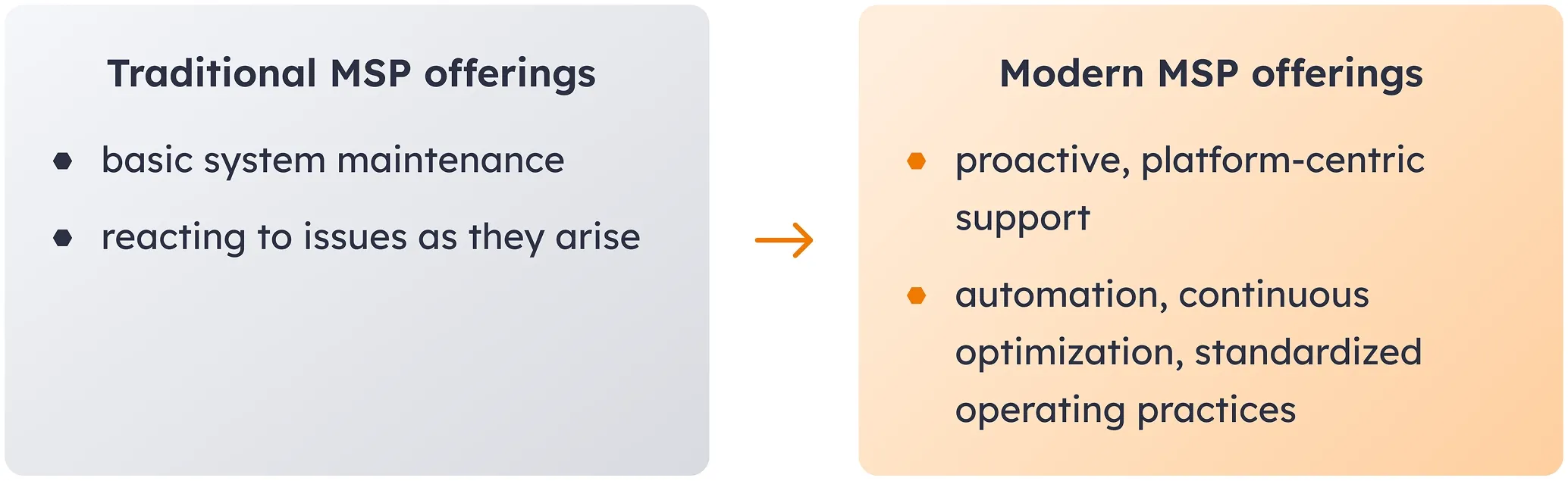
More broadly, today’s MSP offerings have shifted from basic system maintenance to proactive, platform-centric support. Instead of reacting to issues as they arise, providers emphasize automation, continuous optimization, and standardized operating practices.
Keeping systems running is no longer the sole objective. Improving reliability, efficiency, and scalability has become equally important as IT environments evolve.
IT consulting vs managed services: side-by-side comparison
Although the line between IT consulting and managed services is becoming less clear, they still serve distinct purposes and are structured around different engagement principles.
The table below highlights how the two models vary across core dimensions of IT service management.
Primary role
IT consulting
Advisory and decision support
Managed IT services
Ongoing service ownership
Core objective
IT consulting
Define what should be done and how to address a specific tech or business challenge
Managed IT services
Keep agreed IT systems running and supported
Scope
IT consulting
Defined, problem-specific
Managed IT services
Continuous, service-based
Engagement style
IT consulting
Project-based
Managed IT services
Long-term operational engagement
Duration
IT consulting
Fixed timeframe
Managed IT services
Ongoing
Commercial basis
IT consulting
Time & material / fixed‑fee projects
Managed IT services
Subscription / service‑based pricing
Accountability
IT consulting
Recommendations and guidance
Managed IT services
Service performance and continuity
Degree of involvement
IT consulting
High, but limited to the duration of the engagement
Managed IT services
Continuous and embedded over time
Typical outcomes
IT consulting
Roadmaps, target states, actionable recommendations
Managed IT services
Stable operations and agreed service levels
Sources: Springer (2022); Springer (2015)
These differences become especially clear when looking more closely at scope, engagement structure, and commercial models.
Scope, duration, and engagement style
The key distinction between IT consulting and managed services is in the way the work is organized.
While IT consulting focuses on a clearly defined task (a specific challenge, decision, or change) agreed upfront and limited in scope, managed services are structured differently. Their scope is defined around ongoing support for selected systems, platforms, or functions. Instead of addressing a single issue, the service remains active over time, covering day-to-day IT operations within agreed boundaries.
This difference shapes the engagement itself. Consulting follows a start-and-finish pattern, with concentrated involvement during the project and a clear endpoint. Managed services, by contrast, are continuous, with the provider remaining embedded to support operations over the long term.
Pricing and contract models
IT consulting typically follows project-based IT services pricing models, such as time-and-materials or fixed-fee contracts. The cost here is tied to effort, expertise, and a defined scope of work.
Managed services rely on recurring pricing structures instead. Fees are usually set on a subscription or service basis and governed by an SLA in IT services, which defines expected service levels (availability, response times, performance targets, etc.).
As a result, IT consulting and managed services contracts emphasize different priorities:
IT consulting – flexibility in how the problem is addressed, within a bounded engagement
Managed services – predictable delivery and continuous ownership of day-to-day IT operations
Looking for the right delivery model for your IT initiative?
Leave your email to explore how Modsen applies IT consulting and managed services in real scenarios.
Break-fix vs managed vs consulting
To understand the distinction even better, it’s crucial to compare two models with break-fix services.
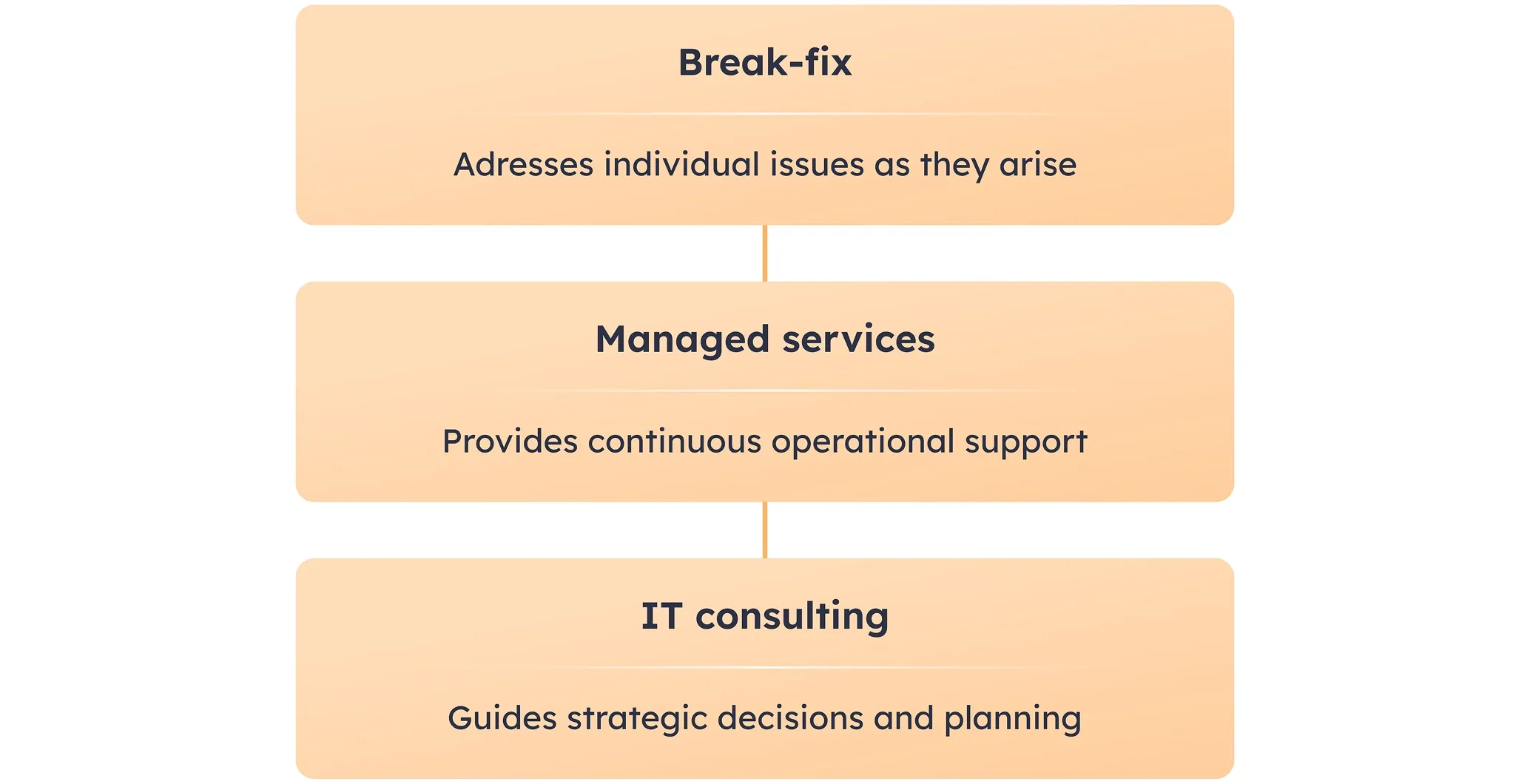
Break-fix support is reactive by nature. Issues are addressed only when something breaks, with no ongoing ownership or service guarantees.
Managed services move away from this model by introducing continuous responsibility for agreed tech systems and services. They are proactive and structured, with predictable delivery regulated by long-term agreements.
IT consulting and managed services, in turn, sit at different layers of the same ecosystem. Consulting helps organizations decide what should be changed and why, while managed services focus on keeping IT environments running over time. Break-fix, by comparison, operates at a tactical level, resolving isolated problems without shaping long-term direction or operational stability.
Hybrid approaches: co-managed IT and advisory retainers
While the rigid distinction between strategy and the operating model is becoming obsolete, organizations increasingly need approaches that connect long-term direction with day-to-day execution.
Hybrid models combining elements of IT consulting and managed services reflect this shift, but do so in different ways.
In the case of advisory retainers, consulting operates alongside execution. Architectural decisions, priorities, and roadmaps are developed in close proximity to delivery and continuously validated in practice. Execution remains primarily with internal teams, while consultants stay focused on guidance rather than operational ownership.
Within co-managed IT services, responsibility is shared between internal teams and external partners. Both sides jointly manage services, decisions, and improvements, enabling faster alignment between planning and implementation. IT is treated as an integral part of the operating model, not a separate function.
When a blended model makes sense
Combining IT consulting and managed services is particularly effective when your business faces several of the following conditions:
priorities change frequently and plans need to be adjusted based on real delivery constraints
internal teams have strong business or domain knowledge but limited capacity for strategic IT planning
decisions need to be made continuously, not as part of one-off transformation initiatives
progress depends on close alignment between architecture, operations, and day-to-day delivery
execution velocity matters more than separating work into rigid “strategy” and “delivery” phases
In these contexts, a blended model allows advisory input to stay grounded in operational reality while delivery benefits from ongoing strategic guidance.
This makes the approach a natural fit for SMBs, where teams are lean, roles often overlap, and the most effective model is neither pure consulting nor full outsourcing, but a pragmatic middle ground.
How to choose between consulting, managed services, and outsourced IT
Choosing the right model depends on two things:
where your organization needs support
how closely that support must be tied to execution
IT consulting works best when the primary challenge is direction-setting (defining architecture, shaping a roadmap, making strategic decisions without hands-on delivery, etc.). It is effective when internal teams are capable of execution but need clarity on what to do and why.
Managed services are a good fit when stability, continuity, and operational efficiency are the main priorities. This model allows you to hand over the responsibility for running and optimizing specific functions or systems to external teams and focus elsewhere.
Outsourced IT support is suitable when cost optimization and offloading routine operational work are the main goals. It is most effective for well-defined, repeatable tasks with limited need for strategic involvement. Explore our software outsourcing guide to learn more.
In comparison, IT consulting and managed services combined make sense when strategy and execution are tightly coupled. The blended approach suits organizations that need ongoing guidance, shared decision-making, and continuous improvement.
FAQ
What is the difference between IT consulting and managed services?
What does a managed IT service provider do?
Is co-managed IT the same as outsourcing?
How much do IT managed services cost per month?
Should a small business use break-fix or managed services?
Conclusion
Choosing between advisory, delivery, or a hybrid approach ultimately comes down to how closely strategy and execution need to work together in your organization.
As business environments become more dynamic, models that combine IT consulting and managed services offer a practical way to maintain alignment, continuity, and momentum, which is especially important for growing teams with limited resources.
If you’re considering any of these models for your business, or weighing how they might fit your current setup, feel free to reach out. A short conversation is often the best way to clarify what will work in practice.
References
Read more






Get a weekly dose of first-hand tech insights delivered directly to your inbox