
TELECOMMUNICATION SOFTWARE: TYPES, VENDORS, AND BUILD VS BUY IN 2026
14 min read
Last updated: Aug 05, 2026
Summary
Telecom operators rarely replace all their software at once. Instead, they modernize one system, integrate another, add AI capabilities, or build custom functionality around an existing platform. The challenge isn't choosing a single product – it's deciding how all the pieces should work together.
This guide explains what telecommunication software includes, how OSS (operations support systems) and BSS (business support systems) fit into the bigger picture, where Generative AI is making the biggest impact, and when custom development delivers greater business value than off‑the‑shelf software.
Whether you're evaluating software for telecommunication, planning a modernization project, or exploring new telecom enterprise software solutions, understanding this architecture – and knowing when telecom software development services are worth bringing in – is the first step toward a decision you won't regret later.
Key takeaways
Telecommunication software is an ecosystem of connected systems rather than a single product. OSS, BSS, network management, customer applications, and specialized tools each serve a different purpose.
Telecom operators typically choose between integrated platform vendors, specialist software providers, and custom development partners depending on their business needs.
Most modern telecom environments combine commercial platforms with custom development rather than relying on a single solution.
Generative AI is enhancing existing telecom systems, particularly in customer support, network operations, and marketing.
Choosing the right software for telecommunication means balancing business goals, technical flexibility, integration requirements, and total cost of ownership.

Paul Kirikov
Head of Business Development Department at Modsen
What telecom software actually means in 2026
People ask “what is telecom software” and expect a single product. In practice, telecommunication software is a bundle of tools that together do five functions for an operator. Here they are in plain language, each tied to what it earns or protects.
Getting paid. This is the billing and customer side, often called BSS (business support systems). It works out what a customer owes, sends the bill, stores their account, and handles new orders. When it works well, money arrives on time and customers see accurate charges.
Keeping the network healthy. This is the operations side, often called OSS (operations support systems). It watches the network, flags faults, and activates services. A good system identifies network issues before they turn into customer complaints.
Monitoring network equipment. These tools track the health of towers, routers, fiber links, and other infrastructure, helping engineers detect hardware problems before they affect customers.
The software customers interact with. The self‑service app, the account portal, and the chatbot. This is the only part most subscribers ever notice, so it shapes how the brand feels.
Guarding the money. Tools that catch billing leaks and fraud, for example, someone racking up charges the operator would otherwise never collect.
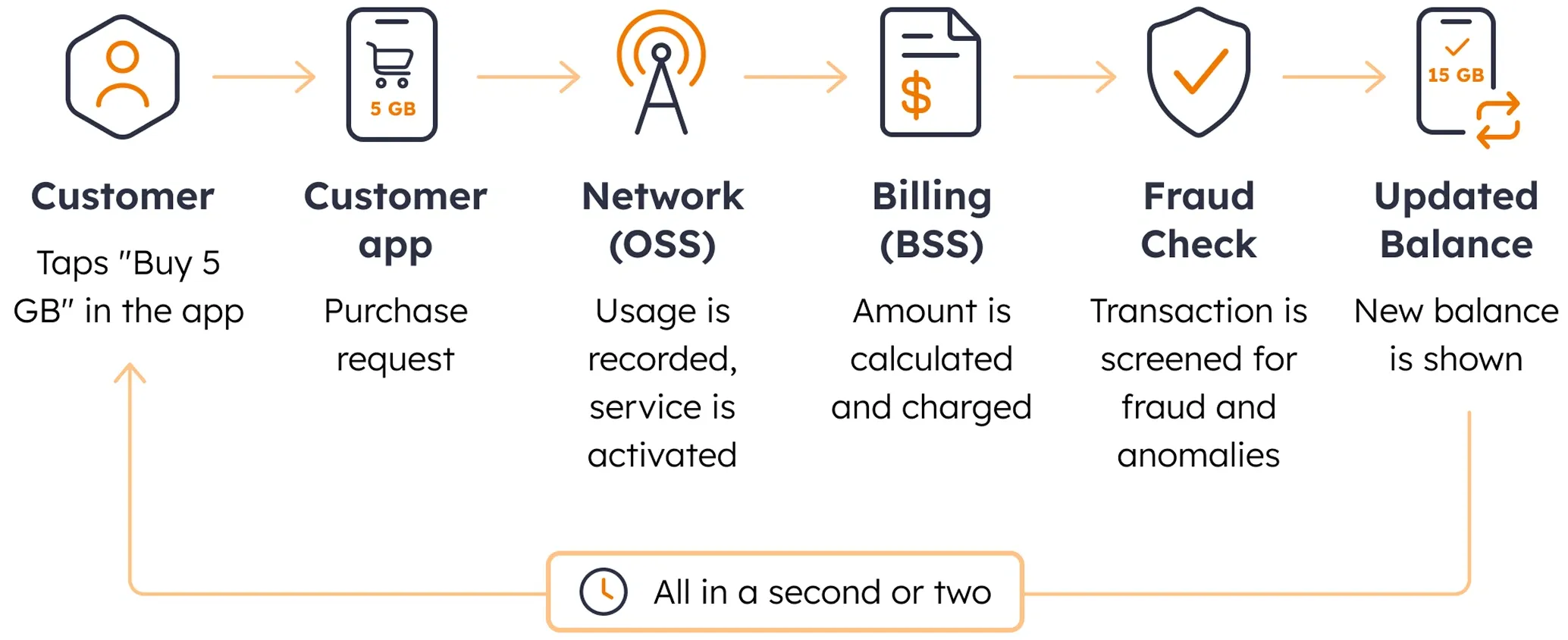
These systems don't work in isolation. Imagine a customer buying a 5 GB roaming package in the mobile app. The network records the service usage, the billing system calculates the charge, the app updates the customer's balance, and fraud detection tools quietly check that everything looks legitimate. When every part works together, the entire process takes just a few seconds. When it doesn't, the result may be an incorrect bill, a failed activation, or a frustrated customer who switches to another provider. The best telecommunication software is almost invisible – it simply keeps everything running smoothly behind the scenes.
The spending pattern reflects this trend. According to IMARC Group, the global telecom OSS/BSS market reached around USD 72 billion in 2025 and continues to grow steadily. Most telecom software investment still goes into the systems that run operations behind the scenes rather than into customer‑facing applications.
Telecom software vendors explained
There are three kinds of suppliers, and the differences matter mostly for your budget, size, and architectural flexibility.
All‑in‑one suppliers provide a broad OSS/BSS platform covering multiple business and operational functions under one commercial agreement. These solutions are commonly chosen by large operators that want a single platform for most core capabilities instead of managing dozens of separate products. The trade‑off is flexibility: integrated suites typically require significant investment, follow the vendor's release roadmap, and can create vendor lock‑in, making future migrations more complex.
Specialist vendors focus on solving one problem exceptionally well, such as billing, fraud management, revenue assurance, or network inventory. They are often a good fit for mid‑sized operators or companies looking to improve one part of an existing environment without replacing everything else. In many cases, telecom software modernization starts this way: replacing a single component is typically less expensive, less disruptive, and easier to justify than launching a full OSS/BSS transformation.
Custom software development partners fill the gaps that packaged products cannot. Rather than replacing commercial platforms, they extend, integrate, or build capabilities around them. That might mean connecting a billing platform with an existing CRM or identity provider, developing a self‑service portal for an MVNO (mobile virtual network operator), or automating workflows that standard software cannot support. These projects are the focus of Modsen custom software development services, and several of our case studies show it in action.
Consider three different operators. A national carrier serving millions of subscribers may choose an all‑in‑one supplier to simplify management across multiple business functions. A regional operator with a stable billing platform might add a specialist fraud management solution to strengthen one weak area without disrupting the rest of its stack. Meanwhile, a new MVNO launching an innovative pricing model may rely on a custom development partner to build features and integrations that no off‑the‑shelf product fully supports. The technology differs, but each decision reflects the operator's scale, priorities, and business model.
One final point: the telecom software market evolves quickly. Vendors regularly merge, acquire competitors, expand their portfolios, or shift product strategies. Before committing to any platform, verify not only its current capabilities but also the supplier's long‑term product roadmap, financial stability, and ecosystem. Those factors often matter more than the feature list itself, and they directly shape the build‑vs‑buy decision covered later in this guide.
How to read the vendor landscape without getting lost
When comparing telco software solutions, three questions will tell you more than any sales presentation.
First, how much does the solution actually cover? Some vendors offer a complete OSS/BSS suite, while others specialize in one area, such as billing or fraud management. Both approaches have their place – the right choice depends on your needs.
Second, how quickly does the vendor deliver updates? Some platforms release new features several times a year, while others update continuously. Faster release cycles make it easier to respond to changing customer expectations and regulatory requirements.
Third, how well does it integrate with your existing systems? Open APIs and standard integration methods make future changes much easier than proprietary interfaces. This is especially important because the term telecom software platform can mean very different things – from a complete OSS/BSS ecosystem to a single application. Focus less on the label and more on how well the platform fits into your existing environment.
The five types of telecom software in plain terms
Earlier, we looked at the five core functions every telecom operator relies on. Each of these functions is delivered by dedicated software, which may consist of one product or several integrated systems. That's why software for telecommunications is never a single application – it's an ecosystem of connected tools.
Operations support systems (OSS) keeps the network running. It monitors performance, detects faults, tracks network inventory, and activates services for customers. For example, if a fiber cable is damaged, OSS alerts network engineers within seconds so they can begin fixing the problem before it affects more users.
Business support systems (BSS) manages the commercial side of the business. It includes billing, CRM, order management, revenue management, and mediation – the process that converts raw network events into billable usage records. For example, if a customer buys a roaming package in a mobile app, BSS processes the order, updates the customer's account, and calculates the correct charge.
Network management systems (NMS) operate one level closer to the hardware. They communicate directly with base stations, routers, switches, and other network equipment, collecting technical data and allowing engineers to configure vendor‑specific devices.
Customer‑facing applications include self‑service portals, native mobile apps, chatbots, and IVR (interactive voice response) systems. These are the digital channels subscribers use to check balances, manage services, or contact support, while OSS and BSS handle the underlying business and network processes.
Specialized telecom applications solve specific business problems that standard platforms don't always cover. These include revenue assurance tools that detect billing leaks and fraud management systems that identify threats such as SIM‑box fraud, and MVNO enablement platforms.
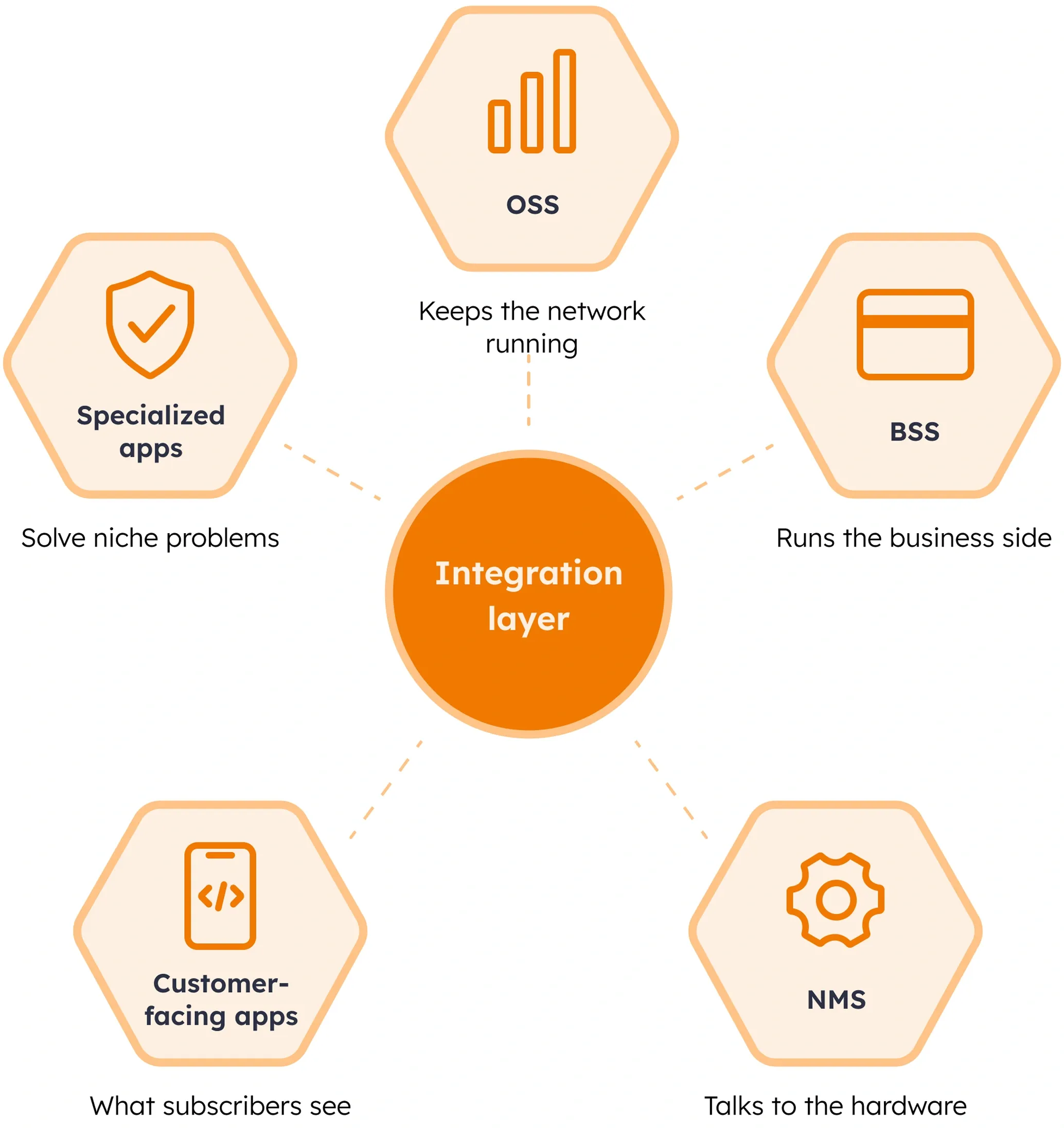
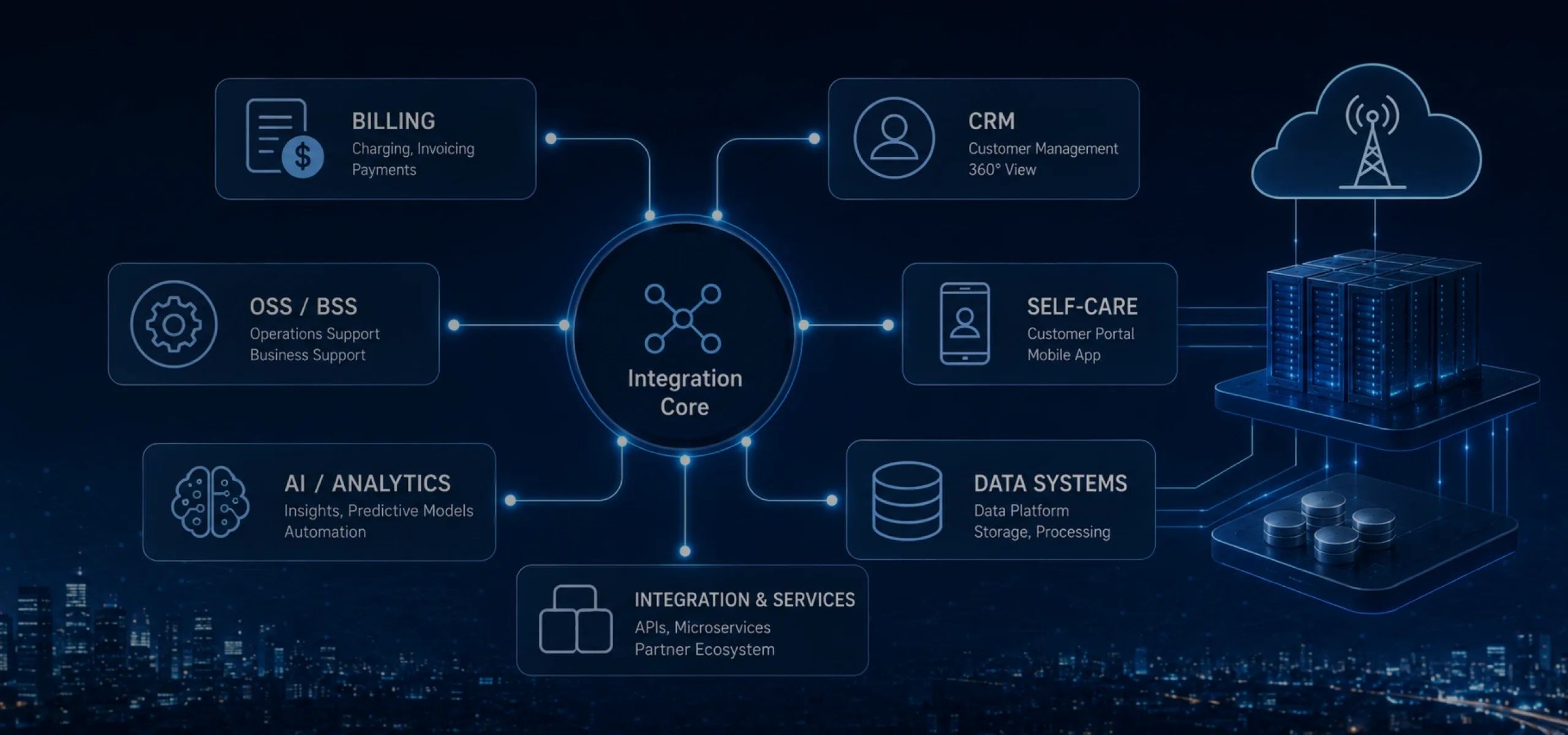
No operator buys these systems as one package and calls it a day. A modern software for telecommunication environment connects them through integration layers, so information flows reliably between network operations, customer services, billing, and specialized applications. As a result, two operators of similar size may still run very different technology stacks depending on their business model, existing infrastructure, and long‑term strategy.
While these five categories provide a useful framework, the actual software landscape is much more detailed. Our guide to telecom enterprise software solutions explores the enterprise modules operators typically combine to build their OSS/BSS ecosystem.
Where AI is actually helping today
The biggest recent change in telecommunication software isn't a new category of products – it's the addition of Generative AI. Instead of replacing OSS, BSS, or customer applications, GenAI acts as an intelligent layer on top of them, helping employees interact with existing systems using natural language and automating repetitive tasks.
Today, operators are seeing the strongest results in three areas.
Customer service. Large language models (LLMs) power chatbots in self‑service apps, summarize previous support cases, and draft responses for support agents. These are among the fastest AI projects to deliver value because they improve existing workflows rather than replacing them. Customer support is just one of many practical Generative AI use cases in telecom now moving into production.
Network operations. AI helps engineers manage thousands of network alarms by grouping related events, generating incident summaries, and searching internal documentation using retrieval‑augmented generation (RAG). Instead of reviewing hundreds of alerts manually, engineers receive a prioritized explanation of what happened and where to investigate first. According to McKinsey, AI‑enabled network operations can reduce operating costs by 15‑30% when combined with redesigned processes and effective adoption.
Sales and marketing. AI generates product descriptions, personalizes offers, and helps identify customers who are likely to switch providers. This allows marketing teams to launch campaigns faster while making customer communications more relevant.
One thing is becoming clear across the industry: Generative AI is primarily an augmentation tool rather than a replacement for telecom professionals. It helps customer service teams, network engineers, and marketers work more efficiently, while the underlying OSS/BSS platforms continue to run the business. Another McKinsey study found that more than two‑thirds of high‑performing companies see data readiness – not AI models – as the biggest barrier to scaling AI, with poor data quality, fragmented systems, and limited data readiness slowing adoption.
Build vs buy in 2026
Most operators don't choose between buying and building – they do both. A commercial telecom software platform provides core capabilities, while custom development fills the gaps that packaged software cannot cover. The real question isn't whether to build, but what is worth building.
Buying is usually the right choice for standard capabilities such as billing, CRM, or network management. Mature platforms are faster to deploy, continuously updated by the vendor, and typically cost less than developing the same functionality from scratch.
Custom development becomes valuable when software needs to support requirements that are unique to the business. Common examples include custom pricing models, integrating systems after a merger, meeting new regulatory requirements, connecting to external platforms, or adding features that are not available – or not available soon enough – in a commercial product.
The decision should be based on business value rather than technology alone. If a custom capability helps launch a new service faster, improves customer experience, or supports a revenue model that off‑the‑shelf software cannot, the investment may deliver a stronger return than adapting business processes to fit a standard product.
In practice, this is how most telecommunication software development projects are delivered. Operators combine commercial platforms with custom integrations, customer applications, analytics, or workflow automation instead of replacing the entire stack. If you're exploring how to build telecom software, this hybrid approach is usually the most practical starting point. Our telecommunication software development guide for operators in 2026 explains the process in more detail – from planning the architecture to integrating OSS/BSS platforms and deploying new services.
Many operators also avoid building large permanent development teams for one‑time initiatives. Instead, they extend existing engineering capabilities through IT team augmentation when additional expertise is needed for integration, modernization, or custom feature development, then scale the team back once the project is complete.
Not sure whether to build, buy, or modernize?
We'll help you evaluate your current architecture, identify where custom development adds value, and define a modernization roadmap that fits your business.
Paul Kirikov
Head of Business Development Department at Mondsen



Hidden costs you'll hit on either path
The purchase price is only part of the total cost. Whether you buy or build, the biggest expenses often appear after the project begins.
If you choose a commercial platform, integration is usually the largest hidden cost. Connecting new software to existing OSS/BSS systems, migrating data, and adapting business processes can take significant time and effort. Deep customization may also make future upgrades more difficult, while the platform still requires people to maintain, configure, and support it.
If you build custom software, the long‑term costs shift elsewhere. You'll need to maintain the application and keep it compatible with changing business.
Deloitte's 2026 telecommunications industry outlook highlights the growing pressure on operators to improve efficiency while continuing to invest in network modernization and digital transformation. In that environment, understanding the full lifecycle cost of a project – not just the initial implementation – is essential. This is where IT consulting helps: evaluating technical options, identifying hidden risks, and selecting an approach that delivers the best long‑term value before development begins.
Where telecom software is heading next
Three long‑term trends are shaping the future of telecommunication software. According to IMARC Group, the global OSS/BSS market is expected to grow from USD 72 billion in 2025 to USD 156.1 billion by 2034, reflecting continued investment in modern telecom platforms rather than short‑term technology shifts.
Cloud‑native platforms. Telecom vendors are gradually rebuilding legacy OSS/BSS products for cloud‑native environments. These migrations typically take years, but they make telecom software platforms easier to update, scale, and operate over time.
AI built into existing systems. AI is becoming part of billing, CRM, fraud management, customer support, and network operations instead of emerging as a separate product. Operators with modern, well‑integrated platforms are generally in a better position to adopt these capabilities.
Open integration standards. Open APIs are becoming the industry norm, making it easier to connect software from different vendors and reduce integration complexity. As interoperability improves, tightly coupled proprietary systems become harder to justify.
None of these changes happen overnight. Modernizing core OSS/BSS platforms is typically a multi‑year journey rather than a quick technology upgrade. Successful telecommunication software development focuses on creating a flexible architecture that can evolve as business needs and technologies continue to change.
FAQ
What is telecommunication software?
What is the difference between OSS and BSS?
Should an operator build telecom software in‑house or buy off‑the‑shelf?
How is AI being used in telecom software?
How much does telecommunication software cost?
Conclusion
There is no universal telecom enterprise software solutions stack that works for every operator. The right architecture depends on your business model, existing infrastructure, regulatory environment, and long‑term goals.
For most telecom companies, success comes from combining proven commercial platforms with carefully chosen custom development, modern integrations, and a roadmap that supports future growth. As cloud‑native technologies, open APIs, and Generative AI continue to reshape the industry, building flexible foundations becomes more important than chasing individual technologies.
Whether you're modernizing legacy software telecom systems, planning a new platform, or extending your existing environment, a clear technical strategy makes every future investment more effective.
If you're evaluating your next telecom initiative, Modsen team can help you quickly define the right modernization approach and build solutions aligned with your business goals. Contact us to discuss your project.
References
1.
McKinsey & Company. Issue Brief: AI‑Driven Telecom Networks, February 2026.
2.
McKinsey & Company. AI Data Readiness: The Key to Scaling Impact, June 2026.
3.
Deloitte. 2026 Telecommunications Industry Outlook, February 2026.
4.
IMARC Group. OSS & BSS Market Size, Share, Growth & Forecast to 2034, 2026.
Read more





Get a weekly dose of first-hand tech insights delivered directly to your inbox