Telecommunication software development guide for operators in 2026
9 min read
Last updated: Aug 26, 2026
Summary
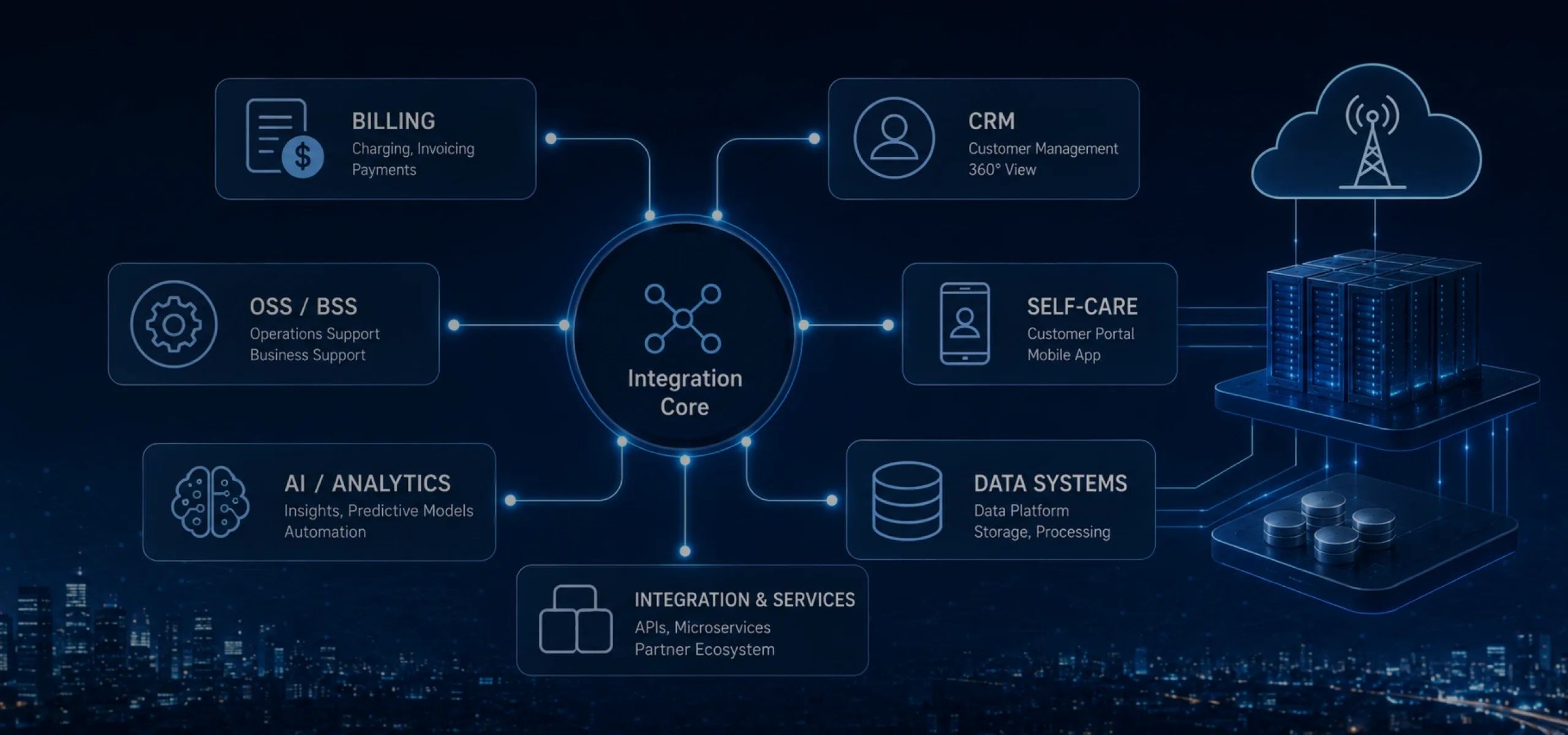
Telecom software projects usually start with a specific gap. The billing platform can't launch a new tariff, the self-care app is behind what customers expect, or a merger left two systems doing the same job. For each gap, an operator can buy an off-the-shelf product or commission a custom build. This guide is about the second route, what telecommunication software development involves in 2026 (project types, timelines, team, stack, and cost), so you can judge when a custom build beats buying. Telecommunication software development is rarely a full rebuild. Most projects are focused modules added to a stack that already runs. Wherever you are in that decision, our telecom software development services can help you scope the options.
Key takeaways
Telecommunication software development is rarely full-stack. Most projects are focused modules, a self-care portal, an MVNO (mobile virtual network operator) enabler, a custom CRM screen, or a fraud-engine extension, not a ground-up rebuild.
Typical timelines, 6-9 months for a focused module, 18 months or more for a full BSS (business support systems) replacement.
Good software development for telecom combines telecom domain knowledge (TM Forum data models, 3GPP charging rules, regulatory compliance) with a modern engineering stack.
Integration with legacy systems is the largest single cost, and it is easy to underestimate.
Build versus buy is a module-level decision. Most operators run a hybrid stack, and a good telecommunication software development services partner helps you choose which modules to own.

Dmitry Bunas
Head of DevOps Department at Modsen
What telecommunication software development actually covers
There are three kinds of telecom applications development, and they differ in time and risk:
Module replacement or extension. You keep the rest of your software and replace or upgrade one part, such as a custom self-care portal on top of the billing system you already own.
Timeline: 6-9 months
Integration layer. A connector between systems that were built separately and don't talk to each other on their own, which is what most post-merger cleanups need.
Timeline: 9-14 months
Greenfield build (rare). The whole thing built from scratch, usually for a brand-new operator.
Timeline: 18+ months
Greenfield builds are rare. Most projects are the first two types, where an operator keeps a vendor suite and commissions extensions and integrations over time. Custom telecommunications management software (monitoring dashboards, tailored reports) is usually an extension too. Knowing which type you face is the first decision in any telecommunication software development project, because the three cost very differently.
How custom telecom software gets built: from scope to go-live
Software development for telecom follows a predictable path, and knowing the stages helps you judge whether a vendor's plan is realistic. A telecommunication software development project usually moves through five stages:
1. Discovery (4-6 weeks). The team maps your architecture (which systems you run, how they connect, how data moves) and confirms which regulations apply, from your national telecom regulator to payment-security and data-protection rules.
2. Architecture and proof of concept (4-8 weeks). The design is drawn up, and the riskiest integration is built first as a proof of concept (PoC), usually a vendor API or a data-quality question, because that is where projects fail.
3. Build (3-6 months). Work runs in two-week sprints, with integration tested continuously against a copy of real, anonymised data.
4. Pre-production (4-6 weeks). The system is tested at full carrier volumes, millions of call detail records (CDRs) an hour, then audited for security and regulatory compliance.
5. Go-live (2-8 weeks). The switch happens in stages, region by region for anything touching billing, with engineering support on standby.
Most telecoms software development projects run 20-30% over the original timeline. The cause is almost always vendor API access or legacy data quality, not slow coding, which is why the risky integration is worth testing first. If you are still choosing a platform, our IT consulting for telecom platform selection helps you get that decision right before any build starts.
Where telecom projects most often slip
Three problems cause most delays, and each is worth raising with a vendor before you sign.
Vendor API limits. The API you need is read-only, its limits are too low for production, or it hides undocumented behaviour. Test that integration in the first few weeks.
Legacy data quality. Old CRM and billing systems hold duplicate records and inconsistent formats. Run a data audit before the architecture is fixed.
Regulatory sign-off. A payment-security review (PCI DSS) or a national regulator (for example, the FCC in the US or Ofcom in the UK) can take longer than planned. Involve them early.
Team roles and stack: who you will be working with
Good telecom software services combine two kinds of people, and a serious build needs both.
Telecom-domain people:
Domain architect. Knows the standard data models (TM Forum) and charging rules (3GPP), so the design does not make costly wrong assumptions.
Integration engineers. Have worked with vendor systems like Amdocs or Oracle.
Data engineers. Migrate subscriber records safely, without losing or corrupting them.
Software-engineering people:
Backend developers. Build the high-volume services telecom depends on, linked by fast protocols such as gRPC.
Security and performance specialists. Own regulatory sign-off and load testing.
DevOps and site reliability engineers (SRE). Keep the platform running and recoverable.
A telecommunication software development project needs both halves, and standing up that mix in-house for one or two modules is rarely worth the time or cost. That is where a partner who already has the full team fits: our custom software development services put a telecom-ready team on your module from day one.
Stack choices for telecom software development
The stack is the quickest way to tell a current telecom team from a dated one. A telecommunication software development team building for 2026 leans on a few defaults:
Cloud-native by default. Services that scale and recover on their own.
A streaming layer (Kafka or Pulsar) for high volumes, with two databases, one for transactions, one for the flood of call records.
Open telecom standards for interfaces, so systems connect cleanly. Old connections (SOAP, legacy CORBA adapters) are wrapped rather than removed.
Design agreed before build. Interfaces are prototyped in general tools like Figma or Storybook, and network-facing pieces in specialised telecom design software, so the design is settled before it costs money to change.
Module-level custom development: where it pays off
Custom work pays off one module at a time, and a few come up repeatedly:
Self-care portal. The app where subscribers manage their own account. Usually built on React or Vue over the vendor's billing system, and often extended into telecom mobile app development for iOS and Android, since subscribers manage their account on a phone.
MVNO or MVNE (mobile virtual network enabler). Unusual tariffs and partner revenue-sharing rarely fit a standard product.
Fraud-rules engine extension. Lets an operator run its own patterns on top of a vendor's base rules.
Custom VoIP development service. For operators selling business voice (VoIP, voice over the internet) with non-standard phone-system links.
Regulatory reporting. Each regulator wants filings in its own format, so this is often built custom.
That is where telecommunication software development pays off, not across the board, but in the specific modules where a standard product falls short. Modsen focuses on exactly these builds, focused telecom software services delivered in 6-9 month cycles. See examples of focused telecom modules in our engineering portfolio to gauge scope and quality for yourself. When AI is the driver, the same module-by-module logic runs through the enterprise modules where AI lands first – CRM, billing, NOC. And when the roadmap is set but the team is short, IT team augmentation for telecom software development projects adds senior engineers to yours.
What custom telecom software development actually costs
A telecommunication software development budget has three parts, and the build price is only the first:
Engineering. Team size, seniority, and duration. A focused module is usually 4-8 engineers over 6-9 months.
Integration. Usually larger than the first estimate. Connecting to existing systems is often the single biggest part of the effort.
Run cost. Monitoring, regulatory updates, and the capacity to keep the module running, usually 15-25% of the build cost a year.
Off-the-shelf costs less at the start, since you pay for a licence instead of funding a build. But the vendor charges for every change beyond its standard product, and those fees add up. A custom module costs more to build, yet you own it and pay no change fees. Over a five-year period, custom development usually delivers a lower total cost of ownership (TCO) for non-standard modules.
Need help deciding what to build?
Talk to our telecom experts. We’ll help you identify the right modules to customize, estimate the effort, and plan the next steps.
FAQ
What does telecommunication software development cover?
How long does a custom telecom software development project take?
What technology stack is used for telecom software development?
How much does telecommunication software development cost?
Is custom software development for telecommunications industry projects worth it?
Conclusion
In 2026, the operators who pull ahead own the two or three modules that set them apart, rather than rebuilding everything. That is what telecommunication software development is for. It turns the systems where an off-the-shelf product holds you back into an advantage you own, and good software development for telecom is knowing which modules those are. Building them well is what a strong telecom software services partner is for.
For the wider picture of vendors and options, start with our guide to telecommunication software in 2026: types, vendors, and build vs buy. If AI is on your roadmap, real generative AI use cases in telecom with ROI shows where it returns money.
If you are weighing a build, we can help you decide. Modsen provides custom telecommunication software development services for telecom operators, and your first architecture consultation is free. Contact us and our engineers will help you map which modules are worth building.
References
Read more






Get a weekly dose of first-hand tech insights delivered directly to your inbox