
WHAT IS TELECOM SOFTWARE AND WHY EVERY OPERATOR NEEDS IT
9 min read
Last updated: Aug 23, 2026
Summary
A text message takes under a second to arrive. In that second, several connected systems have already checked your account, confirmed you have a valid plan or enough balance, screened the transaction for anything that looks like fraud, and logged it correctly for the next invoice – all before the message shows up on the recipient's screen. Collectively, it is telecom software, and it is the reason a single operator can serve tens of millions of subscribers without a human touching most of those transactions.
The importance of these systems continues to grow. According to IMARC Group, the global OSS/BSS market reached approximately USD 72 billion in 2025 and is projected to more than double by 2034, reflecting continued investment in the software that runs telecom operations behind the scenes.
So what is telecom software, exactly? It is the layer of applications sitting on top of the physical network separate from towers, cables, and routers that lets an operator sell a service, keep the network running, and get paid correctly for both. Some of it is bought as software for telecommunication off a vendor's shelf; some of it is built in‑house or with a development partner. This guide walks through what that layer actually covers, who inside an operator uses it every day, and when it makes more business sense to build a piece of it rather than buy it outright.
Key takeaways
Telecom software covers OSS (network operations), BSS (billing and customer management), network management, customer‑facing apps, and specialized tools such as fraud detection. Together, vendors often package this as telecom enterprise software solutions.
Telecom software runs every customer interaction. From activating a data package to generating a monthly bill, multiple systems work together in seconds.
The bulk of software for telecommunication comes from commercial platforms; custom development fills the specific gaps a standard platform can't cover.
Integration drives most project complexity. Connecting existing OSS, BSS, CRM, and customer systems is often more challenging than deploying new software.
The market keeps growing. Global spending on OSS and BSS platforms alone is on track to more than double by 2034, a sign operators keep investing in this layer even as their networks mature.

Dmitry Bunas
Head of DevOps Department at Modsen
What telecom software actually means
Most people associate telecom with towers, cables, and antennas. In reality, much of an operator's work happens in software – from activating new services and calculating bills to monitoring network performance and supporting customers. That's because telecom software isn't a single application but a collection of systems that keep the business running.
Picture an airline. The planes, runways, and radar systems are the infrastructure. Everything else – ticketing, check‑in, baggage tracking, crew scheduling, the app that tells you your gate changed – is software. Telecom operators work the same way: towers, fiber, switches, and antennas are the infrastructure, while billing engines, fault‑management dashboards, and the mobile app on a subscriber's phone sit in the software layer on top of it.
That distinction is worth spelling out plainly:
Not telecom software: network hardware (switches, routers, antennas), physical infrastructure (cables, towers), and the subscriber's own device.
Definitely telecom software: a billing engine, a fault‑management system, a customer mobile app, a fraud‑detection engine.
A few telecom abbreviations appear throughout this guide, so it's worth defining them upfront. An internet service provider (ISP) delivers internet connectivity. A mobile network operator (MNO) owns and operates its own mobile network. A mobile virtual network operator (MVNO) provides mobile services without owning network infrastructure, leasing capacity from an MNO instead. All three rely on telecom software, although MVNOs typically depend on it even more because they don't manage the underlying network themselves.
What lives inside a telecom software stack
To answer the question "what is telecom software," it helps to think of it as a stack of systems. Each layer supports a different part of an operator's business.
What it actually does
OSS (operations support systems)
Keeps the network running by detecting faults, monitoring performance, tracking equipment, and activating services
BSS (business support systems)
Manages customers, orders, and billing
NMS (network management systems)
Sits closer to the hardware and manages the network equipment itself
Customer‑facing apps
The apps and portals customers use every day
Specialized tools
Handle specific business tasks
Typical examples
OSS (operations support systems)
Fault management, performance monitoring, network inventory
BSS (business support systems)
Billing, mediation, CRM, order management
NMS (network management systems)
NMS for network‑wide monitoring; EMS (element management systems) for individual devices like base stations and routers
Customer‑facing apps
Self‑care portals, mobile apps, IVR (interactive voice response), chatbots – where telecom customer service software lives
Specialized tools
Fraud detection, revenue protection, and software that supports virtual mobile operators (MVNOs)
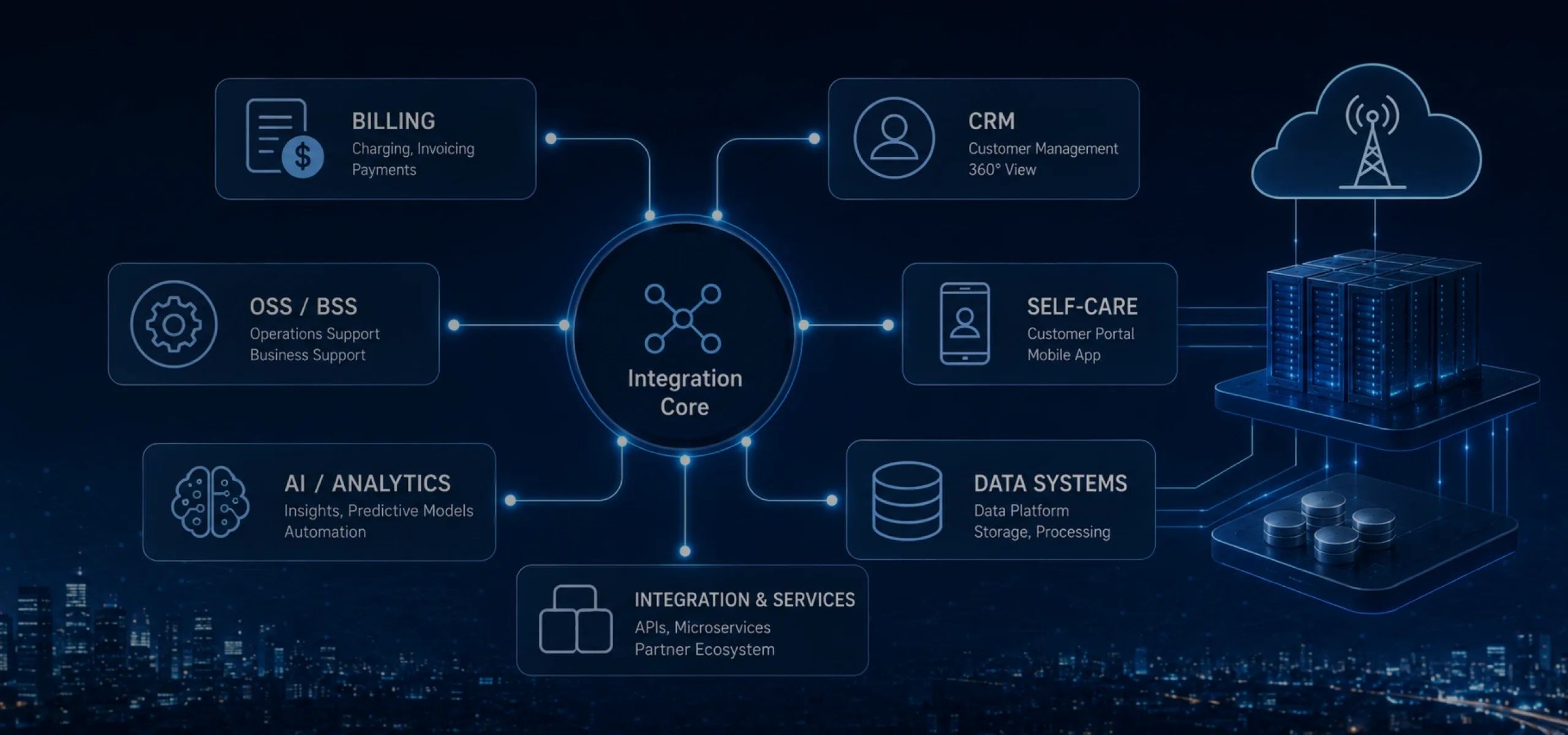
This table shows the main categories of telecom software, and each category includes several individual products and tools. Our guide to the 10 enterprise modules behind every operator explains what those systems do and how operators use them together.
How software layers talk to each other
Although each layer has a different role, they work as one connected system. Imagine a subscriber buying a weekend data package in the operator's mobile app. The entire process usually takes just a few seconds.
1. The app sends the request to the operator's business systems (BSS).
2. BSS checks the customer's account and confirms they're eligible for the new service.
3. The purchase is processed and recorded.
4. OSS activates the data package on the network.
5. The network confirms the service is live.
6. The transaction is saved so the customer sees the correct balance and, if needed, the purchase appears on the next bill.
Several software systems are involved in what feels like a single tap. That's what telecom software looks like in practice: a group of connected applications sharing information in real time to deliver one seamless customer experience. When everything stays in sync, subscribers barely notice the technology behind it. If one system falls behind, the result can be a failed purchase, an incorrect balance, or a call to customer support.
Telecom software in everyday operations
Different teams rely on different types of telecom software, depending on their role.
Network operations engineers use OSS dashboards to monitor the network, investigate faults, and restore services when problems occur.
Billing teams work in BSS to process customer charges, resolve billing issues, and check for lost revenue.
Customer support agents use CRM systems, billing tools, and customer activity logs to answer questions and resolve requests.
In a large telecom operator, these are usually three separate teams working with different telecom software products – often from different vendors. The biggest challenge isn't using the software itself but making those systems exchange data reliably. That's why integration is often more important than choosing a single vendor.
Off‑the‑shelf vs custom: When custom development makes sense
Most operators don't choose between buying or building everything from scratch. In practice, they use an existing telecom software platform and add custom functionality where standard products no longer fit.
A commercial platform is usually the right choice for common business needs, such as standard prepaid or postpaid billing. For a mid‑sized operator with a conventional business model, an established platform from vendors like Cerillion, Comarch, or Oracle BSS is often the fastest and most cost‑effective option.
Custom software development for telecom becomes worthwhile when the business has requirements that standard platforms weren't designed to handle. Common examples include:
An MVNO with unique pricing models
Integrating two billing systems after a merger
Meeting market‑specific regulatory requirements
Connecting the platform to fintech services, IoT devices, or B2B partner systems
In these situations, operators rarely replace the entire platform. Instead, they build one targeted component around it – a customer self‑service portal, a billing extension, an integration layer, or a fraud detection module. This is where specialized telecom software services bring the most value: extending existing platforms rather than replacing them.
Projects like these are at the core of Modsen telecom applications development expertise. For example, we developed a big data analytics platform that helped a telecom operator turn network and customer data into actionable insights, and an AI‑powered call center solution that enhanced existing CRM and telephony systems instead of replacing them.
A skilled telecom software developer combines telecom domain knowledge with expertise in modern software engineering, allowing operators to build solutions that fit both business processes and today's technology standards. Because these specialists are difficult to hire for short‑term initiatives, many operators extend their internal teams with experienced engineers instead of building a dedicated team from scratch. IT team augmentation is often the fastest way to access that expertise when a project has a defined scope and timeline.
If you'd like to see how these projects move from idea to production, our guide on how telecom software development actually works explains the typical development process step by step.
Not sure whether to extend your platform or build a custom solution?
Tell us about your telecom project. Our experts will review your requirements, assess your existing systems, and recommend whether extending your current platform or building a custom solution is the better option.
Dmitry Bunas
Head of DevOps Department at Modsen



The real cost of telecom software
In software development for telecom, every project includes three major cost categories, and the software license is only one part of the total investment.
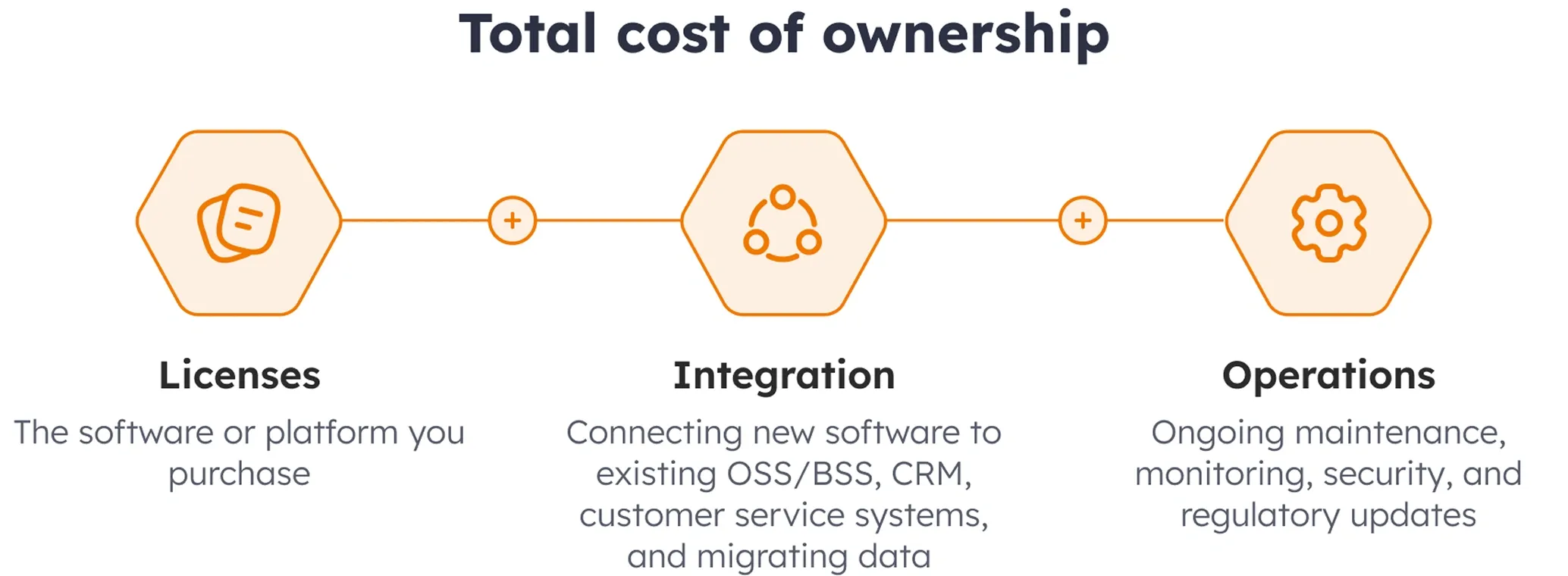
The real challenge often begins when a new platform has to work with existing OSS/BSS systems, CRM platforms, and telecom customer service software that have evolved over many years. Every additional integration increases project complexity, testing effort, and long‑term maintenance. This is one reason many operators modernize individual telecom enterprise software solutions instead of replacing an entire platform at once. Extending an existing billing system, adding a new customer portal, or building a dedicated integration layer is often less disruptive than introducing a completely new platform.
Because every operator's technology landscape is different, the first step is usually deciding what actually needs to change. Many operators work with telecom software services partners to assess existing systems, compare modernization options, and identify integration risks before development begins. IT consulting helps reduce uncertainty and avoid costly changes later in the project.
FAQ
What is telecom software in simple terms?
What are the main types of telecom software?
Who actually uses telecom software inside an operator?
What does a telecom software developer actually do?
Can a smaller operator build its own telecom software?
Conclusion
Telecom software isn't a single product – it's five connected layers of systems that keep an operator's network running and its billing accurate, mostly without anyone noticing. Buying the core of that stack from an established vendor is the right call for most operators, since commercial billing, CRM, and network‑management platforms are already mature and hard to improve on. Custom development earns its place in narrower situations: a non‑standard MVNO tariff, two billing systems merging after an acquisition, a regulatory requirement a vendor hasn't built for, or an integration no off‑the‑shelf product supports. In these cases, the smarter move is usually one focused custom module rather than a full platform rebuild.
For the fuller picture of vendors and the build‑vs‑buy decision across the whole stack, see our guide to telecommunication software in 2026: types, vendors, and build vs buy.
If you're weighing a custom module against an off‑the‑shelf upgrade, Modsen telecom engineering team can look at your stack and flag where a focused build would save the most integration cost and deliver the fastest return.
References
Read more





Get a weekly dose of first-hand tech insights delivered directly to your inbox