
Telecom enterprise software solutions: 10 must‑have modules
11 min read
Last updated: Aug 24, 2026
Summary
Telecom enterprise software solutions are the modules an operator runs its business and network on, and a mid‑size operator loses revenue every month it cannot see: a rating error in charging, a discount that never expired, an interconnect settlement never reconciled. The cause is almost never one broken system – it is the gaps between disconnected modules. As TM Forum notes, the industry is moving toward plug‑and‑play OSS and BSS components operators assemble rather than buy as one suite. This guide covers the 10 modules every operator runs, where integrations break, and where a custom build pays off. Scoping a wider engagement? Start with Modsen telecom software development services.
Key takeaways
Telecom enterprise software solutions split into three layers: business support (BSS), operations support (OSS), and specialized modules.
Ten modules are non‑negotiable: billing, charging, CRM, order management, revenue management, fault management, performance monitoring, inventory, fraud management, and subscriber data management.
Integration between modules causes more operational pain than the modules themselves.
Buy commodity modules, build the ones that set the operator apart – the decision is made module by module.
Billing, fraud, and CRM get replaced most often, because they change faster than vendors ship.

Dmitry Bunas
Head of DevOps Department at Modsen
What counts as telecom enterprise software (and what doesn't)
The line is throughput and compliance.


Telecom enterprise software solutions are carrier‑grade modules built to handle high‑volume transactions, e.g. millions of CDRs (call detail records) per hour, under regulatory obligations, with multi‑tenant logic that separates one operator's or one MVNO's (mobile virtual network operator's) data from another's.
That is a different engineering problem from a standard business application. For the foundational definitions, see what is telecommunication software.
The IT solutions for telecommunications that matter split into three “layers”:
1. The BSS layer runs the commercial side: billing, charging, customer relationship management (CRM), order management, revenue management. It covers everything from generating an invoice to resolving a customer complaint.
2. The OSS layer runs the network side – fault management, performance monitoring, inventory, service activation. It covers everything from detecting a network alarm to knowing what equipment is deployed where.
3. The specialized layer (fraud management, revenue assurance, MVNO enablement, subscriber data management) carries the highest regulatory exposure and is usually the first software for telecommunications an operator replaces when requirements shift.
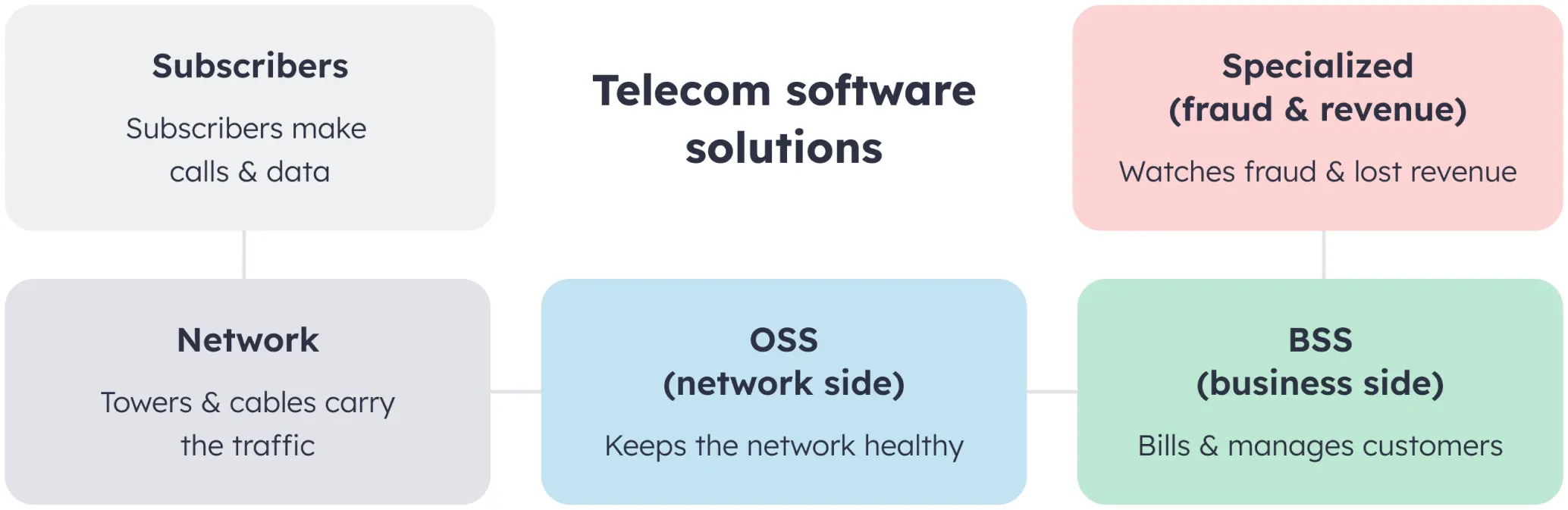
They work as one connected chain: from the subscriber and the network up through OSS and BSS to the specialized systems.
10 must‑have modules: What each one actually does
Based on industry observation, a mid‑size operator typically runs 15–25 distinct modules in production; Tier-1 operators run 50 or more. The list below is the telecom software products an operator cannot run a business without.
Business support modules
1. Billing
Generates invoices, applies taxation and discounts, and handles IFRS 15 (International Financial Reporting Standard 15) revenue recognition. This is the telecommunications accounting software function of the stack. When billing is wrong, revenue leaks quietly, and operators usually find the discrepancy months later in reconciliation.
2. Charging
Manages real‑time balance for prepaid accounts and event‑based postpaid. Every call, data session, and SMS is rated against a balance in real time. When charging is slow or misconfigured, prepaid customers get free minutes or data, and the loss compounds at scale.
3. CRM
Holds customer profiles, interaction history, and segmentation. Telecom CRM software is tightly coupled to billing and charging: a care agent needs real‑time balance, active plan, and outage status on one screen, not spread across three systems.
4. Order management
Orchestrates fulfillment across BSS and OSS when a customer buys or changes a service. A SIM activation triggers a sequence across charging, inventory, and network provisioning. When order management fails, orders stall silently and the customer stares at "pending" for days.
5. Revenue management
Covers pricing configuration, partner settlements, and revenue share. Interconnect billing between operators, what one operator owes another for carrying traffic, runs through this module.
Operations support modules
6. Fault management
Receives alarms from network elements, correlates them, and routes them to the right team. An operator with 10,000 nodes generates thousands of alarms a day; fault management separates noise from a real outage.
7. Performance monitoring
Tracks KPIs (key performance indicators) such as latency, throughput, and dropped‑call rate across the network. Operations teams use it to catch degradation before it turns into a customer complaint.
8. Inventory
Records what is deployed where: topology, physical equipment, logical services. When inventory is inaccurate, field engineers replace the wrong hardware and provisioning fails.
Specialized modules
9. Fraud management
Detects SIM‑box fraud, IRSF (International Revenue Share Fraud), and account takeover. Fraud patterns evolve, so off‑the‑shelf rule sets go stale within months of a new fraud type appearing.
10. Subscriber data management
The telecom database software layer, holding subscriber profiles, authentication data, and MSISDNs (mobile station international subscriber directory number). Every call authentication, roaming session, and service lookup queries this module. Downtime here affects the entire network.
Building a single custom module rarely justifies a full hiring round, so operators add the engineers they need for the project through IT team augmentation and release them once it ships.
Rebuilding just one module?
Modsen team can map the integration scope and propose a delivery plan for the module that is holding you back.
Why three modules get replaced more often than the rest
Three modules of telecom enterprise software solutions carry the highest replacement rate.
Billing – regulatory changes (IFRS 15 updates, new tax regimes) and new product launches (5G pricing, bundled services) push billing past what the current system can model. This is where telecommunications accounting software ages fastest. Operators often replace billing and CRM software together during a single BSS modernization, because the two share so much customer and product context.
Fraud management – fraud patterns evolve faster than vendor release cycles. When a new fraud type surfaces, an operator needs custom detection rules within weeks, and not at the next annual release.
CRM – customer‑facing UX expectations move quickly and vendor UI tends to lag. Operators build custom care and self‑care front ends on top of the vendor CRM back end rather than wait for a vendor redesign.
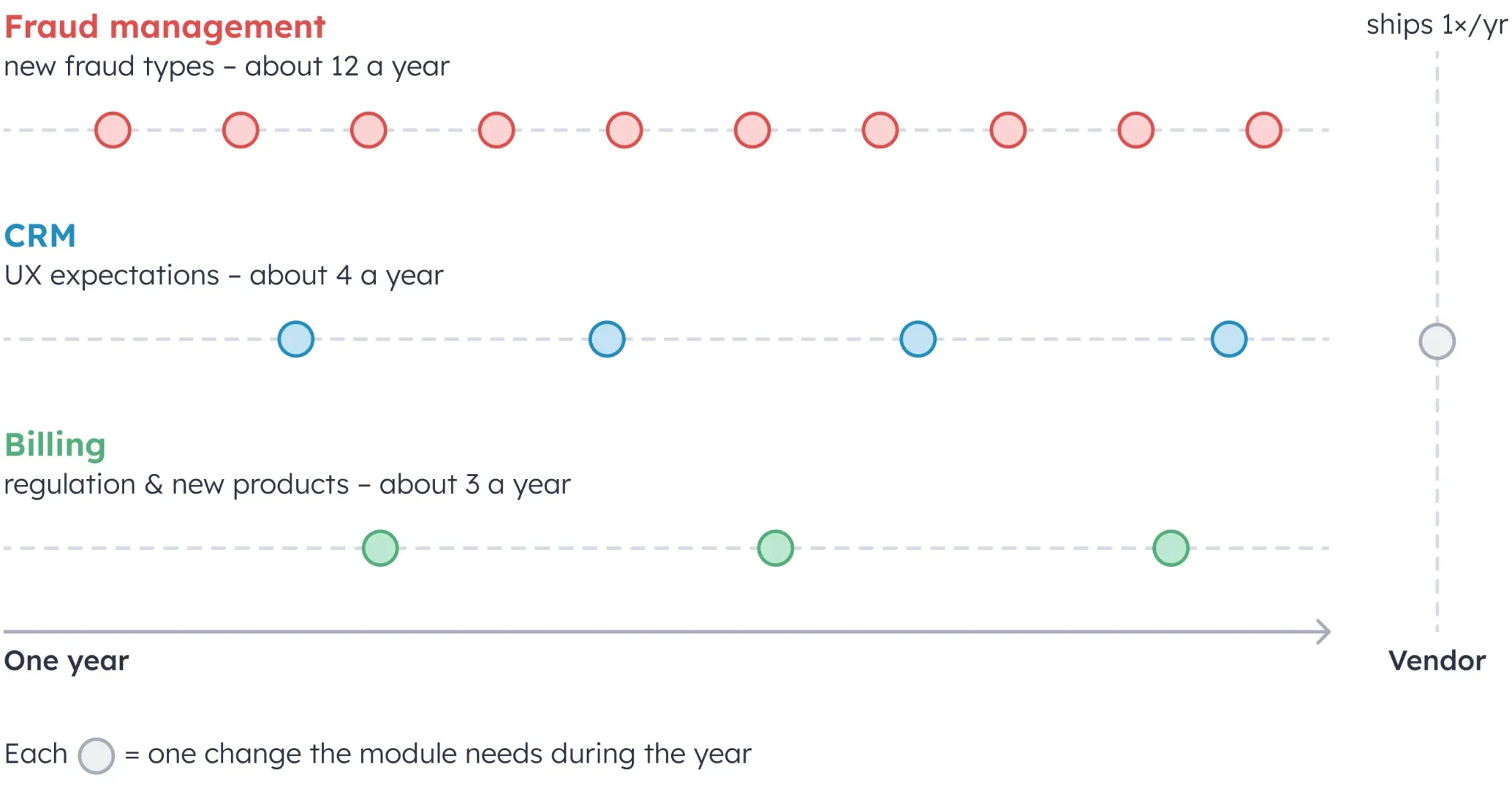
Fraud, self‑care, and billing each change many times a year, while the vendor ships once, so operators build custom telecom enterprise software solutions.
Integration patterns between modules: Where things break
Integration between modules is the main source of operational pain across telecom enterprise software solutions. Modules from different vendors expose different APIs, use different data models, and ship on different release cycles. There are three ways operators connect them.
Point‑to‑point. Direct API (application programming interface, a connection between computers or between computer programs) calls between two systems. Simple to set up, but it becomes unmanageable as modules grow: 10 modules imply up to 90 possible point‑to‑point connections.
ESB (enterprise service bus). Middleware that sits in the middle and passes messages between systems. Every module connects to it once instead of wiring to each other directly. It decouples modules, but because everything flows through one place, that place becomes a single point of failure and slows down under very high volumes.
Event streaming (Kafka, Pulsar). Modules publish and consume events. Scalable and replayable, but it needs a team that can run streaming infrastructure.
Point‑to‑point
Best for
Two tightly coupled systems (CRM ⇄ billing)
Watch out for
Multiplies fast as modules grow
ESB
Best for
Legacy OSS integration
Watch out for
Becomes a bottleneck at high volume
Event streaming
Best for
New microservices, high‑throughput flows
Watch out for
Team capability requirement
Most operators run all three at once, and that is normal. It is what gradual modernization over many years leaves behind. The hard part is not choosing a new module but connecting it to everything already in place, and the CRM‑to‑billing link is usually where those integration problems show up first.
Integration work like this often needs extra hands, and it is one of the areas Modsen team supports through our custom software development services.
Build vs buy at the module level: Where custom pays off
The choice is made one module at a time, and it comes down to a simple question: does this module make the operator money, or just keep the lights on?
Some modules do the same job for everyone – billing standard plans, storing subscriber data, catching network alarms. Buy those. A vendor solved that problem years ago, and building your own version wastes budget on work that gives you nothing your competitors do not already have.
Other modules decide how fast you launch a new plan, how much fraud you lose, and whether customers like dealing with you. These are the modules worth building, because they are where you either beat the competition or fall behind and no vendor roadmap moves fast enough to give you an edge there.
Buy
What you do
Take a vendor product as-is
Best for
Commodity modules every operator runs the same way
Examples
Standard billing, fault management, inventory, subscriber data
Hybrid
What you do
Buy the core, build a layer on top
Best for
Modules where the vendor engine is fine but your process is your own
Examples
CRM front-end, order-management connectors
Custom
What you do
Build the module around your business
Best for
Modules that set you apart, or that no vendor fits
Examples
MVNO enablement, custom fraud rules, self-care, regulatory reporting
The middle option is the most common in practice. The vendor handles the heavy, standard work underneath; the operator builds the thin layer on top – the screens staff use every day, the rules specific to its own products, the links to its other systems. You buy the engine and build the part that carries how you actually run.
Custom does not mean starting from scratch. The operator keeps every vendor module already in place and adds one custom piece on top, usually in a 6–9 month project. That is a contained, low‑risk way to fix the one module holding the business back and it is the work Modsen team does. For how a build like that runs start to finish, see how custom telecom software development actually delivers a module.
What to check before choosing an enterprise telecom software vendor
Five questions to answer before signing with a telecom enterprise software solutions vendor.
Does it use TM Forum Open APIs or the vendor's own?
TM Forum Open APIs are the industry standard. Proprietary APIs mean extra integration work every time you add another module.
How often do they release updates?
Tier‑1 suite vendors release once a year; cloud‑native vendors release quarterly. A yearly cycle means waiting up to 12 months for a regulatory fix.
What is in the integration toolkit?
SDK (software development kit), sandbox, and sample integrations. A vendor without a sandbox is one you cannot test before you commit.
Is it cloud‑native or a lift‑and‑shift VM image?
Cloud‑native scales on its own and updates automatically. An old system just moved onto cloud servers only changed address.
Is the compliance posture documented?
Ask for up‑to‑date PCI DSS (Payment Card Industry Data Security Standard), SOX (Sarbanes‑Oxley Act), and GDPR (General Data Protection Regulation) compliance.
FAQ
What are telecom enterprise software solutions?
What is telecom CRM software and how is it different from regular CRM?
How many telecom software modules does a typical operator run?
Should an operator build telecom CRM software in‑house?
What are the main benefits of enterprise telecom management software?
When does custom development make more sense than buying a module?
Conclusion
Ten modules, three families, integration as the hardest problem, and a build‑vs‑buy decision made module by module rather than across the whole telecom software platform – that is the shape of a modern operator's software estate.
If you are rebuilding one or two modules of your telecom enterprise software solutions stack, Modsen telecom engineering team can map the integration scope and propose a delivery plan. For the wider market picture first, read telecommunication software in 2026: types, vendors, and build vs buy.
See examples of focused telecom modules in our engineering portfolio.
References
Read more





Get a weekly dose of first-hand tech insights delivered directly to your inbox