
Generative AI use cases in telecom: 7 real examples with ROI
15 min read
Last updated: Aug 25, 2026
Summary
Generative AI (technology that can write text, answer questions, or summarize documents on its own, the kind behind tools like ChatGPT) has moved past the demo stage in telecom. Most telecom companies now run at least one generative AI use case in telecom in production: a support chatbot, a tool that helps call‑center agents, or a system that summarizes internal documents. This piece covers seven of those use cases, the realistic return on investment for each, and where the technology still falls short. Whether you're scoping the integration work yourself or bringing in outside hands through telecom software development services, here's what's actually running in production right now.
Key takeaways
Generative AI in telecom mostly supports teams rather than replacing them. Tools that help human agents currently show a clearer payback than fully automated chatbots.
Three areas account for most real use: customer support, network operations, and personalizing what a customer sees in the self‑care app.
Most pilots get stuck on messy internal data and on connecting to existing systems, not on the AI itself.
Conversational AI in telecom, meaning any software that can hold a conversation with a customer, now runs on this newer generation of AI by default. The older, scripted chatbots that only understood a fixed list of phrases are mostly gone from new projects.
Whether to build a custom tool or buy a ready‑made one depends on how deeply it needs to connect into billing or network systems.

Dmitry Bunas
Head of DevOps Department at Modsen
Why genAI is different from earlier AI in telecom
Older AI in telecom (roughly the 2010s through the early 2020s) handled tasks like predicting which customers might cancel, spotting unusual network activity, or flagging fraud. It worked with tidy, organized data, numbers and records sitting in neat database tables, and each tool did one narrow job.
Generative AI works differently. It can read messy, unstructured material: call recordings, internal memos, support tickets, and turn that into a written answer without being told in advance exactly what to look for. In practice, that means telecom teams need fewer separate, specialized tools and more of one general‑purpose AI, paired with a method usually called "retrieval" (in plain terms: the AI looks up the right internal document before it answers, instead of guessing from memory). A 2024 review of the field in IEEE Communications Magazine, by Bariah and colleagues, makes the same point: the industry is shifting from many narrow, single‑task models toward fewer, general‑purpose ones that can be pointed at different problems.
This doesn't replace the older tools. Fraud detection and network‑anomaly alerts still run best on the older systems built specifically for that structured, numbers‑based work. Generative AI in the telecom market fills a different gap: the messy, written material those older tools were never built to read. That mix, old tools and new ones running side by side, is what a typical telecom AI setup looks like today. Modsen has built both sides of that for telecom clients directly: a churn‑prediction platform built on classical machine learning and predictive analytics, and a contact‑center system combining call routing, voice‑based sentiment analysis.
From an operations standpoint, that mix changes what a team needs to watch for. An older, narrow AI tool has one main failure mode: its predictions slowly get less accurate over time, so you retrain it. A generative AI tool paired with document lookup has more ways to go wrong. The documents it searches can go out of date. Two internal documents can disagree with each other. The AI can answer confidently from the wrong document. Or the outside provider can quietly change how the tool behaves. That's true across nearly every one of the generative AI use cases in telecom industry teams are piloting right now.
None of that shows up on a standard "is the system online" dashboard. Someone needs to be watching what the AI actually says, not just whether the servers are running, or the first sign of trouble will be an angry customer instead of an alert.
That shift, from many small specialized tools to one general AI plus document lookup, is what makes the next seven use cases possible. Here's where they actually show up in production.
7 real generative AI use cases in telecom (with ROI ranges)
Each of the following runs in production today at some telecom company. For each one: what it does, where it sits, the reported payback, and the catch.
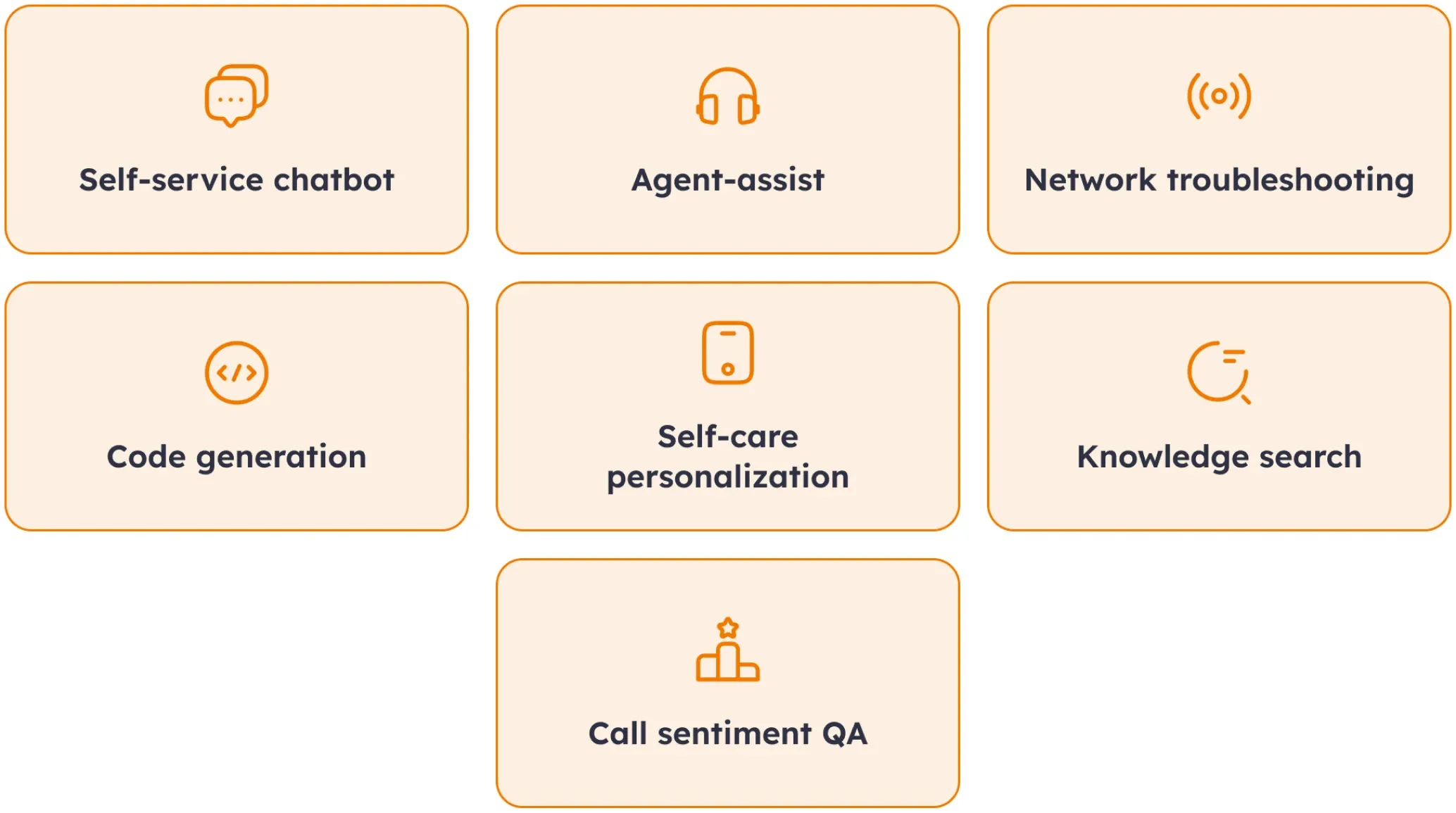
Top AI use cases in telecom already in production
1. Self‑service chatbot
The first thing most telecom customers run into now isn't a human; it's a chatbot on the website or app answering routine questions. Vendors in this space report chatbots handling millions of customer interactions for clients, with 20% to 40% of simple questions fully resolved by the bot in well‑run setups. This kind of AI‑driven chatbot solution for telecom companies is quickly becoming the default for handling simple support volume. We built one of these ourselves, for a telecom operator in Eastern Europe: a chatbot paired with automated call routing and voice-based sentiment analysis, sitting on top of the client's CRM. Four months in, wait times were down 40%, satisfaction scores were up 25%, and churn was down 34%. Yet, it still can't do everything: ask it to upgrade a plan and it hands the conversation to a human.
2. Real‑time help for call‑center agents
This one sits quietly behind the scenes: while an agent is on a live call, the AI pulls up the customer's history and suggests what to say next, right there on the agent's screen. The clearest number here comes from a study from the National Bureau of Economic Research: support agents using this kind of assistant became 14% more productive on average, with newer agents gaining the most, 34%, and veterans barely moving, one of the clearer cases of conversational AI in telecom earning its keep instead of just demoing well. The catch is speed, not accuracy: the AI needs an answer in under two seconds to keep pace with a live call, which only happens if the customer records behind it are current.
3. Faster problem‑solving for the network team
Anyone who has carried a pager for network operations knows the real cost usually isn't the outage itself, it's getting woken up at 3 a.m. for something a troubleshooting guide could already answer. That's the gap this AI use cases in telecom closes. The AI searches the company's own runbooks and suggests likely causes and fixes, and in deployments like this. A 10% to 20% cut in time‑to‑fix is a realistic range for well‑documented incident types, though it swings a lot depending on how current those runbooks are kept. Where it gets shaky is anything rare or undocumented: confidence drops fast on unfamiliar problems, so a person still needs to double‑check, and someone should keep a record of what the AI suggested for review afterward.
4. Help writing routine software code
Give the engineering team a small, repetitive task, a config tweak, a minor integration between two internal systems, and this kind of tool speeds up the first draft. Gains of 15% to 25% on that kind of work are typical, though the number drops fast once the codebase is messy or undocumented. What it doesn't speed up is the decision to merge. Every line goes through the same tests and the same review a person would write, because a small mistake in billing‑system code can look perfectly fine at a glance and cause real damage three weeks later.
5. Personalized content inside the self‑care app
Every subscriber sees a different version of the self‑care app, built from their own usage data instead of one static screen for everyone. Someone burning through data gets an upgrade suggestion; someone about to travel sees a roaming option before they cross the border. It's one of the quieter AI/ML use cases in telecom, but it's what turns usage and billing data into the actual line a customer reads on screen, not a marketing team writing copy by hand. Reported engagement gains land in the 10% to 20% range, worth checking against a company's own data. Where it still misses: pricing and roaming terms need a human check, and a system tuned purely for clicks can quietly narrow what a customer ever sees, missing a real shift, like new travel habits, instead of catching it.
6. Searchable summaries of internal know‑how
Not every use case needs a dramatic before‑and‑after. This one just keeps internal manuals, regulatory updates, and supplier documents easy to search for employees, in the background, with nothing customer‑facing about it. That's exactly why it's usually the first thing a telecom company tries: the risk if something goes wrong is low, and the win, less time spent hunting through outdated PDFs, shows up almost immediately.
7. Turning support calls into text, then checking the tone
Quality monitoring on support calls used to mean a supervisor listening to a small, random sample and hoping it was representative. This use case converts every call to text and flags the ones with a negative tone for review instead, and it's a good example of conversational AI in telecom doing unglamorous work that never shows up in a demo but changes how QA teams actually operate day to day. Our own chatbot project for the telecom operator in Eastern Europe ran this as part of its voice‑based sentiment analysis, feeding straight into call routing rather than sitting off to the side as a separate QA step. Anyone who's sat through a quality review built on 2% of calls already knows why this one catches on fast. in Eastern Europe ran this as part of its voice-based sentiment analysis, feeding straight into call routing rather than sitting off to the side as a separate QA step. Anyone who's sat through a quality review built on 2% of calls already knows why this one catches on fast.
All seven of these are running in real telecom deployments already, which is what makes them real generative AI use cases in telecom rather than a roadmap slide. The devil's in the details, though, and a few of those details are worth more attention than the rest.
Generative AI is already live in telecom
Claim your free consultation to find your starting point.
Where generative AI still misses (the honest limitations)
The day‑to‑day list is short, and every item on it is something a team can plan around rather than just brace for: confident wrong answers, especially risky around billing and regulatory wording, which is why most teams keep a human sign‑off on anything that touches an invoice. Document lookup that's only as good as the documents behind it, solved less by better AI and more by someone owning the job of keeping those documents current. Live‑call use cases needing sub‑two‑second responses, which usually comes down to testing under real call volume before rollout. Personal data that can't leave the building without a proper agreement in place. Per‑use costs that can quietly outgrow the savings if adoption stalls below a certain threshold, worth checking against actual usage numbers a few months in, not just at launch. Someone also has to own the tool once it's live: who gets alerted if it goes down, and what happens instead while it's down, a decision worth making before go‑live.
One risk goes deeper, and it ties back to the call‑center numbers earlier: newer agents gained the most from AI assistance, seasoned ones barely moved. That's good news for ramp‑up time today, but it raises a real question for five years out, one that matters more the further AI in telecom industry adoption goes. If new agents lean on AI‑suggested answers instead of building their own judgment call by call, a company may end up with fewer people who could actually handle a hard call without the tool. Productivity gains now can be a skill deficit later, and it's worth tracking separately from the headline numbers.
A similar pattern shows up on the network side. An AI trained on past incidents gets better at recognizing the failures it's already seen, and slower at flagging something genuinely new. A troubleshooting assistant tuned entirely on historical patterns can quietly nudge a team toward the familiar diagnosis, the one that matched last time, instead of catching the one incident that doesn't fit any pattern in its training data. That's precisely the kind of rare, undocumented failure a network operations team most needs help with, and the one this technology is structurally worst at catching.
One thing worth doing early: sitting down and figuring out which of these risks actually apply to a specific rollout, and shaping the solution around them before committing to anything. That's the kind of conversation IT consulting for telecom platform selection is meant for, and we're happy to have it.
Self‑service chatbot
ROI
20%+ deflection; our case: −40% wait time, −34% churn
Where it lives
Customer‑facing layer
Key limitation
Fails on account changes (plan upgrades, SIM swaps)
Real‑time help for call‑center agents
ROI
15%+ handle‑time cut; 14%+ productivity (NBER)
Where it lives
CRM / customer service software
Key limitation
Needs sub‑2s response and clean, current account data
Faster problem‑solving for the network team
ROI
20%+ faster fix time
Where it lives
Network operations / OSS
Key limitation
Confidence drops on rare, undocumented incidents
Help writing routine software code
ROI
15%+ faster on routine changes
Where it lives
Engineering / dev tools
Key limitation
Speeds up drafts only; human review stays mandatory
Personalized content in the self‑care app
ROI
10%+ engagement gain
Where it lives
Product layer (self‑care app)
Key limitation
Can narrow what a customer ever sees
Searchable summaries of internal know‑how
ROI
No fixed ceiling; low‑risk, fast payoff
Where it lives
Employee‑facing tools
Key limitation
Only as reliable as the documents behind it
Voice‑to‑text + sentiment analysis for QA
ROI
Full call coverage vs. small manual sample
Where it lives
QA / compliance
Key limitation
Tone ≠ context; sarcasm and edge cases slip through
Generative AI use cases in telecom: quick‑reference ROI table
Where generative AI plugs into the telecom stack
The "stack" here just means the different layers of software a telecom company runs, from the app a customer sees down to the systems that manage the network itself.
Customer‑facing layer: chatbots, call transcription, self‑service tools, personalized content inside the self‑care app, anything the customer sees directly. Most pilots start here because it's the easiest layer to try out and the easiest to measure: how many questions did the bot resolve on its own.
Billing and customer‑account systems: agent‑assist tools built into the CRM, systems that answer billing questions directly. Takes more work to connect, but tends to pay off more once it's running.
Network‑management systems: incident triage for the network team, searching troubleshooting guides, summarizing alerts. The hardest layer to get right, since a wrong suggestion here can lead to the wrong fix being applied to a live network.
Engineering tools: code generation, summarizing internal documents. Lowest risk to customers, mainly useful for speeding up internal work.
Most companies don't run one single "AI platform" that covers everything. They add AI tools into whichever existing system needs one, which means the hard part usually isn't the AI itself. It's connecting that AI to systems that were never designed to work with it, and that's true whether the tool in question is a customer‑facing chatbot or one of the quieter forms of conversational AI in telecom sitting behind the scenes. For the ten most common software areas where this kind of AI shows up first, billing, customer records, network operations, see our breakdown of telecom enterprise software solutions.
Knowing where it fits in still leaves the harder question: build it yourself, or buy something ready‑made?
Build vs buy for generative AI pilots in telecom
In practice, there are three ways to get any of this running, and each one trades speed for control differently.
Ready‑made tools: pre‑built bots from vendors like Salesforce, Amdocs, Nokia, etc. Fastest to try out, but the loosest connection to a company's own systems, with some risk of getting locked into that one vendor. Best for simple, standalone jobs like an FAQ bot.
A general AI service with a custom layer on top: the company builds a thin, custom layer over a general AI provider such as OpenAI or Anthropic, or an openly available model. Quicker to launch than a fully custom build, but the company itself has to manage the ongoing upkeep, privacy rules, and monitoring. For teams that just need extra hands for that, rather than handing the whole build to an outside vendor, IT team augmentation for telecom software development projects is usually the lighter option.
A fully custom tool, built to fit: deeply connected to the company's own billing and network systems, with its own safety rules and monitoring built in from the very beginning.
Most companies end up using all three at once: a ready‑made bot for FAQs, which covers the simplest slice of conversational AI in telecom, a lightly customized layer for personalizing the self‑care app, and a fully custom tool for network operations. That mix is part of why the generative AI in telecom market looks more fragmented than a single vendor leaderboard would suggest, most of the money goes into stitching pieces together. The same build‑vs‑buy tension shows up across telecom software more broadly, not just the AI layer, as we cover in our guide to telecommunication software in 2026: types, vendors, and build vs buy. Technology partners like Modsen typically get called in for that third option, building the connections between the AI provider, the existing billing or network systems, and the company's own rules, usually over a 4 to 6 month project. What often gets underestimated with any of these three options is who keeps maintaining the tool after launch: updating it as the AI provider changes its model, fixing it when its answers get worse, refreshing the documents it searches, and watching the ongoing cost. That's ongoing work, and someone on the company's side needs to own it. For the fuller picture of what telecom software development brings to a project like this, see our guide to building and buying telecom software in 2026.
But which of these three options wins out over the next few years? That depends on where things go next.
Vendor lock-in and an over-built system are both costly to undo
Book a free consultation before deciding.
What's coming next: the future of AI in telecom industry
Three shifts, apparently we like the number three today, are likely to define that test.
Fully automated AI helpers that can carry out several steps on their own are still mostly demos, and the first real, low‑risk uses, things like organizing internal knowledge, should reach production around 2026 to 2027.
Voice‑based interfaces will start replacing the old "press 1 for billing" phone menu, one company at a time.
AI built into billing and network software from the ground up is still an early, multi‑year plan for most vendors.
None of this is a 2026 story. It's a three‑to‑five‑year one, and most of today's AI use cases in telecom are simple enough to course‑correct along the way if a shift lands earlier than expected. Analysts at Research and Markets estimate the market of AI in telecom at roughly $1.12 billion in 2026, growing to $6.16 billion by 2030, and that money is more likely to reward companies that spent the years before it getting their own integration right than whoever ships a chatbot fastest. their own integration right than whoever ships a chatbot fastest.
FAQ
What are the main generative AI use cases in the telecom industry?
What is the difference between conversational AI and generative AI in telecom?
What ROI can telecom operators realistically expect from GenAI pilots?
Should telecom operators build their own GenAI or use vendor bots?
How is AI transforming customer service in the telecom industry?
Conclusion
Any of these use cases can work. What decides whether it actually pays off is three things: a realistic ROI given your current systems, a rollout that stays safe once it's live, and something your own team can actually work with day to day. Those are the questions worth working through before committing to anything. Contact us if it'd help to talk through what that looks like for your own systems, Modsen telecom engineering team can walk through the scope directly.
Read more





Get a weekly dose of first-hand tech insights delivered directly to your inbox