
Staff augmentation model explained: How to structure your engagement
8 min read
Last updated: May 26, 2026
Summary
The staff augmentation model lets you bring in external specialists without the overhead of a permanent hire. Unlike software outsourcing, where a vendor delivers output independently, augmented engineers work under your direct management and inside your existing systems.
Getting the structure right from the start determines whether augmentation runs smoothly or adds coordination overhead instead. This guide walks through each piece – from the hiring process and pricing to agile integration, contracts, and when a different model might fit your requirements.
Key takeaways
The staff augmentation model gives you direct control over external talent while keeping your internal team in the lead.
Staff augmentation and dedicated teams solve different problems; picking the wrong one has real cost and timeline implications.
Contracts need to cover scope, IP ownership, NDA terms, and exit conditions before work starts.
Provider selection matters as much as the model itself: time zone overlap, tech stack fit, and scaling speed all affect delivery.

Paul Kirikov
Head of Business Development Department at Modsen
The staff augmentation process step by step
The augmentation process follows a clear sequence, and the staff augmentation model is only as reliable as how well that sequence is executed. Shortcuts at any stage tend to surface later as integration problems, when they're harder to fix.
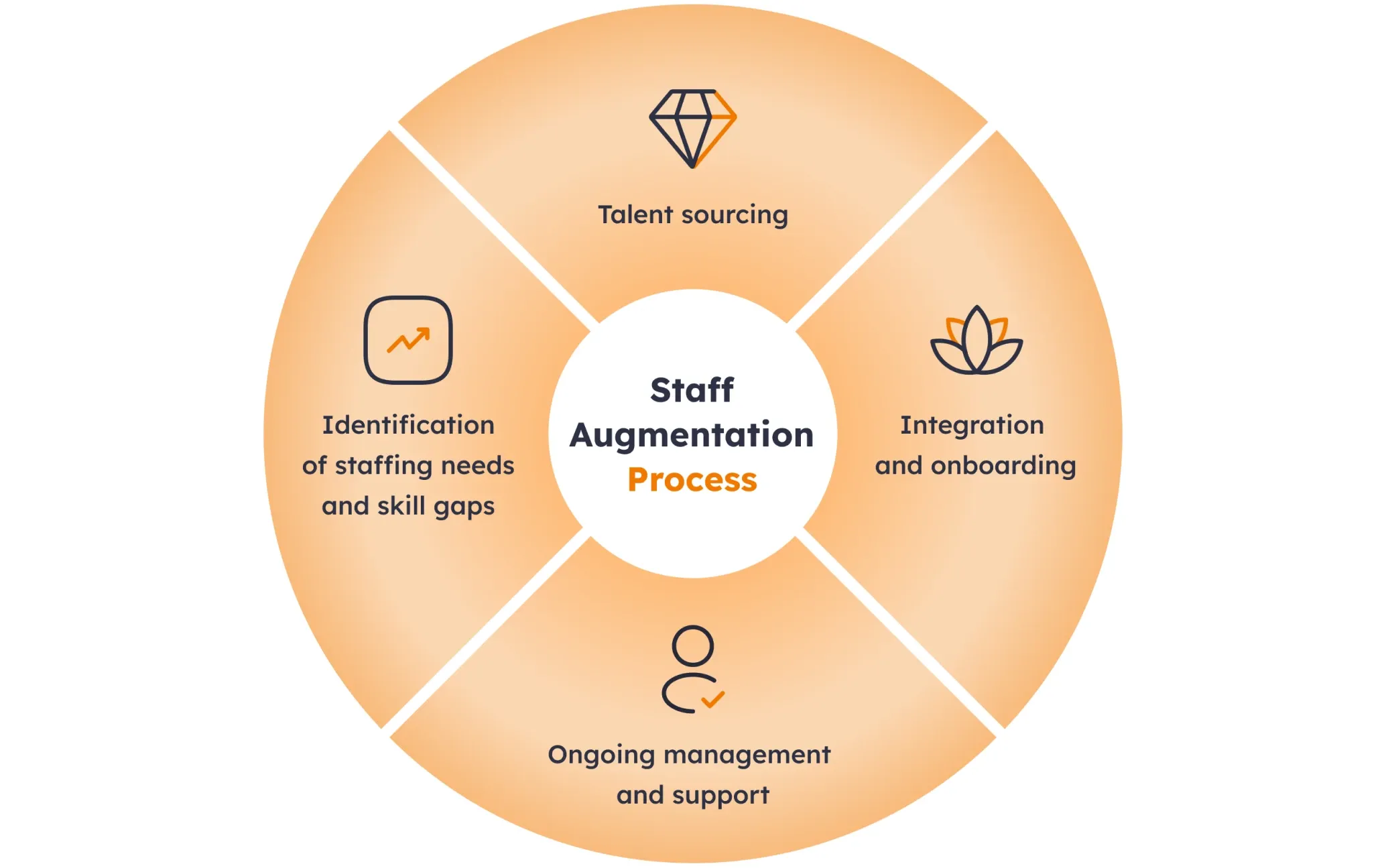
Process of staff augmentation step by step
Discovery, screening, and candidate selection
Before CVs reach your inbox, a solid vendor spends time understanding the actual work: the stack you're running, how your team operates day to day, what the role needs to cover, and where the gaps are. This phase isn't a formality. Vendors who skip it send profiles that look good on paper but don't fit the technical context or team dynamic.
Screening typically runs in two stages: the vendor filters for technical qualifications first, then you interview the shortlist for fit. Depending on role complexity, this takes one to three weeks – bringing in specialized technical engineers for niche stacks or architecture roles typically sits at the longer end. A good provider will also tell you when your requirements are hard to fill at the rate you're expecting – that transparency saves more time than it costs.
Onboarding augmented staff into your workflow
Once candidates are selected, onboarding is where the staff augmentation model either delivers or starts creating friction. Augmented engineers aren't contractors you assign tasks to and check on weekly. They join sprint planning, attend standups, and work inside your project management setup from the first day.
For team augmentation in agile environments, the setup phase carries more weight than most teams expect. Assign a clear point of contact on your side, document communication norms, and give augmented team members access to the same tools and repositories as your permanent staff. Most integration problems trace back to onboarding decisions, not skill gaps.
For a complete overview of what staff augmentation is and how it's structured, the linked guide covers the fundamentals in detail.
Staff augmentation pricing models and cost structures
Cost structure is usually the first thing clients want clarity on. Choosing the wrong model early creates budget unpredictability and misaligned vendor incentives down the line.
Hourly, monthly, and retainer-based pricing
Hourly rates for augmented engineers range from $25 to $90 per hour for Eastern European talent, and $75 to $130 for US-based specialists. This structure works well when your workload varies month to month, and you need the flexibility to adjust headcount.
Monthly retainer pricing fixes a set number of hours or a full-time equivalent for a predictable monthly fee. It's typically cheaper than hourly billing at the same volume, which makes it the default choice for continuous development work running longer than two months.
Sprint-based pricing ties payment to defined delivery cycles rather than hours logged. It works in tightly scoped agile projects where output per sprint is measurable and consistent throughout the engagement.
Staff augmentation vs Time and material
The two models differ in one fundamental way: who carries accountability for delivery, and how contracts are structured around that.
Staff Augmentation
Billing basis
People (capacity)
Who manages the team
Client
Accountability for results
Client
Best for
Shifting requirements, ongoing development
Contract flexibility
High, headcount adjusts as needed
Time and Material
Billing basis
Output (deliverables)
Who manages the team
Vendor
Accountability for results
Vendor
Best for
Defined scope with a clear end state
Contract flexibility
Moderate, scope-bound
Staff augmentation and T&M models comparison
With the staff augmentation model, you carry the process responsibility – more control, more management load on your side. In T&M engagements, the vendor owns the result. For projects where team continuity matters more than fixed deliverables, augmentation generally fits better. For a well-scoped project with a defined end state, T&M may be the stronger choice.
How does staff augmentation work with agile teams
The staff augmentation model works well in agile environments when the engagement structure addresses those specifics upfront.
Structuring the engagement model for agile delivery
The staff augmentation engagement model in agile teams has one rule that matters more than anything else: augmented engineers need to be treated as full team members, not a separate resource pool. That means including them in retrospectives, backlog refinements, and sprint reviews, not just assigning tickets through a project tool.
The engagement structure should define sprint cadence, reporting lines, escalation paths, and how augmented capacity integrates into sprint planning and velocity tracking. Without that clarity, teams end up with two parallel workflows that don't really connect.
IT staff augmentation as a scalable solution
As a scalable IT staff augmentation solution, the model adapts well to phases of growth or variable delivery demand. Augmented engineers are frequently brought in to push custom software development through critical build phases – scaling headcount when delivery pressure is high, then reducing it once the sprint load drops, without restructuring the internal team around those fluctuations.
The flexibility works in the other direction too. When a project stalls or requirements shift, you aren't locked into a fixed team configuration for months. Most augmentation agreements allow for scaling adjustments within two to four weeks, depending on contract terms.
Staff augmentation model vs Dedicated team model
Both approaches solve a staffing problem, but they operate differently and suit different situations. Choosing the wrong one means rebuilding the engagement structure partway through the project.
Key differences in control, cost, and flexibility
Choose the staff augmentation model when:
Your internal team is already in place, and you need to fill specific skill gaps or scale capacity for a defined phase.
You want to manage the engineers directly and keep delivery ownership on your side.
The project timeline is under 12 months, or headcount needs may shift between sprints.
Speed of hire matters – augmented specialists can be onboarded in days to two weeks.
Choose the dedicated team when:
You're building a product over a multi-year timeline and need the vendor to manage the team structure.
Your organization doesn't have the bandwidth to handle day-to-day engineering management.
Team consistency and long-term knowledge retention are higher priorities than cost flexibility.
The dedicated team makes sense when you're building a product over years and want the vendor to own the management layer. The staff augmentation model fits when you already have a functioning team and need to add specific capacity or skills without taking on additional management overhead – and comparing augmentation types and formats helps clarify which variant of the model fits your situation best.
Need to scale your team without losing control of delivery?
Modsen helps companies add vetted engineers fast and integrate them into existing workflows with minimal disruption.
Contracts and agreements in staff augmentation
A staff augmentation contract isn't something to skim through and sign. The legal structure of the staff augmentation model determines what happens when requirements change, when someone leaves the project mid-sprint, or when there's a disagreement about scope or delivery responsibility.
A well-structured contract covers: scope of work and role definition, billing rates and payment schedule, IP ownership (augmented engineers should assign all IP to the client), NDA terms and what data they cover, SLA commitments for responsiveness and staff replacement timelines, and exit clauses specifying notice periods and transition responsibilities.
The staff augmentation agreement should also address data security, especially when augmented engineers will access production systems, customer data, or proprietary repositories. This clause is frequently left vague until it becomes an audit or compliance problem.
Hiring the right IT staff augmentation service provider
When you hire an IT staff augmentation service provider, evaluate on essential criteria: portfolio relevance and domain expertise, disclosed rate ranges, time zone overlap with your core team, communication and cultural fit, and how quickly they can scale when you need more people.
Ask for references from clients who ran augmented teams for more than six months. That's where you find out how providers handle turnover, communication gaps, and scope drift – in situations that don't come up in sales conversations.
Ready to try the staff augmentation model for your business? Modsen's IT staff augmentation services cover technical hiring, onboarding support, and ongoing team management.
FAQ
How does the staff augmentation model work?
What pricing models exist for staff augmentation?
What is the difference between staff augmentation and time and material?
How do you structure a staff augmentation contract?
Is staff augmentation better than a dedicated team?
Conclusion
The staff augmentation model works when it's built on a clear structure – not just a vendor agreement and a list of ticket assignments. The process from candidate selection through onboarding, the contract terms, and the agile integration setup: each of these determines whether augmented engineers contribute effectively or create coordination friction instead.
Get the contract right before work starts. Set up communication norms and tool access on day one. Choose between augmentation and a dedicated team model based on your actual project stage, not a general preference. And evaluate providers on references and domain fit, not just rate sheets.
When those elements are in place, the staff augmentation model gives you a level of control and flexibility that holds up across project phases – and that's the structure worth getting right from the start.
If you are looking for how to build your augmented team, get in touch with Modsen to discuss your requirements.
References
Read more






Get a weekly dose of first-hand tech insights delivered directly to your inbox