
Types of staff augmentation: Short-term, dedicated, hybrid
8 min read
Last updated: May 13, 2026
Summary
Not every external engineering engagement works the same way, and the difference matters when you're trying to solve a specific problem rather than just add headcount. The main types of staff augmentation differ in scope, duration, and how much control your team retains over day-to-day execution. Choosing between a short-term contract, a dedicated setup, or a hybrid approach depends on whether you need two developers for a six-week sprint, a stable product team for 18 months, or something that adjusts as the project evolves. This guide covers each model and when it's actually the right call.
Key takeaways
Short-term, dedicated, and hybrid are the three core types of staff augmentation.
Short-term augmentation works for defined, time-boxed projects; dedicated teams are built for long-term product development.
Hybrid model let you start small and scale as the project scope becomes clearer.
Choosing the wrong model adds ramp-up costs – the decision comes down to timeline, requirement stability, and internal management capacity.

Paul Kirikov
Head of Business Development Department at Modsen
Short-term staff augmentation
Among the types of staff augmentation, the short-term arrangement is the most straightforward to set up. Short-term staff augmentation covers engagements from a few weeks to around six months. The scope is typically narrow and well-defined going in: close a skill gap, hit a deadline, handle a load spike that internal capacity can't absorb.
When short-term augmentation makes sense
The most common reasons are product launches, end-of-quarter development pushes, or backfilling of engineers. If your internal team has a concrete scope but not enough bandwidth to execute on time, temporary staff augmentation adds capacity without committing to a full hiring cycle.
It also fits cases where you need a skill your team doesn't carry permanently. For example, adding iOS engineers for 10 weeks to build a mobile layer on an existing web product is more practical than hiring them outright, especially when that feature represents a one-time delivery.
Knowing when to bring in specialized engineers for a defined period, rather than maintaining that specialization internally, is often where short-term models save the most time.
Typical engagement length and cost range
Most contracts run one to six months. Some vendors require a minimum engagement period of one to three months before accepting a short-term project. Rates vary by region: Eastern European engineers typically cost $25-90/hour, while US-based contractors run $75–130/hour at comparable seniority.
The arrangement is direct: you manage the work, set priorities, and augmented engineers report into your existing structure. This is the staff augmentation model in its clearest form – your governance, external capacity.
Dedicated team augmentation
Where short-term augmentation fills a defined slot, the dedicated development team model is about building a stable engineering extension that operates continuously. The team is assembled for your product specifically and works exclusively on it.
How a dedicated development team model works in practice
In most setups, a dedicated augmentation model involves engineers, a tech lead, and a QA specialist under one vendor contract, integrated into your development workflow. Sprint planning, standups, code reviews, and backlog management happen alongside your core team rather than separately from it.
The difference from a managed service is that architecture decisions and task prioritization stay on the partner side. Teams in this model take two to four weeks to ramp up, but context accumulates over time – after six months, an external team knows your codebase, naming conventions, and stakeholders in a way short-term contractors rarely do.
For a closer look at how pricing and contract structures vary across types of staff augmentation, the guide on how to structure your engagement and pricing covers the specifics in detail.
Contracts typically start at six months and are reviewed quarterly. Many companies maintain dedicated teams for two to four years, particularly where an external group owns a whole product domain.
Staff augmentation vs dedicated team: Key differences
The core difference here is where management responsibility sits. With standard augmentation, your internal leads direct the augmented engineers day to day. With a dedicated team, the vendor often provides a team lead who coordinates delivery – though strategic decisions remain on the client side.
Day-to-day management
Staff augmentation
Client-side
Dedicated team
Shared (client + vendor lead)
Team composition
Staff augmentation
Variable
Dedicated team
Fixed
Ramp-up time
Staff augmentation
Days to 2 weeks
Dedicated team
2-4 weeks
Typical duration
Staff augmentation
1-6 months
Dedicated team
6+ months
Best fit
Staff augmentation
Specific skill gaps
Dedicated team
Long-term product development
Key differences between staff augmentation and a dedicated team
Not sure which model fits your project?
The right engagement structure depends on your timeline and how stable your requirements are. Our specialists can help you avoid costly ramp-up mistakes.
Paul Kirikov
Head of Business Development



Hybrid augmentation: Combining models for flexibility
Some projects don't fit either of the previous types of staff augmentation cleanly. A company might start with a short-term contract to prototype a feature, then convert part of that group into a dedicated arrangement once the scope is validated, and the team has proven itself. This hybrid approach is common in product companies that need to move quickly without locking in a long-term structure from the start.
Agile staff augmentation in hybrid setups
This approach designs external contributions around sprint cycles from the beginning. Engineers are added or removed between sprints based on current workload rather than a fixed headcount – useful when development velocity changes substantially by quarter. Scaling up before a release, pulling back during a consolidation phase.
The practical cost is coordination overhead. Running a flexible roster requires solid documentation and engineering discipline, because bringing someone into an active sprint mid-cycle is more expensive than having them there from day one. Companies that manage this well typically invest upfront in onboarding materials that make handoffs fast regardless of timing.
Offshore vs onshore vs nearshore staff augmentation
Geography affects all types of staff augmentation in concrete ways: time zone overlap, synchronous communication capacity, and cost. Each delivery model trades differently across these variables, and the right choice usually comes down to how much real-time collaboration the project actually requires day to day.
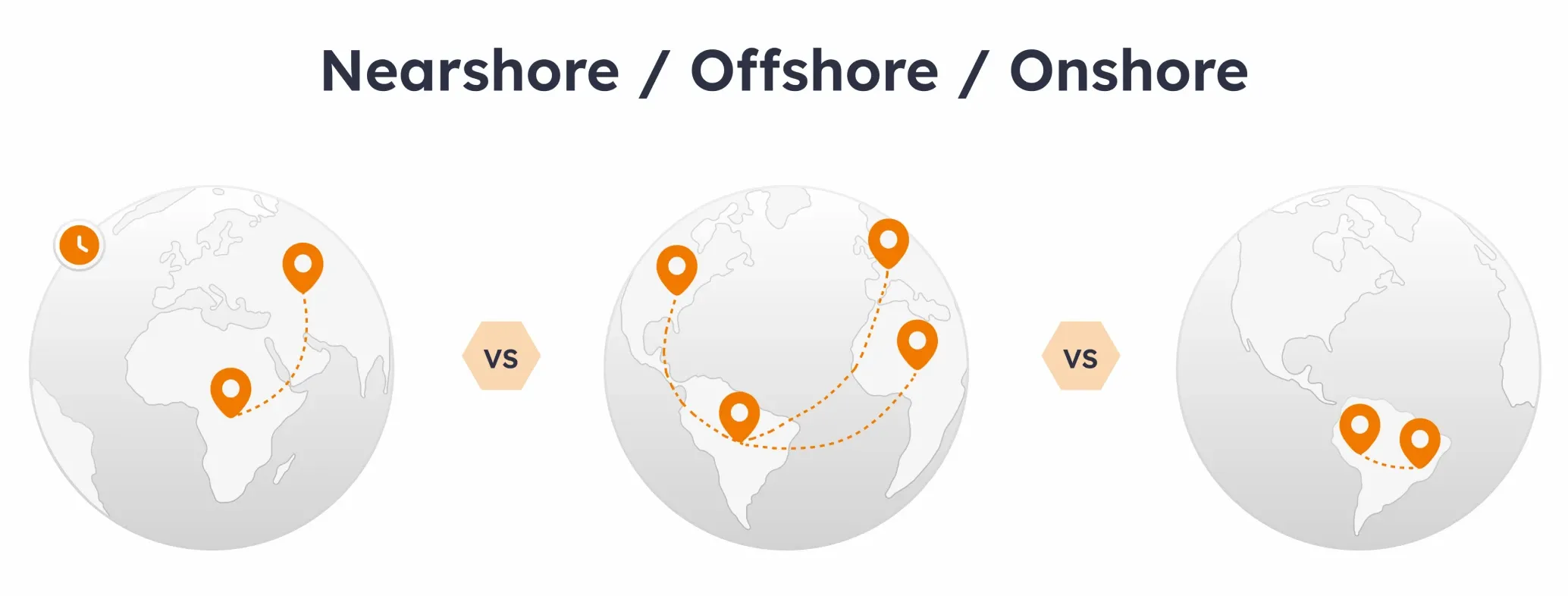
Nearshore vs offshore vs onshore staff augmentation
Offshore staff augmentation: Pros and trade-offs
Partnering with teams in South Asia or Southeast Asia typically means hourly rates 40–70% below US equivalents. For budget-sensitive projects with clearly defined requirements and tolerance for asynchronous workflows, the economics can be compelling.
The operational challenges are real: a 9–12 hour time difference leaves a narrow window for live conversation. Most arrangements that work well offshore are built around asynchronous communication – requirements documented upfront, feedback delivered in writing. When vendors build two to four hours of scheduled overlap into the contract, the engagement can be reliable long-term. Early-stage product work tends to be the weak spot, where shifting requirements need frequent real-time input.
Remote and onshore options for US companies
Remote staff augmentation separates location from contract structure. An engineer working from Eastern Europe may be nearshore by time zone but classified differently by contract terms, depending on the vendor's entity structure.
This distinction became more relevant after 2020: as distributed work normalized across the industry, companies built out the tooling, documentation practices, and async communication norms that make geographically dispersed engineering teams genuinely viable – not a temporary workaround, but a standard operating model. By 2024, remote work had stabilized at levels five to six times higher than pre-pandemic norms, according to BLS data.
Onshore staff augmentation means contracting engineers within the same country. For US companies, collaboration is easiest, and compliance is straightforward, but rates are comparable to direct employment. It suits regulated industries like healthcare and fintech where data handling requirements or clearance levels make international arrangements complicated.
The nearshore model sits between these extremes. Eastern Europe and Latin America are the most common nearshore regions for US companies, with four to six hours of daily overlap and rates roughly 40–50% below onshore. This is the model that has grown most significantly over the past several years – particularly for product companies that need real-time collaboration without an onshore budget. For context on how this fits within broader hiring strategies, software outsourcing models compared alongside staff augmentation provides useful framing before evaluating vendors.
How to choose the right types of staff augmentation for your project
The types of staff augmentation described above differ along a few core dimensions. A few questions narrow the options quickly.
Is the scope fixed or evolving? Fixed scope with a clear deadline points to short-term augmentation. If the product roadmap is still shifting, a dedicated model gives you more room to adapt without restarting the hiring process.
How much management bandwidth does your team have? Standard augmentation requires active day-to-day direction from your internal leads. If they're already stretched, a dedicated setup with a vendor-side lead reduces that overhead materially.
What is the ramp-up timeline? Short-term contracts can start in days. A dedicated team takes two to four weeks to assemble and onboard properly, which matters when the project is already running behind.
What does the budget allow, geographically? Offshore reduces cost most aggressively; nearshore balances cost and collaboration; onshore maximizes integration but costs accordingly.
If you're still working through the foundational context, a comprehensive look at what staff augmentation is covers the baseline model before you compare types.
FAQ
What are the main types of staff augmentation?
What is nearshore staff augmentation?
What is the difference between staff augmentation and a dedicated team?
Is offshore staff augmentation reliable?
When should I choose short-term over long-term augmentation?
Conclusion
The types of staff augmentation available to engineering teams cover more ground than the generic "hire contractors" framing suggests. Understanding which staff augmentation model fits your situation is ultimately what determines whether the engagement delivers or just adds overhead.
Short-term arrangements suit defined, time-boxed work with clear requirements. The dedicated model fits companies building stable external engineering capacity for the long haul. Hybrid setups offer room to adjust as a product evolves or as internal team composition changes.
Geography adds a meaningful layer: offshore, nearshore, and onshore approaches each carry different trade-offs between cost, time zone alignment, and real-time collaboration capacity. The right model is rarely obvious upfront – it depends on how long the need lasts, where management responsibility sits, and how much synchronous communication the work actually requires.
If you're ready to evaluate options for your team, get in touch with Modsen to discuss which engagement model fits your product and timeline.
References
1.
2.
3.
4.
5.
6.
Read more






Get a weekly dose of first-hand tech insights delivered directly to your inbox